






BRIDGET RILEY
b. 1931, United KingdomAssociated with the Op Art movement and one of the most significant figures in post-war British art, Bridget Riley uses apparently simple geometric shapes to create illusions of movement on a flat surface. Since the 1960s, her abstract paintings have centred the relationship between colour, line and form.
Early Years
Bridget Riley was born in 1931 in Norwood, south London. When the Second World War began and her father was called up to the army, Riley and her mother and sister moved to Cornwall (the artist kept a studio in Cornwall for many years). After studying at the renowned Cheltenham Ladies College, she studied at Goldsmiths’ College (1949–1952) and then the Royal College of Art (1952–1956). In 1958, she joined the advertising agency J Walter Thompson as a commercial illustrator. “I had no talent whatsoever for layout and typography,” Riley told Waldemar Januszczak in 2019. “But I could draw.”
Bridget Riley: Artworks
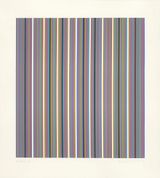
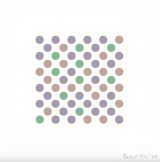
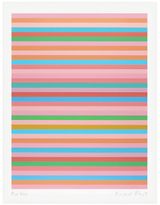
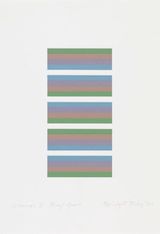
Riley’s visual language focuses on the feeling evoked by a painting, rather than a depiction of a figure or object. Partly as a response to Pointillism, in the early 1960s Riley began to explore how perception could be altered by creating art using repeated shapes, engaging with the viewer, examining how the eye organises patterns and in turn manufacturing optical effects on a flat canvas.
Following inclusion in the group exhibition The Responsive Eye (1965) at MoMA, she became associated with Op Art—her work Current (1964) was on the cover of the show’s catalogue. Although known for monochromatic works, she introduced colour into her artworks in 1967.
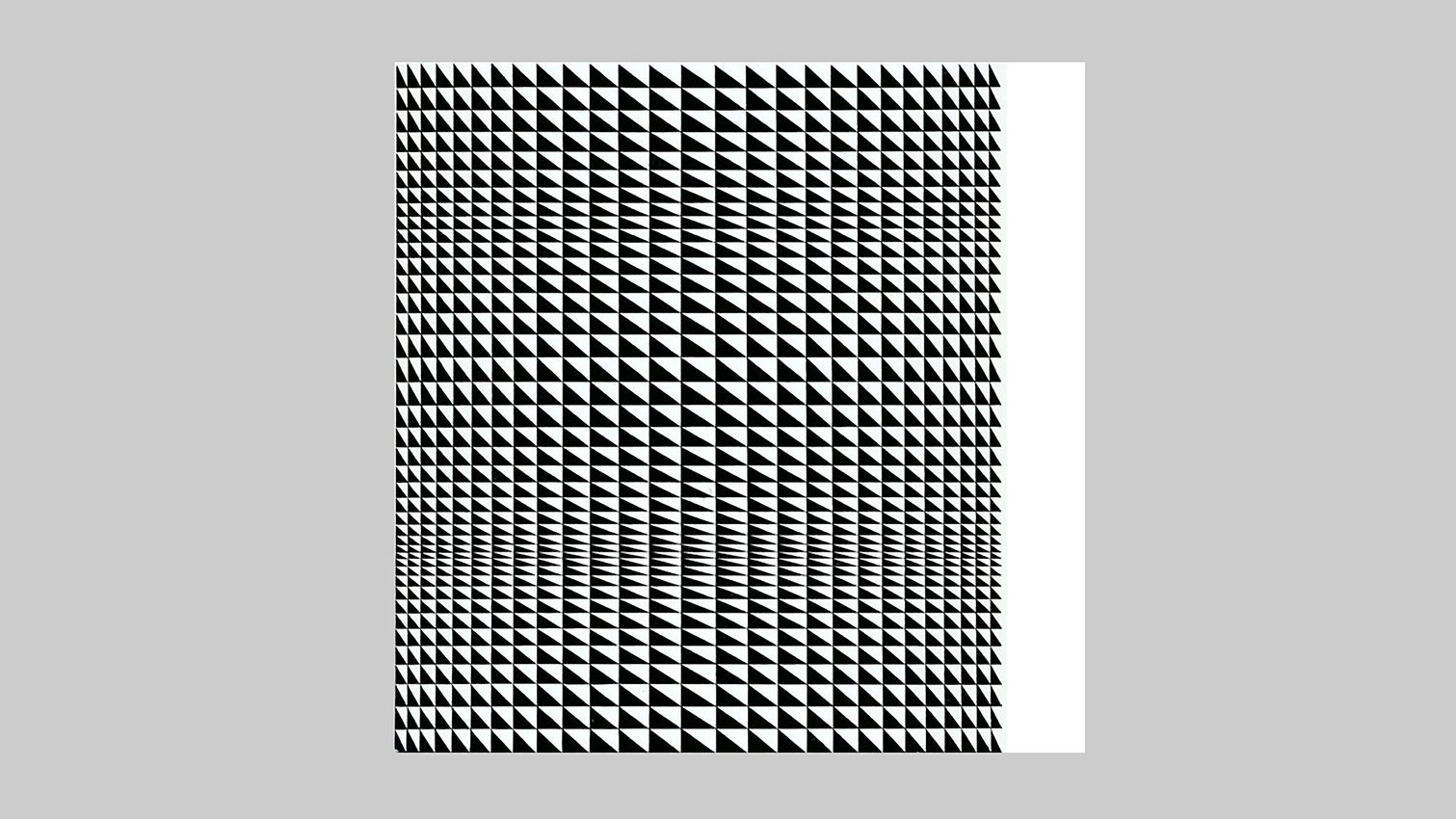
- Movement in Squares (1961) is one of Bridget Riley’s most famous artworks, marking a point in her career where she embraced pure abstraction. Using only black and white squares and rectangles, Riley created an optical illusion by keeping the height of the shapes constant but altering their width.
- Gala (1974) is a great example of how Riley used vibrant colours to create a rippling effect. Her visual experimentation proved worthwhile in the saleroom—Gala sold for £4.4 million at Christie’s in 2022.
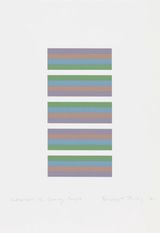
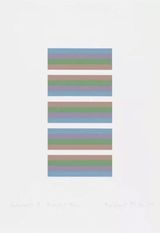
- Riley visited Egypt in 1979, which inspired her Ka series of 1980. In response to seeing tomb paintings in Luxor and artefacts in Cairo museums, she changed her colour palette to incorporate dusky pinks, saffron yellow, teal and purply-blue.
Bridget Riley: Select Awards
- International Prize for Painting, Venice Biennale (1968)
- Commander of the Most Excellent Order of the British Empire (CBE) (1974)
- Companion of Honour (1999)
- Praemium Imperiale, Tokyo (2003)
- Member of the American Academy of Arts and Letters (2022)
Bridget Riley: Select Exhibitions
Select Solo Exhibitions
- Bridget Riley, Dia Beacon, New York City (2026)
- Bridget Riley, Tate Britain, London (2025)
- Bridget Riley Drawings: From the Artist’s Studio, The Art Institute of Chicago (2022) (and touring)
- Bridget Riley: Messengers, National Gallery, London (2019)
- Bridget Riley: The Stripe Paintings 1961–2014, David Zwirner, London (2014)
- Bridget Riley: Flashback, Walker Art Gallery, National Museums, Liverpool (2009) (and touring)
- Bridget Riley: A Print Retrospective 1962–2003, Rotermann Salt Storage, Tallinn (2004) (and touring)
- Bridget Riley: Paintings from the 1960s and 1970s, Serpentine Gallery, London (1999)
- Bridget Riley, Paintings 1982–1992, Kunsthalle, Nuremberg (1992) (and touring)
- Bridget Riley Paintings and Drawings 1981–1983, Nishimura Gallery, Tokyo (1983)
- Bridget Riley, Works 1959–1978, Albright-Knox Art Gallery, Buffalo, New York (1978) (and touring)
- Bridget Riley: Paintings and Drawings 1961–1973, Whitworth Art Gallery, University of Manchester (1973) (and touring)
- Bridget Riley: Drawings, Richard Feigen Gallery, New York City (1966)
- Bridget Riley, Gallery One, London (1962)
Select Group Exhibitions
- The Sun and The Moon: Art Inspired by the Celestial, Saatchi Gallery, London (2026)
- Kandinsky’s Universe: Geometric Abstraction in the 20th Century, Museo Barberini, Potsdam (2025)
- One-on-One: Bridget Riley / Pierre-Auguste Renoir, The Phillips Collection, Washington DC (2022)
- Monochrome: Painting in Black and White, The National Gallery, London (2017) (and touring)
- Moving: Norman Foster on Art, Carré d’Art, Nîmes (2013)
- Psychedelic: Optical and Visionary Art since the 1960s, San Antonio Museum of Art (2010)
- Beyond Geometry: Experiment in Form, 1940s–1970s, Los Angeles County Museum of Art (2004) (and touring)
- Collection 2000, Tate Modern, London (2000)
- Ready Steady Go: Paintings of the Sixties from the Arts Council Collection, Royal Festival Hall, London (1992) (and touring)
- Aspects of British Art Today, Tokyo Metropolitan Museum (1982) (and touring)
- The Mechanised Image, City Museum and Art Gallery, Portsmouth (1978)
- British Painting ’74, Hayward Gallery, London (1974)
- British Pavilion, Venice Biennale (1968)
- The Responsive Eye, MoMA, New York City (1965) (and touring)
Further Reading
- The Bridget Riley Art Foundation
- 2019 interview with Waldemar Januszczak
- Artist profile page at David Zwirner
Bridget Riley FAQs
What is Op Art?
The term Op Art (abbreviating “optical art”) was coined by Time Magazine in 1964 to describe the works of Victor Vasarely. Op Art is characterised by (often monochrome) abstract patterns that manipulate the viewer’s eye into thinking that the flat patterns are moving or flashing.
What is the Bridget Riley Art Foundation?
The Bridget Riley Art Foundation, established in 2011, aims to advance arts education—particularly abstract art. Among the projects it has supported is the Peckham Road Fire Station, the South London Gallery’s contemporary arts space.
Does Bridget Riley use assistants?
Yes, Riley has been using assistants since the early 1960s. The large scale of her works, and her methodical process of creation (each painting is designed to create a certain perceptual effect), require precision and smooth surfaces, so while she plans patterns and experiments with colours, assistants produce the paintings.
Ocula


View Bridget Riley's Artworks





























Bridget Riley in Ocula Magazine











Explore and Follow Artists Shaping Contemporary Art
A respected voice in contemporary art discourse.
Focusing on ambitious storytelling and insightful art-world commentary. Ocula Magazine publishes in-depth interviews, critical essays and timely analysis on the artists, exhibitions and ideas driving the global art world.
Learn more about Ocula Magazine
Showcasing the best of the art world.
Ocula partners with galleries from around the world to highlight their artists, artworks and exhibitions. Gallery membership is by application and invitation, with each member vetted by an independent panel.
Learn more about Ocula Membership
Specialises in the sale of major artworks.
Led by a team with deep ties to the world’s leading auction houses, galleries and collectors. Ocula’s advisory team offers bespoke services to high-net-worth clients from around the world who are looking to acquire the best of contemporary and modern art.
Learn more about our team and services