





RICHARD SERRA
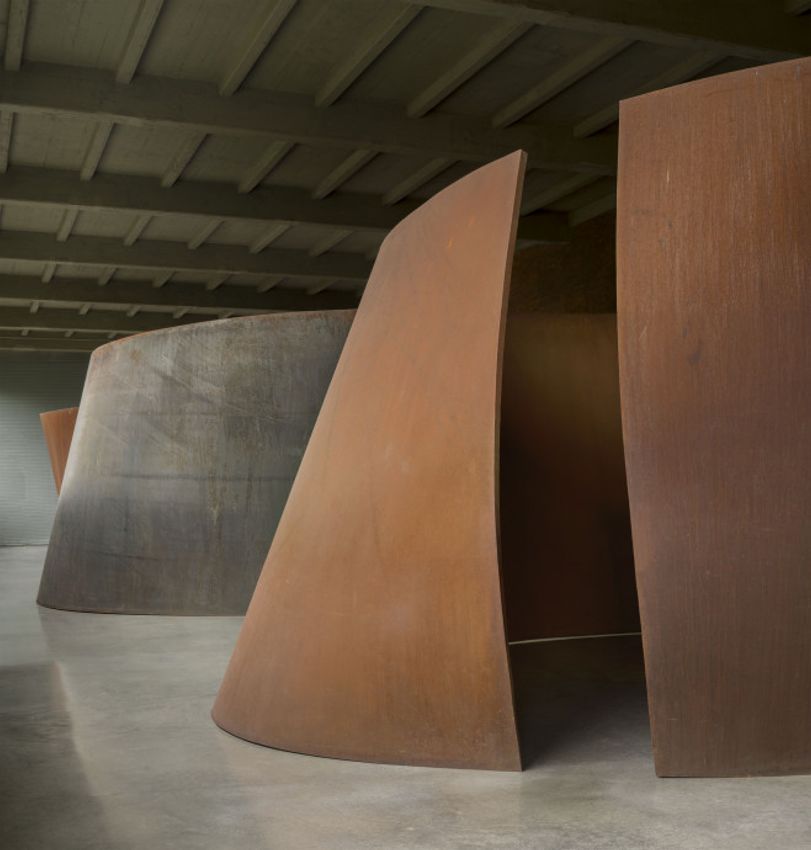
b. 1938, United StatesRichard Serra’s large-scale sculptures were designed to be experienced, rather than simply seen: emerging from the Minimalist movement, his twisted ribbons of steel, flowing geometric forms and weathered panels invited exploration—and controversy.
Early Years
Richard Serra was born in San Francisco in November 1938, the second of three sons. His father Tony was a pipe-fitter in a shipyard and Richard Serra went on to work summer jobs in steel mills from the age of 15. Spotting a talent for drawing, Serra’s third-grade teacher told his mother to take him to museums and his mum began introducing Serra as “an artist”. After a year at the University of California in Berkley, Serra transferred to the Santa Barbara campus where he majored in English Literature, gaining his BA in 1961, as well as studying painting with Howard Warshaw. Warshaw encouraged Serra to apply to art school—Serra gained a scholarship to Yale, earning his BFA in 1962 and MFA in 1964. He travelled to Europe on a Fulbright scholarship, drawing and painting as he went—seeing Velázquez’s Las Meninas allegedly made him realise the two-dimensional limits of painting and he started following other paths. (although an installation with live animals incurred the wrath of the authorities in Rome). He first started sculpting when he moved to New York City in 1966.
Richard Serra: Artworks
- Richard Serra’s sculptures rely on dynamics, rather than fixings. His 1960s sculptures were made of non-traditional materials, including vulcanised rubber, neon, lead and fibreglass. The artist also explored the process of making sculpture—for example, before making 1967’s To Lift, he wrote a series of action verbs (“to curve”, “to roll” etc) which he then enacted with materials in his studio—To Lift considers the response of a piece of rubber to that verb.
- The Splash/Cast series of the late 1960s also explored process: Serra deposited ladlefuls of molten lead at the junctions between walls and floors and when it cooled, it bonded to the surfaces in varying patterns. One of Serra’s studio assistants for this series was the composer Philip Glass.
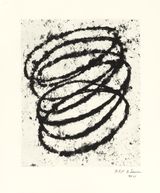
- Richard Serra’s paint, wax and pigment drawings explored the limits of two-dimensional art (for example, 2005’s A Drawing in Five Parts). Again, he considered process when creating these pieces.
- Rounds and Ellipses became part of Serra’s practice during the early 1990s. Four Rounds: Equal Weight, Unequal Measure (2017) comprises four huge steel-forged circular forms, each weighing more than 83,000 kg (although ranging in height and diameter) and each imprinted with a textured patina during the forging process. He began the gravity-defying Torqued Ellipse series during the 1990s, huge steel sculptural panels producing a curved effect.
- The Matter of Time (2005) is on display at the Guggenheim Museum in Bilbao, where it has lived since the institution opened. Viewers are invited to explore evolving sculptural forms, from a double ellipse to a spiral, changing their perspective as they move through each piece.
Richard Serra: Select Public Commissions
- East-West/West-East, Brouq Nature Reserve, Qatar (2014)
- 7, Qatar (2011)
- Connector, Segerstrom Centre for the Arts, Costa Mesa (2006)
- Viewpoint, Dillingen/Saar (2006)
- Santa Fe Depot, San Diego Museum of Contemporary Art (2006)
- Wake, Olympic Sculpture Park, Seattle Art Museum (2004)
- Vortex, The Museum of Modern Art, Fort Worth
- Ballast, University of California, San Francisco (2003)
- TEUCLA, University of California, Los Angeles (2002)
- 4–5–6, Colby College, Waterville Maine (2000)
- Walking Is Measuring, Fundaçáo de Serralves, Porto (1999–2000)
- The Hedgehog and the Fox, Princeton University (1998)
- Afangar (Stations, Stops on the Road, To Stop and Look: Forward and Back, To Take It All In), Videy Island, Reykjavik (1990)
- Greenpoint, Sheldon Memorial Art Gallery, University of Nebraska (1988)
- Fulcrum, Broadgate, London (1986–1987)
- Terminal, Hauptbahnhof, Bochum (1977)
Richard Serra: Select Awards
- Skowhegan Medal for Sculpture (1975)
- The Carnegie Prize, Carnegie Museum of Art, Pittsburgh (1985)
- Order of Arts and Letters, France (1985)
- Praemium Imperiale, Japan (1994)
- Golden Lion gold medal for sculpture (2001 Venice Biennale)
- Commander of the Order of Arts and Letters, France (2008)
- The Commander’s Cross with Star of the Order of Merit of the Federal Republic of Germany (2009)
- Knight of the Order of Arts and Letters, France (2014)
- Knight of the National Order of the Legion of Honour, France (2015)
- Alexej von Jawlensky Prize (Wiesbaden) (2017)
- J Paul Getty Medal (2018)
Richard Serra: Select Exhibitions
Select Solo Exhibitions
- Richard Serra: Running Arcs (For John Cage), 1992, Gagosian Gallery, New York City (2025)
- Richard Serra: Every Which Way, David Zwirner, New York City (2024)
- Richard Serra: Casablanca, Galerie Lelong, Paris (2024)
- Richard Serra: 40 Balls, Cardi Gallery, Milan (2022)
- Richard Serra: Transmitter, Gagosian Gallery, Paris (2021)
- Richard Serra: Equals, Hiram Butler Gallery, Houston (2019)
- Richard Serra: Vertical and Horizontal Reversals, David Zwirner, New York City (2014)
- Richard Serra Drawing: A Retrospective_, MoMA, New York City (2011) (and touring)
- Richard Serra: Solids_,_ Richard Serra: Sculpture_,_ Richard Serra: Drawing_, Gagosian Gallery (New York City and two London locations) (2008)
- Richard Serra: The Matter of Time, Museo Guggenheim Bilbao (2005)
- Richard Serra: Out-of-Round Drawings, Gagosian Gallery, New York City (1999)
- Richard Serra: Drawings and Prints, The National Museum of Art, Osaka (1994)
- Richard Serra: Gravures Récentes (Recent Engravings), Galerie Lelong, Paris (1989)
- Richard Serra, Pompidou Centre, Paris (1983)
- Richard Serra: Elevator 1980, The Hudson River Museum, Yonkers (1980)
- Richard Serra: Large-Scale Drawings, Ace Gallery, Los Angeles (1974)
- Richard Serra, Galleria La Salita, Rome (1966)
Select Group Exhibitions
- Au 108 rue Vieille du Temple, David Zwirner, Paris (2026)
- It Must Be Seen. The Autonomy of Colour in Abstract Art, Fundación Juan March, Madrid (2025)
- something new, something old, something desired, Hamburger Kunsthalle (2022)
- PUSH / PULL, Skarstedt Gallery, London (2019)
- The Long Run, MoMA, New York City (2017)
- Move: Choreographing You, Hayward Gallery, London (2010)
- Alexander Calder, Richard Serra, Frank Stella, Van de Weghe Fine Art, New York City (2001)
- Die Epoche der Moderne-Kunst im 20 Jahrhundert (The Age of Modernism: Art in the 20th Century, Martin-Gropius-Bau, Berlin (1997)
- Minimalism and Post-Minimalism: Drawing Distinctions, Hood Museum of Art, Dartmouth College (1990)
- Individuals: A Selected History of Contemporary Art, 1945–1986, Museum of Contemporary Art, Los Angeles (1986)
- American Drawing in Black and White: 1970–1980, Brooklyn Museum, New York City (1980)
- The Video Show, Serpentine Gallery, London (1975)
- documenta 5, Kassel (1972)
- 1968 Annual Exhibition: Contemporary American Sculpture, Whitney Museum of American Art, New York City (1968)
Further Reading
- Artist profile page at Gagosian
- Artist profile page at David Zwirner
- Obituary from The New York Times
- Obituary in Wallpaper
- Interview in the Guardian from 2008
Richard Serra FAQs
Why was Richard Serra’s Tilted Arc controversial?
Tilted Arc was a 36.5-metre-long, 3.6m-high Cor-Ten steel sculpture designed by Richard Serra and commissioned by the United States General Services Administration (GSA) in 1981 to be installed in New York City’s Federal Plaza. However, it was unpopular with people working and living around the plaza, requiring them to change their route between buildings. The saga of Tilted Arc lasted eight years, culminating in a trial in which it was ordered to be removed (it was dismantled in 1989). Tilted Arc raised questions about how public art could be independent, ambitious and yet acceptable to the people interacting with it, and whether site-specific commissions could have a life away from the place for which they were designed.
Did someone die installing a Richard Serra sculpture?
Yes, in 1971 Serra’s Sculpture No 3, two huge steel plates balanced against each other, was being installed at the Walker Art Centre in Minneapolis when one of the plates fell on to a rigger called Raymond Johnson and killed him. Serra found himself being urged to stop making his large-scale art, although a later investigation said that the crane operator had not followed the rigging instructions.
What happened to Clara-Clara?
Richard Serra married his second wife, the art historian Clara Weyergraf, in 1981, and her name was given to Clara-Clara, a 213,370kg Cor-Ten steel sculpture originally commissioned for a 1983 Serra retrospective at the Pompidou Centre in Paris. But it was deemed too heavy for the institution’s floors and instead installed in the French capital’s Tuileries Gardens. However, the way it disrupted familiar views of the Parisian skyline did not go down will with the city’s citizens. In 1985 Clara-Clara was bought by the City of Paris and moved to a park in the 13th arrondissement, where it became a magnet for graffiti, sport and the homeless. In 1990 it was removed and placed in storage, re-emerging restored in 2008, back in the Tuileries Gardens as part of the Monumenta exhibition, but it only lasted until 2009. Following Serra’s death in 2024, the City of Paris discussed bringing Clara-Clara back to the city, but this had not happened by 2026.
Ocula

Explore Richard Serra's Exhibitions On Now
















Richard Serra in Ocula Magazine






Explore and Follow Artists Shaping Contemporary Art
A respected voice in contemporary art discourse.
Focusing on ambitious storytelling and insightful art-world commentary. Ocula Magazine publishes in-depth interviews, critical essays and timely analysis on the artists, exhibitions and ideas driving the global art world.
Learn more about Ocula Magazine
Showcasing the best of the art world.
Ocula partners with galleries from around the world to highlight their artists, artworks and exhibitions. Gallery membership is by application and invitation, with each member vetted by an independent panel.
Learn more about Ocula Membership
Specialises in the sale of major artworks.
Led by a team with deep ties to the world’s leading auction houses, galleries and collectors. Ocula’s advisory team offers bespoke services to high-net-worth clients from around the world who are looking to acquire the best of contemporary and modern art.
Learn more about our team and services