





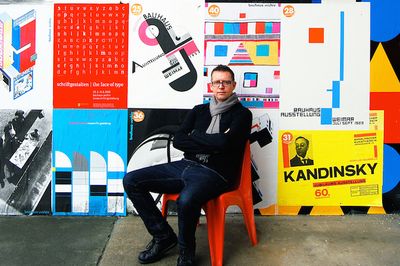
Australian artist Peter Atkins was one of 7 artists invited to create new site-specific public art works for the forthcoming Christchurch Biennial, SCAPE8: New Intimacies, curated by Rob Garrett.
An important figure in Australian contemporary art, Peter Atkins has exhibited extensively both in Australia and internationally and is represented in the collections of every Australian State Gallery as well as prominent Institutional, Corporate and Private collections both nationally and internationally.
Ocula spoke to Peter Atkins on the occasion of SCAPE8 about his new work Under Construction—Chaos and Order.
SCAPE8 represents the second iteration of the Biennale since the devastating earthquakes in 2011. How was the experience of working in Christchurch – a city still very much in recovery?
My initial site visit and tour of the city by curator Rob Garrett was at times overwhelming and brought back terrible memories and images of the Newcastle earthquake, which I experienced along with my family and friends in 1989. This experience helped give me an insight into how residents were affected by the stress and turmoil. The sense of loss, confusion and disruption was palpable. However, I also knew that in time, as with Newcastle, a stronger city would emerge. Humans are surprisingly resilient to natural disasters.
Biennial curator, Rob Garrett, has spoken about SCAPE8 in the context of people forming new, memorable and intimate connections with the fabric of the city. What is your view on the role of art, in encouraging imagination and hope in the necessary process of recovery and healing?
I’m particularly interested in opening up challenging dialogues between the audience and the artwork. I’m hoping the work will act as a memory trigger, eliciting from the viewer various emotional states or reactions, provoking memories around the idea of loss, what was, what’s missing, lost elements of the city, perhaps also allowing a platform for a shared optimism for the future, the possibility of happier or easier times ahead. There appeared to be an undercurrent of these emotional states prevalent throughout the community of Christchurch on my first visit. It is an important aspect of this work that it relates to these states as well as the current dislocated landscape. My work attempts to provide a positive engagement with contemporary abstraction by metaphorically carving out a space for the audience to add their own narratives.
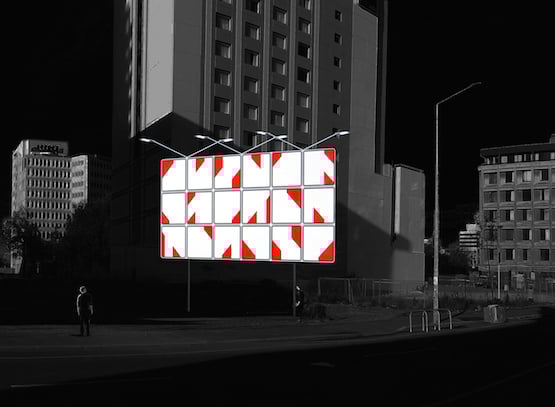
Quoting your interest in ‘taking seemingly ordinary elements of our day-to-day surroundings and re-presenting them thereby challenging perceptions and offering new ways of interpreting ones surroundings’, there are obvious connections between your work and the theme of the Biennial, New Intimacies. Tell us about what you have created for SCAPE8?
The conceptual framework of this proposal centers around the theme of ‘Sightlines’ as outlined by curator Rob Garrett in New Intimacies. The work is titled Under Construction—Chaos and Order and is situated on The Press site along Gloucester St, between Manchester St and Colombo St. The work is double sided, so lends itself to being read from two vantage points, offering the possibility of entirely different readings of the one work. I’ve appropriated and deconstructed a series of common ‘lane management’ road signs unique to New Zealand. They are white with orange angled forms that suggest spaces within the landscape, possibly work sites under construction or being demolished. Large black arrows on the signs (which were later erased on the final work) alert and direct drivers around these hazards as they navigate the city. These signs were ubiquitous throughout the center of Christchurch when I made my first site visit in mid 2014. On one side I’ve arranged eighteen pairs of deconstructed signs in a random pattern that suggests a state of disorder or chaos – the city collapsed. The orange forms suggest rooflines, chimneys, roadways, city blocks etc. The fragmented pattern also implies obstacles, shards, dead ends and blockages - alluding to feelings of uncertainty, confusion and frustration. The opposite side of this sculpture however, is much more optimistic and signals the future rebuilt city center. The signs are arranged as an ordered, organized, methodical structure. This logical arrangement of patterns and the implied state of being ‘in control’ are what humans aspire to. However, this side of the sculpture will, I suspect, mostly be viewed by drivers in their rear view mirrors, or by passengers as they turn to briefly glimpse the work as they leave the area. The ‘sightline’ from this position implies that this goal is slightly out of reach, an ideal or something to aspire to – perhaps the future rebuilt city.
As well as responding to the lane management signs you encountered in Christchurch, I understand you also made reference to the work of both Colin McCahon and Rosalie Gascoigne when developing the project?
Yes, it is impossible not to reference Rosalie Gascoigne when working with roadsigns and clearly she has been a major influence on this work and throughout my practice. Robert Macpherson is another artist who has influenced my work at various stages. All three of us share a deep affection for the Australian landscape and in particular, the vernacular of highway road-signage within Australia. Conceptually though, we all approach the form and narrative from different angles. However, when I first saw the signs they also reminded me of my first experience seeing the work of Colin McCahon, the series is titled Angels and Bed from 1976-77. These works, painted on a black ground have various white triangle and square forms entering the picture plane, some from the side and others from the corners. The works from this series were painted after various friends of McCahon’s had become ill. The painted forms variously represent a room with a bed and Hi-Fi speakers. The forms could also be interpreted perhaps, as others have suggested, as protective angels watching over their charges. These powerful works, based around ordinary, everyday circumstances, remain some of my favourite images from contemporary art and are loaded with universal feelings of memory, concern, sorrow and loss. It seems appropriate within my practice to build upon and combine these and other personal narratives, (including those of New Zealand born Gascoigne and to a lesser extant Macpherson) when formulating ideas for this work, especially considering the context of the site within New Zealand. In my opinion the best art is made up of dialogues between other artists… voices joined together…no one exists in a vacuum; it is these multi-layered connections to memory and experience that underpin my practice. This new work for Christchurch had its genesis in a much earlier work of mine titled Hume Highway Project, and is, in many ways, an extension of that project. Ultimately, the work should stand on it’s own, though perhaps on this occasion, it’s on the shoulders of giants…
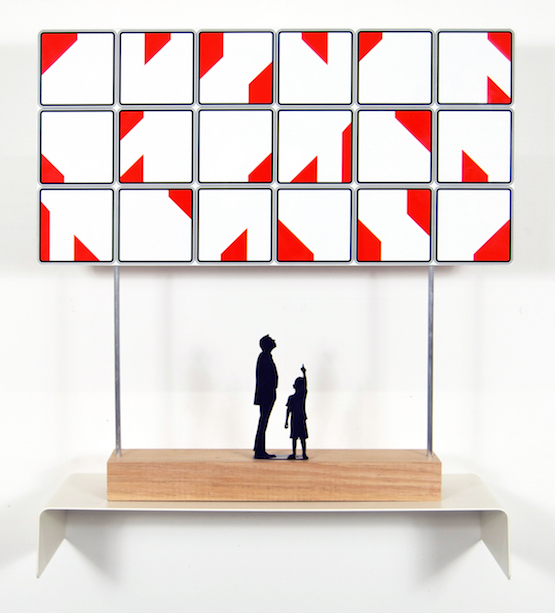
It is interesting to think about how the work will be encountered by the public. Installed on the street, it exists outside of the traditional ‘white cube’ providing viewers with the opportunity for a truly individual experience of the work – on their own terms. Were you thinking about this when making the work?
Yes. An artwork sited within the landscape is in many ways free of the expectations and confinements of a gallery space. As you say, viewers either engage or not on their own terms. I am not necessarily interested in provoking negative reactions with this work, though it does have that capacity, instead, I am hoping that during the daytime the work will stand quietly in the cityscape, allowing the viewer to quietly contemplate, gently eliciting memories, evoking emotional states and personal narratives. At night when fully lit, the work will become a beacon in the darkness, drawing people in, simultaneously becoming a memory of place and a marker for the future rebuilt city. The specific siting of the work ensures that it will be seen from many vantage points throughout the inner city offering various levels of engagement with the viewer.
Tell us briefly about the production. I understand that you wanted to produce the work in collaboration with local manufacturers of road signage and that you intended for local road workers to install it. Why was this was important to you and if in the end you were able to do so?
The work is essentially a contemporary reworking of existing road signage. I didn’t want to step outside the existing vernacular, it was important for me to use the exact same processes and materials to fabricate the structure from the ground up. The engineering, manufacture and installation were all done in house with the team from Fulton Hogan. It was an overwhelmingly positive experience for me to work alongside these people; they embraced the project from the very first meeting. Ultimately, I wanted these workers, many of whom may never have had access to contemporary art, to claim a sense of ownership, to feel proud of their engagement with the work. It is after all, a sculpture for the people of Christchurch, so it’s appropriate that they physically build it as well. —[O]
Main image: Peter Atkins, Bauhaus Archive, Berlin


A respected voice in contemporary art discourse.
Focusing on ambitious storytelling and insightful art-world commentary. Ocula Magazine publishes in-depth interviews, critical essays and timely analysis on the artists, exhibitions and ideas driving the global art world.
Learn more about Ocula Magazine
Showcasing the best of the art world.
Ocula partners with galleries from around the world to highlight their artists, artworks and exhibitions. Gallery membership is by application and invitation, with each member vetted by an independent panel.
Learn more about Ocula Membership
Specialises in the sale of major artworks.
Led by a team with deep ties to the world’s leading auction houses, galleries and collectors. Ocula’s advisory team offers bespoke services to high-net-worth clients from around the world who are looking to acquire the best of contemporary and modern art.
Learn more about our team and services