




Raqs Media Collective
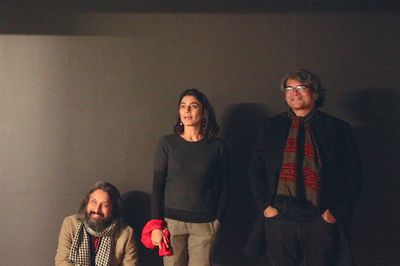

Raqs Media Collective comprises a group of three practitioners—Jeebesh Bagchi, Monica Narula, and Shuddhabrata Sengupta—all based in New Delhi. The collective was formed in 1992 after its three members graduated from the Mass Communications Research Centre at the Jamia Milia Islamia university in Delhi.
Through the 1990s Raqs made a number of documentary films, including In the Eye of the Fish (1997), Present Imperfect, Future Tense (1999) and a thirteen-part television series, Growing Up (1995), which display many of the themes that they have continued to explore in their subsequent work—the urban landscape, the meaning and uses of media and technology, the nature of knowledge and what it means to learn. Through their work, learning becomes not only an artistic impulse but a wider human faculty associated with the capacity of individuals and societies for imaginative and ethical innovation.
In 2001 Raqs co-founded the Sarai Programme and the Sarai Reader Series at the Centre for the Study of Developing Societies, New Delhi, with Prof. Rvai Vasudevan and Prof. Ravi Sundaram as directors of the programme. The word sarai, or caravanserai, common to many Central Asian and Indian languages, refers to the shelters for travellers, sometimes large and extravagant, that traditionally dotted the cities and highways of that part of the world, facilitating travel and commerce but also enabling the exchange of stories and ideas. Raqs started producing art as part of and with the help of the researchers and practitioners of the Sarai Programme. They have since made works in a wide range of mediums—installations, film, photography, print and online works, archive related projects, public interventions, essays, publications, lecture-performances, engagements with pedagogical procedures and collaborations, often working with contemporaries from a number of different disciplines.
Based in Delhi since its foundation, Raqs Media Collective has a complex relationship to location. The city of Delhi is very often the subject of their work, and in their engagement with modernity they often display a lived relationship with myths and histories from South Asia and its wider region. They are, however, resistant to the label ‘Indian’ since, they argue, it represents an abstraction so extreme that it can explain nothing about them, and prefer to talk about themselves simply as ‘from Delhi’. Highly sensitive to intellectual and cultural currents from elsewhere, they are cynical of the language of multiculturalism, identity and nationalism and prefer to find other languages with which to narrate personal and social histories.
In addition to Documenta and the Venice Biennale, their work has been shown at the Walker Art Center in Minneapolis, the Palais des Beaux Arts in Brussels, the Liverpool Biennial and the Guangzhou Triennial. They have had numerous group and solo exhibitions and are represented by Frith Street Gallery, London and Project 88 Mumbai.
Raqs comes from the Persian, Arabic and Urdu word for the visionary state attained through the ritual dance by whirling dervishes.
Here Monica Narula speaks to Anabelle de Gersigny about their work currently on show at the Kochi-Muziris Biennale (Log Book Entry Before Storm, 2014) and their recent exhibition Asamayavali / The Untimely Calendar, at the National Gallery of Modern Art in New Delhi.
I’d like to start with the Kochi-Muziris Biennale—could you tell me about the work Log Book Entry Before Storm (2014), and its site-specificity in particular? With this piece, how did you respond and approach the subjects that the curator Jitish Kallat was presenting and how did you work with the particular site you exhibited in?
The topic of the biennale to us was actually about opening out. Meaning, that the concept for the biennale is so open, that one can take it to mean a number of different things.
Jitish suggested we look at this house. We had been looking at Aspinwall with him and then when he talked about the house, I said let’s go and look at it and we did, and it just made absolute sense. In that sense I think it’s a perfectly curated situation because it felt like the right space for us. It’s an interesting space because it is two houses that imperfectly mirror each other. When we first looked at it, it was one building that had been divided into two separated spaces, linked to each other by a shared wall. They were tied together, but had hardly any architectural communication at all. We speculated that it would have been one house before and you can see the wall that slices through the two houses.
One house is longer and bigger than the other, but the boundary wall that is in between them goes around and over the well, so half the well is accessible from one side, half from the other. The other option is that the house was built like that, which is also possible. When you look at the rooms, you start to think that it was build like that because if how they are laid out. Architecturally, it was an interesting space.
The house had not been lived in for maybe a year or two, but the sense of the previous inhabitants was still very strong and present. Two women had lived there, one was a renter and the other was the owner, living either side of the wall. They had very long Christian names. What we felt when we walked in was that in a sense, they were living so close that they should be one, but they weren’t, in fact far from it. It felt repressed and constricted. It was darker than you would expect it to be and it felt like it was all cowering inwards.
Then you had this sense of being on the sea, looking outwards, from a site that has been the centre for a lot of historical circulation, with Kochi as the starting point. It became interesting to consider how and where these two worlds met—interiority versus exteriority. Site-specificity in itself opens up a number of doors and opportunities, and a freedom to explore ideas. The experience reminded me of a site-specific work we did for CAA (Contemporary Art Archipelago) called There is more salt in your tears. We visited the Turku Archipelago in 2010, and we noticed the low salinity of the Baltic Sea. Someday, the Baltic Sea may become more saline due to global warming, and its unique ecosystem will have all but died. But until that happens, there is more salt in our tears. Again, with this work we drew viewers into a narrative or conversation, this time with the ocean. We used mirror-steel spelling out the phrase that floated as a reflection of the sea’s thoughts.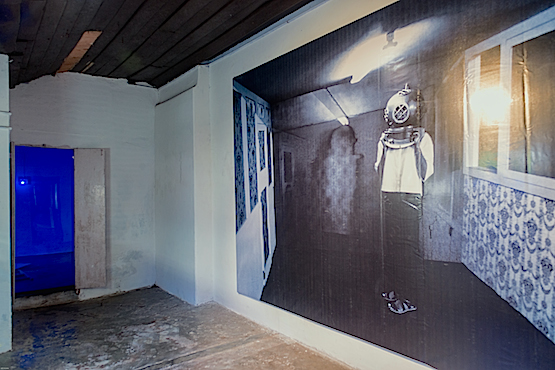
You transcend time, but also geographical space with this work. You reintroduce circulation into the still interior by perforating the interior wall and introducing the possibility of movement. In fact, you created a space where all kinds of circulations are possible—air, light, sound, depth and ideas. You also purposefully bring in exterior elements, like the lighthouse signalling to ships at sea and you use this to compound a sense of claustrophobia and entrapment in the back spaces. Can you tell me a little more about that, was it in particular the concept of capturing a time and space that you were focused on?
We thought it would be interesting to actually think about the possibility of making a breach, of creating porosity and not thinking of things as being here or there, in or out, this side or that side and how there is going to be a back and an opening. Not an opening towards something, but just the circulation. Meaning, not only a circulation or balance between the two spaces, but between states of being. We placed the mysterious deep sea-diver, suspended and dream-like, to give a sense of submergence between this land and the sea because in a way, this has been a land of constant movement. Any coast is. People come and people go. That’s why we included the ammonites (an extinct group of marine invertebrate animals), reminding us that this land, right up to the mountains, was once submerged under water. This brings the piece back to the facts amongst what is a very sensorial piece. We intended it to be an experience, for people to spend time with the sound and the light. For viewers to get a sense of the infinite, of time being continuous, filtering into everything, unquantifiable, just as the ammonites have an infinite spiral which for us in this case represented the infinite cycles that bind us all. Here we are talking about cycles within time that render the clocks and calendars obsolete. The rooms work in this way too, there is an infinite cycle to them, you are yourself, within a space that is encouraging you to spend more time with yourself.
We often use our projects as a game we are playing with the viewer—they have a set of problems that they have to solve. Much like the site-specificity for the artist, and the challenges and questions this poses, we do the same for the viewer. In this instance, we took existential, geographical and historical scale and brought this to the story of these two women.
It’s soothing in a strange way. You feel like you are incubated. Somehow you don’t want to leave and you can explore the different spaces and whilst they almost act as mirrors, there is no repetition.
Yes, even though there’s not that much and the space is quite small. There’s very little to see, as it were. But that was the whole idea—how do you create a feeling or sensation of going inside yourself? I think that’s what happens to me now when I do it—you feel like something is settling you in some way inside. ‘To be’ is something very physical, and when you think about capturing that, you inevitable wonder what, why and things like that. And that I think is what is interesting. So the image of the deep-sea diver and the diving bell reflects what it means to be just one of us. It creates a sense of submergence, but we are diving into another thing, a different context and environment, into thoughts and memories. We placed the diving bell itself in an inaccessible room, swathed with an indigo light. This reflects the state of interiority, the isolation that is possible even when we live one next to the other. But also, it is asking the viewers to use their imagination—what does it feel like to be in that space, to experience the room that they cannot enter? Just like history, we know it is there, but it is no longer accessible to us, we have to use our imaginations to access what the world was like before we existed in it. Similarly, in the ‘now’, we also have to use our imaginations to access what the world is like from another person’s perspective. The sound of the morse code playing out calls to you and resonates, it is an invitation. Again, its echoes are about the infinite cycles within the space.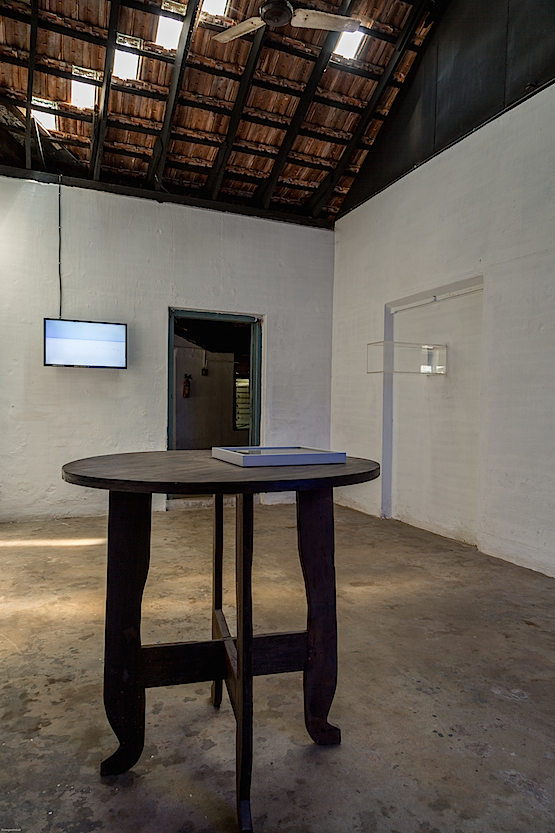
Does this tie in with the well that used to be on this site as well, that was shared between the families?
Yes, it is a deep well that was shared between these women. The well brought up a sense of incubation, a feeling of isolation. It brought forward a self-reflection that is only possible within your own private space. At the same time, the well represented endless possibilities, it was a source, and on the other hand, it was a symbol of divergence as it was the one point where that the two houses were joined, reminding us in turn of the daily separation and division by the wall, of the two families. It made us consider how from one source, two different lives, thoughts, behaviours can be acted out for the duration of a lifetime.
How do you think this work will feed into future projects if at all?
I think this is hard to predict. We have made works in the past, yet we never imagined they might feed into current work. For example, we used the colour indigo with this piece, which is a colour we have used in previous works but for very different reasons. Here it is used for its soothing qualities. But in Untold Intimacy of Digits (2012) it was about the hand print that belonged to Raj Konai. He was a Bengali peasant who, in 1858, was commanded by a government official to put hand to paper as a means of identification, in an attempt to manage colonial Britain’s wayward subjects. It found its way to Francis Galton, a eugenicist and polymath, becoming a key part of his research into identification, which foreshadowed fingerprinting. Identity cannot be quantified, that is a ridiculous assumption. Experience cannot be drawn out of the lines in a person’s hand. The need to record every person, to register them, as an idea is actually impossible, because these things are infinite. Here we were talking about colonialism, some of the people they were trying to record were made to plant indigo and these indigo prints were the first record of Indians.
The same thought does not find itself in this work, but it is a thread from a previous work that has been continued, and I am sure that elements from Log Book Entry Before Storm will find their way into future pieces.
Sarai was in some ways founded on this thought; it brings people together and leads to other things, but the origins still have a running thread through these new projects, initiatives and conversations.
What this biennale means to the Indian contemporary art scene has been brought up a lot. However, what does the biennale mean to you and what how has this experience been different to other projects in terms of the public engagement so far?
Kerala is different, it has a different language and culture. Yes, we are united by our passports but other than that, it is a different country. We are from New Delhi and there is a very distinct dynamic there. Here, even the guards were asking questions, they really wanted to understand what it was that we were creating, why were we creating a sense of being submerged under water? What was this important? Perhaps the regions communist background has something to do with it, there isn’t a sense of hierarchy that you get in other cities, particularly in the art world. Here, there is a more even ground socially.
It is always great to do things which are not commercially driven because there is a freedom to it.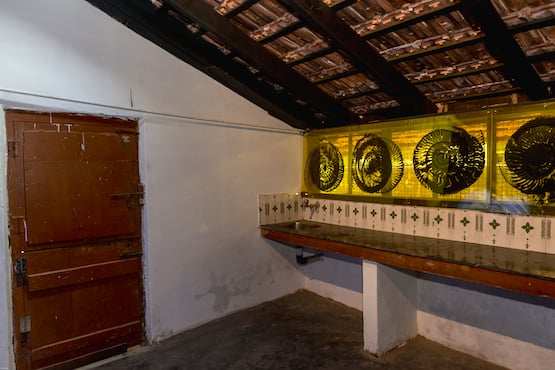
Finally, could you talk a little bit about your show at the National Gallery of Modern Art in New Delhi. This is described by Prof. Rajiv Lochan, director of the National Gallery of Modern Art in New Delhi, as a ‘springboard for your explorations into the future […] an acute way of reading contemporaneity, a working mill of ideas that face the future […] it is an un-retrospective’. Can you tell us a little bit more about how the experience of a retrospective will instruct future projects?
We have been calling the show - ‘prospective, not retrospective’ - by this we mean that the show, even though it has work from across our career in contemporary art (with many works produced in the last three years), it marks the direction in which we see ourselves heading. It is not a survey of the past as much as it is an indication of the future. Putting together this show has revealed many strands and points of emphasis. There is clearly a close attention to life forms, a growing complexity in our thinking about questions of time and duration and a concern with how time gets refracted in the working day. Also, seeing all the works together gives us a sense of our ludic propensities, our love for riddles, and our interest in prising images out of archives and making them do unexpected things. Where do we go from here? The show is urging us towards playful directions. We are at the moment thinking about how to bring power and authority down from its imperious pedestal, we are taking the telegrams and the signals that begin to be present in this show forward. We are signalling to the future.
Could you expand on the question of ‘how to be with the untimely, and how to survive encounters with time, unscathed’ and how you approached these concepts in the exhibition/works?
Firstly, by insisting that we view the past, the future and the present without any kind of hierarchy. As we said in the opening, “tomorrow is not better than today”. Secondly, by working with time as if it were a labyrinth (and this was made possible by the architecture of Jaipur House in the NGMA) and by finding secret passages, placing reflections in mirrored spaces, seeking folds in space and time, working with cul-de-sacs. Thirdly, by playing with repetitions and tangential relationships, by making images and concepts mirror and touch each other such that you don’t know if you encountered something first as an image or as a thought. Finally, by revisiting moments in history and endowing them with a life that makes them walk in the clear light of the present. —[O]
Raqs Media Collective, ‘Asamayavali/The Untimely Calendar’, at the National Gallery of Modern Art, Jaipur House, India Gate, New Delhi. Showing until 19th April 2015
Main image: Raqs Media Collective, Jeebesh Bagchi, Monica Narula, and Shuddhabrata Sengupta. Photo: Manisha Gera Baswani




A respected voice in contemporary art discourse.
Focusing on ambitious storytelling and insightful art-world commentary. Ocula Magazine publishes in-depth interviews, critical essays and timely analysis on the artists, exhibitions and ideas driving the global art world.
Learn more about Ocula Magazine
Showcasing the best of the art world.
Ocula partners with galleries from around the world to highlight their artists, artworks and exhibitions. Gallery membership is by application and invitation, with each member vetted by an independent panel.
Learn more about Ocula Membership
Specialises in the sale of major artworks.
Led by a team with deep ties to the world’s leading auction houses, galleries and collectors. Ocula’s advisory team offers bespoke services to high-net-worth clients from around the world who are looking to acquire the best of contemporary and modern art.
Learn more about our team and services