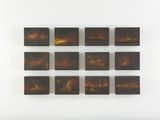
Teresita Fernández’s public sculptures draw from natural phenomena to create optical illusions that evoke shifting states like land formation and water.
Commissioned by the Blanton Museum of Art in Austin in 2009, Stacked Waters (2009) is a site-specific installation comprised of 3100 square feet of custom-cast acrylic that produces the illusion of dancing waters. It was inspired by the box shape of the museum’s Rapoport Atrium, which Fernández covered in a striped pattern.
The title paid homage to Donald Judd‘s ‘stacked’ sculptures, a series of identical boxes installed along wall surfaces, as well as his exploration of box interiors.
Fernández’s public project Fata Morgana (2015) was a dynamic installation that played on light. Referencing the phenomenon of a fata morgana, a mirage that forms along the horizon, the work consisted of a long stretch of canopy made from golden mirror-polished discs installed along Madison Square Park in New York.
Political Conscience
In Fernández’s work, landscape is often employed as a motif for outdated ideals and tradition. Through the use of such motifs, Fernández re-imagines, replaces, and reveals the existing environment as a method of resistance.
The site-specific installation OVERLOOK: Teresita Fernández confronts Frederic Church at Olana (2017) juxtaposed landscapes of painters like Frederic Church with pictures of indigenous populations and travellers to better understand the context that allowed for their work.
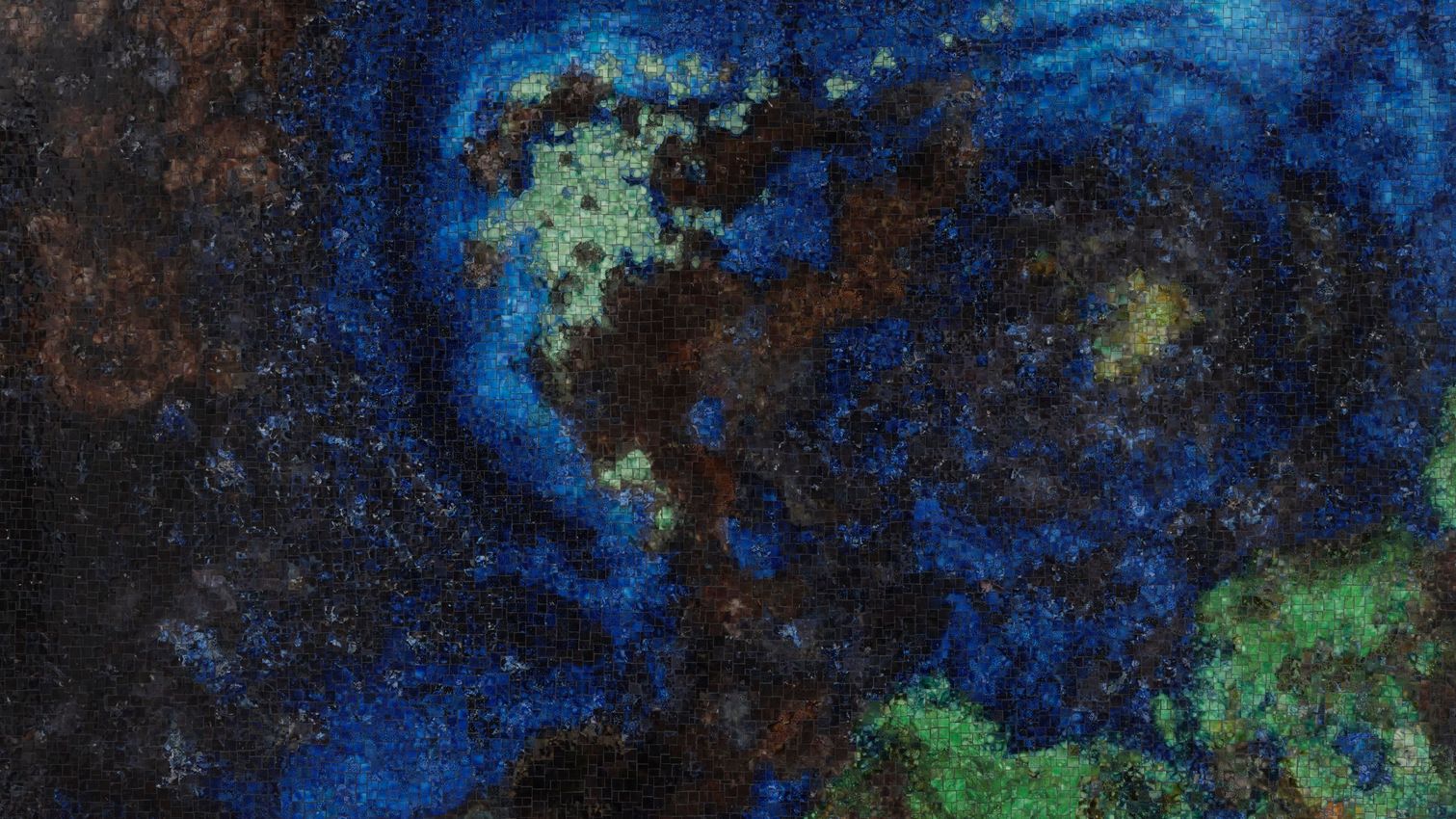
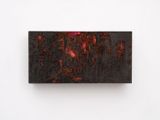
In 2017, Fernández showed Fire (America), a series of paper and mural works that addressed the current tensions in the United States and its residual scarring. In glazed ceramic murals Fire (America) 5 (2017) and Charred Landscape (America) (2017), the landscape of the United States is set ablaze with violence, warring ideologies, and the looming threat of climate change.
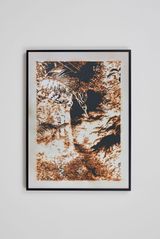
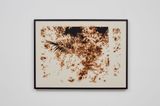
Other works in the series, like Burned Landscape (America) 1 (2017), hint at a similar death of the American ideal, with burnt laser-cut paper framed as a landscape.
Latinx Advocacy
Fernández is also known for her advocacy for Latinx artists, including the organisation of the 2016 Latinx Arts Futures Symposium, which brought together artists, curators, museum directors, researchers, and funders to address the omission of Latinx voices within American institutions.
As a result, the Whitney Museum of American Art hired their first curator specialising in Latinx art in 2018, following head curator Scott Rothkopf’s attendance at the symposium.