






Sherman Sam
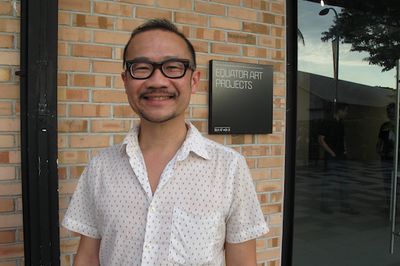

Sherman Sam is an artist and writer based in London and Singapore. He has exhibited his paintings and drawings internationally, including one-person shows at The Suburban (Chicago), the Rubicon Gallery (Dublin), Lugar do Desenho (Porto) and the Centro de Arte (San Joao de Madeira, Portugal), and most recently at Some Walls (Oakland, CA).
His work has also been included in numerous group shows in Europe and America, including M6: Around London (Andratx, Majorca), Sight Mapping (Sweden, Scotland, Spain), Plan D, an exhibition which he curated (Portugal, Ireland), Rhyme not Reason at the Janet Kurnatowski Gallery (Brooklyn), Paper: A-Z at the Sue Scott Gallery (New York), Connected at Feature Inc (New York), and most recently_The Theory and Practice of Small Paintings_ at Equator Art Projects (Singapore).
He was contributing editor at www.kultureflash.com, and has written for The Brooklyn Rail and various British art magazines. Currently he contributes regularly to Artforum and artcritical.com. From 2006-8 he was the Inspire Curatorial Fellow at the Hayward Gallery in London, and was the selector for the Pro Arts 2010 Juried Annual in Oakland, California. A poem for Agnes and Raoul, a group show he has curated will open in the summer of 2014 at Ancient and Modern in London.
“This was a transformative moment for my work and I found that the drawing was able to articulate as clearly some of the ideas I had in the paintings.
TG: Sherman, it is quite an unusual thing: hanging drawing and paintings together as you do. Why are you doing this? Is it to show your working method—sketch to painting—or to show that drawing is as much an autonomous practice as painting?
SS: Firstly, I don’t think it is that unusual to place drawings and paintings together in an exhibition, however in most shows drawings usually serve as a secondary purpose to the main work (be it painting, sculpture and even installation, film or performance)—as if to explain it. There is some truth to this, as drawing is always more direct, and I like to say that it shows you an artist thinking.
It was when I first moved to London that I began to draw deeply because I didn’t have a studio for a few years. This was a transformative moment for my work and I found that the drawing was able to articulate as clearly some of the ideas I had in the paintings. Gradually it became its own activity—not that I ever thought that drawing was a way to develop paintings, but even though I was from early on thinking of drawing as its own process, it was really when I had to go to the kitchen table regularly that it took on its own life! So since then I try to always put the drawings up as well.


TG: Ha, Ha! Maybe we should call them kitchen table works instead of drawings. A lot of good work gets made on kitchen tables. It is where Paul Klee did a lot of work apparently. Anyway, so we should see the drawings as works in their own right - not just studies. I sense that both paintings and drawings are produced quite slowly. Am I correct?
SS: Yes that’s right, these are slowly grown things. The process of drawing for me is parallel to that of painting. I think of it as a process of slowly coming into being. So both painting and drawing come about in their own timely manner, however the drawings—I like to think—grow in their own “language” while the painting in theirs. The cross over has to do with forms, motions (in how I move my hand), and thinking.
TG: How long does a painting or drawing normally take? And at what point do you decide on the size and shape of the paintings. Each one seems to be a totally different size.
SS: Each takes anything from 9 months to 5 or 6 years—this is an approximation as you lose track after a while. Time is quite important to the work. I make my panels usually in the summer, so there is a response to things that happened over the previous year. For example, I made some small, tall panels a few years ago, and it took an age to figure out how to work in that shape.
So this summer I made some larger tall ones as a response to good progress to those earlier pieces. Now only time will tell how to finish them. As for the drawings, it is different. First they are cut out from large new sheets of paper—usually some kind of handmade printmaking paper, I find these to be the hardiest. Then as the drawing progresses I sometimes cut out bits.. think of it as a kind of erasure.
“The process of drawing for me is parallel to that of painting. I think of it as a process of slowly coming into being.
TG: And why are the paintings so small normally? Is this an ecological thing or an anti-heroic thing or a delight in small, intimate marks and objects?
SS: They were never very big from the time I left art school, The idea was that these are human sized conversations, rather than corporate statements or—at the other extreme—sublime disappearance (?). So in the first few I made they were measurements taken from my body. But they have shrunk over the years.
In 2007 I was invited to show at Michelle Grabner and Brad Killam’s project The Suburban in Chicago, I decided to just bring out the work in my hand luggage, which required the paintings to be much smaller. I found, to my surprise, that they were even better! The other factor is that I have been very nomadic for the last three decades, and I guess somewhere in my psyche I must feel that there is a practicality to making work that is easy to travel.
TG: There are other painters who work on a similar size—Merlin James, Thomas Nozkowski for instance. Are these painters you feel a kinship with not only for the intimate size of their paintings but a wider shared aesthetic?
SS:


Yes, I most certainly do. And Raoul de Keyser now, but when I was a student also Jake Berthot, Bill Jensen, Robert Ryman and Gregory Armenoff. I came to know of Merlin’s work later when I moved to London. Mostly then it was Berthot and Nozkowski who were the big inspirations when I was young.
It was an idea of making small things, personal forms of communication rather than big expressions. They are also expressions that are, let’s say, less generic. Let’s call it a humbler idea of art making. In the case of Tom’s work, also an abstraction that was more idiosyncratic and very different from anything else about. The first time I looked at an image of one, I was flummoxed.
“The other factor is that I have been very nomadic for the last three decades, and I guess somewhere in my psyche I must feel that there is a practicality to making work that is easy to travel.
TG: These are not artists whose work is known in Singapore: your work will also probably seem strange to many people here. How do you recommend they get to understand it or feel comfortable with it?
SS: Now there’s an idea for a show: bring work by those people to Singapore!
I don’t think my paintings are far off the spirit of some kinds of Asian painting. I say this in an unspecific way because I’m not hugely knowledgeable on the subject, but I do think that my painting is contemplative in certain ways. Having said that, increasingly there is also something agitated there too... agitated like modern life. Discomfort is not necessarily a bad thing, is it? So, let’s say... they are like agitated contemplation. Now, does that work?
TG: Yes, I think so. Early on you used the words “human sized conversation”. These paintings are often head size hung at head height. In some odd, elliptic way do they function as mirrors or portraits? You look at them much as you might look at a person’s face to try and catch their mood or character.
SS: It is interesting you say that, Berthot did paint a group of works (these are abstract elliptical shapes filling small rectangular canvases in the Eighties) that were deliberately head sized, and yes I was aware of those things as a student.. so maybe there is some residual influence.
But that isn’t my intention, I shy away from such direct referentiality. I don’t think of myself as an abstractionist who paints emotions or moments (if there are such artists). My friend Alex says what I do is resistance, I think that’s quite right at some level. But if you’re happy for me to get in your face or even into your head, then I am equally pleased to do so. —[O]


A respected voice in contemporary art discourse.
Focusing on ambitious storytelling and insightful art-world commentary. Ocula Magazine publishes in-depth interviews, critical essays and timely analysis on the artists, exhibitions and ideas driving the global art world.
Learn more about Ocula Magazine
Showcasing the best of the art world.
Ocula partners with galleries from around the world to highlight their artists, artworks and exhibitions. Gallery membership is by application and invitation, with each member vetted by an independent panel.
Learn more about Ocula Membership
Specialises in the sale of major artworks.
Led by a team with deep ties to the world’s leading auction houses, galleries and collectors. Ocula’s advisory team offers bespoke services to high-net-worth clients from around the world who are looking to acquire the best of contemporary and modern art.
Learn more about our team and services