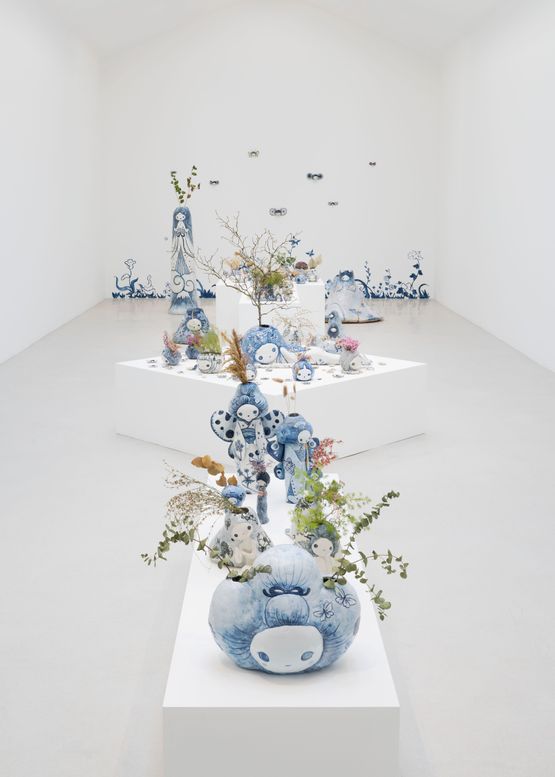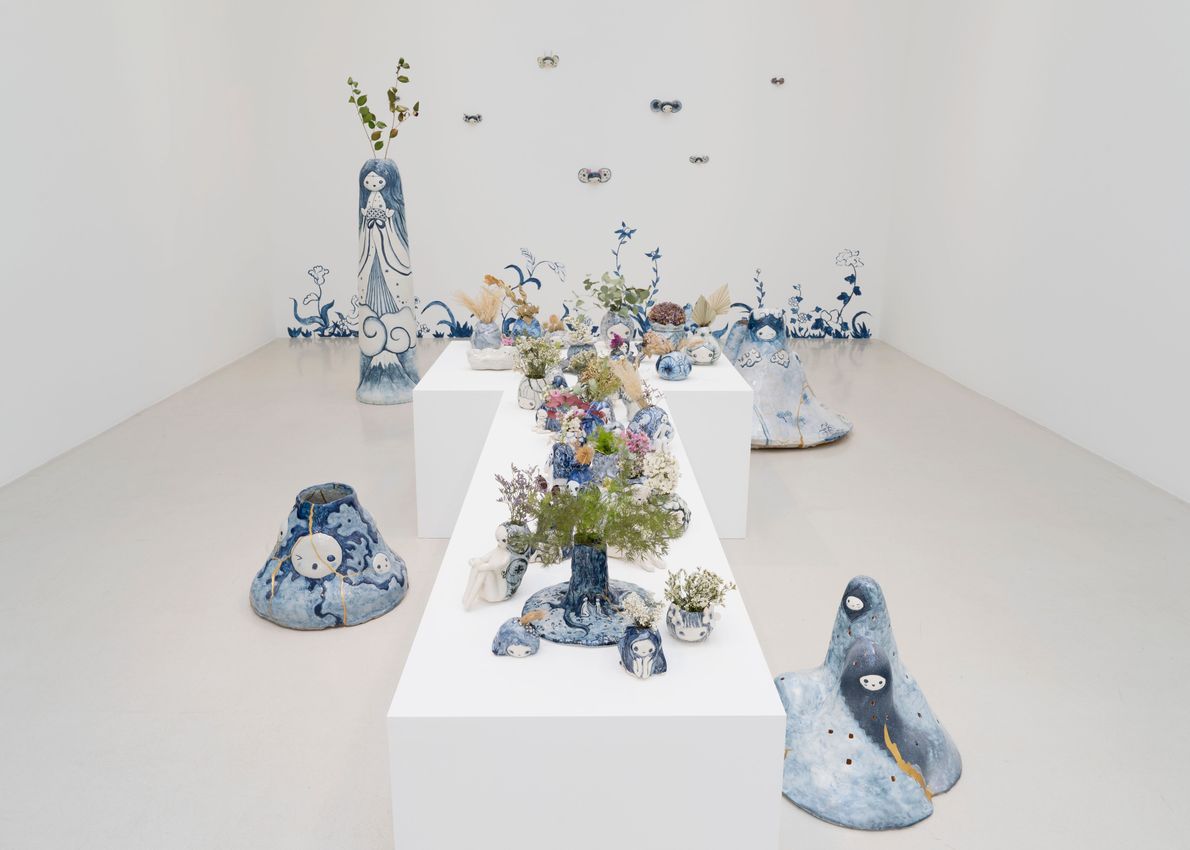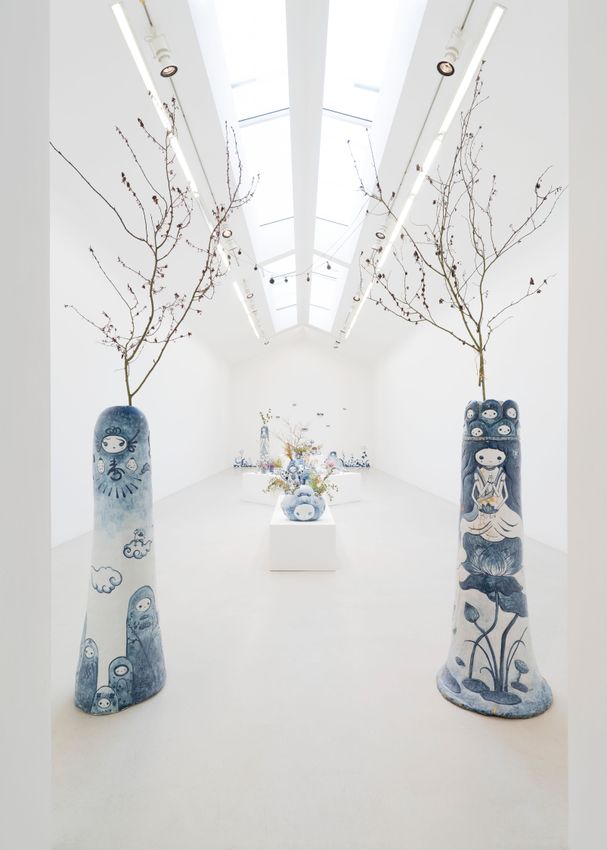
Perrotin is pleased to present Emptinesses, the fourth soloexhibition by Chiho Aoshima with the gallery. For this new exhibition,Chiho Aoshima has developed a universe that combines traditionalJapanese references, memories of manga, science fiction, a love ofnature and somewhat ambiguous female representations.Oscillating between romanticism and futuristic projections, theboundaries between reality and fantasy become increasinglyblurred...
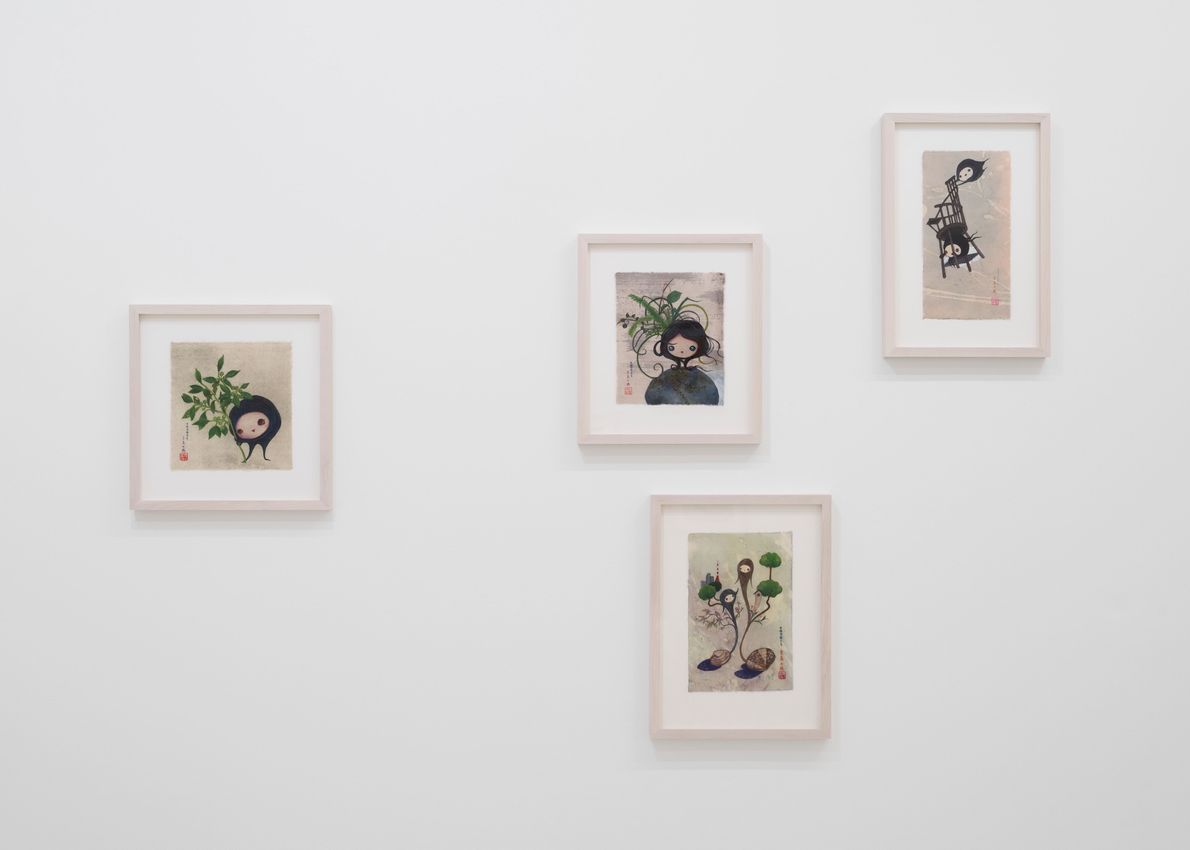
Through ceramics, watercolours and acrylic on canvas, the artist, whowas born in Tokyo in 1974, is continuing a cycle that currently focusesmainly on female figures, having abandoned zombies and skulls. One ofthe paintings in the exhibition, Act with Caution on a Full Moon Day!,2024, shows a green mountainous landscape transformed into a facewith long hair, evoking notions of animism. In the background, a sexynaked figure plays with rabbits whilst attempting to tame her long mane– a kind of Ophelia 2.0, in reference to the painting by the Pre-Raphaelite artist John Everett Millais. This link can easily be made with the workof Chiho Aoshima, who admires Odilon Redon, a French contemporaryof the British painter and the author of a dark romanticism tinged withstrangeness and otherworldliness. ‘I was very young when I first felt thethrill of leafing through art books about Redon, but he remains my favourite artist to this day,’ she says. ‘I love his vision of the world, his exquisite colours, his sad eyes and the fact that he expresses things that arenot visible to the naked eye...’ The painting can also be read as depictingseveral generations – the young girl and the mature lady with her curledup fingers – and if we continue to delve into the history of art, as acontemporary and very personal version of Gustav Klimt’s Three Ages ofWoman (1905). Or an allegory of the temptress witch, faced with a naïveingenue... The intoxicating piece from Death and the Maiden, a quartetby Franz Schubert, also springs to mind, which was written in 1824 andused in Jane Campion’s film Portrait of a Lady in 1996.
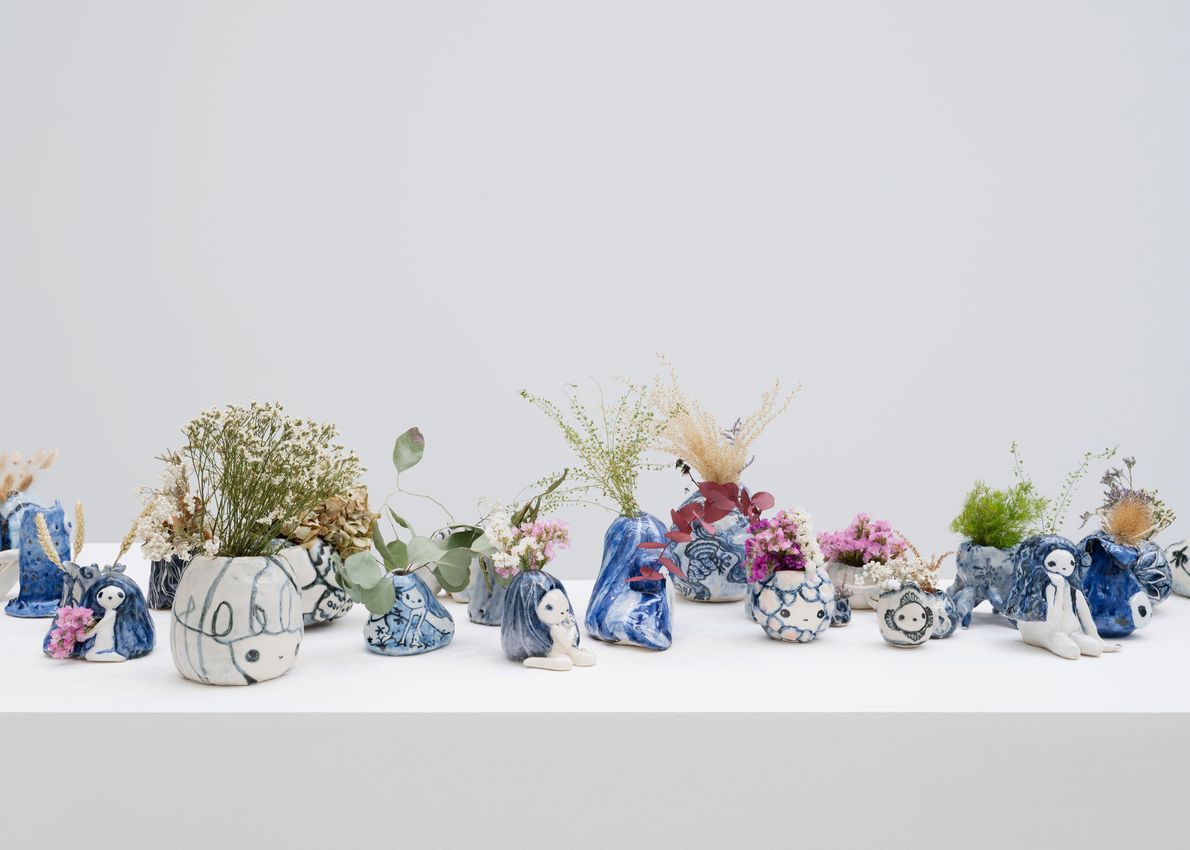
Representing these multiple figures of girls and women is a way forChiho Aoshima to express her own emotions without committing herselfto a cause. She is increasingly exploring this through the medium ofceramics, depicting small figures midway between fairies and geisha, ormore mysterious apparitions, reminiscent of the Shinto religion, alwayswith a very sensual link to the natural elements. Utagawa Kuniyoshi andTsukioka Yoshitoshi are often mentioned as possible cultural Japaneseinfluences. Commentary on her work has also focused on her interest inantiquities, cemeteries and ruins, in which she sees a mystical dimension,but also a spatial projection of an almost third kind. In a text by KatySiegel, she said that the ruins of Angkor gave her the impression of ‘entering another dimension.’ The kind of dimension that we imagine tobe driven by the resurgence of disaster films, manga recounting postapocalyptic projections or the danger of immanent ecological disasters.Here again, the artist takes a restrained approach to the subject, notactively engaging in the environmental debate, but still expressing herintimate and personal relationship with the cosmos. ‘When I moved fromTokyo to Kyoto, I was moved by the fact that you could see the sky wideopen... Here, I can admire the mountains close by and I can see that,every day, this view is conditioned by the presence or absence of clouds.But it seems to me that there must have been more beautiful landscapesand skies in the past...’ She hints at a nostalgia which never subsumesher, but which lends a timeless poetry to her work. Lately, ceramics,which she makes directly in her studio or in Shigaraki for the largerpieces, have become increasingly important. As in the early days of hercareer, the general theme is the coexistence of humans and nature.Breaking down the ever-diminishing hierarchies between art and crafts,the artist does not shy away from developing her ideas through theproduction of vases. She places luminous flowers in them, as well asweeds and dried flowers. ‘The moment when my work and my plantsmerge makes me happy,’ she says, bringing an emotionality, even asentimental enthusiasm, to the ancestral art of ikebana. The regularpractice of ceramics also leads Chiho Aoshima to be more accepting ofthe effects of chance and to rethink the notion of experience.
In her works on paper and canvas, this experience is pursued with aredoubled connection between the figure and nature, shaking up thedirections of gravity and levitation. Flowers and their roots fly into the sky.Rhizomes break free. Tufts of grass are inhabited by a joyful colony ofelves, haloed by a luminous sky and the flight of dragonflies. These Odonata, signs of good fortune, could simultaneously be likened to dronesand discreetly speak to us of surveillance... The vibrant, shaded colours,far removed from the Superflat of her beginnings, draw the viewer intoher galaxy, which oscillates between fairy tales and anxious projections...It’s like a rejection of ordinary triviality, or what she calls ‘Riajuu’ inJapanese, the feeling of fulfilment in the real world, which she has neverbeen able to fully experience. Chiho Aoshima reflects a great deal on thistime, which moves at a frenetic pace. Always with a style that whispersbetween poetry, false naivety, gentle eroticism, dynamism and mysticism,she asks herself questions: ‘I don’t want to forget respect for nature andlife, which was dear to people in the past. However, with the progress ofscience and technology, many things have been elucidated, which is whyI would like to become acquainted with the wonders of the universebefore I die. I would also like to understand why, when we’re talkingabout somebody, there is a strong probability that they will appear or callus...’ There is therefore an infinite narrative embodied in these seeminglyharmless and innocuous female allegories...
—Marie Maertens
Press release courtesy Perrotin
Chiho Aoshima started her art practice in the 1990s, rising to prominence with the international debut of her masterful, digitally rendered work in the acclaimed Superflat exhibition held at the Museum of Contemporary Art, Los Angeles in 2001.


Emmanuel Perrotin founded his first gallery in 1989 at the age of 21. He has opened since then over 17 different spaces, with the aim of continuing to offer increasingly vibrant and creative environments to experience artists work. He has worked closely with his roster of artists, some since more than 25 years, to help fulfil their ambitious dreams and projects.

A respected voice in contemporary art discourse.
Focusing on ambitious storytelling and insightful art-world commentary. Ocula Magazine publishes in-depth interviews, critical essays and timely analysis on the artists, exhibitions and ideas driving the global art world.
Learn more about Ocula Magazine
Showcasing the best of the art world.
Ocula partners with galleries from around the world to highlight their artists, artworks and exhibitions. Gallery membership is by application and invitation, with each member vetted by an independent panel.
Learn more about Ocula Membership

Specialises in the sale of major artworks.
Led by a team with deep ties to the world’s leading auction houses, galleries and collectors. Ocula’s advisory team offers bespoke services to high-net-worth clients from around the world who are looking to acquire the best of contemporary and modern art.
Learn more about our team and services