‘What is Beauty. It is a momentary flicker of ever-vanishing youth.’1 Takashi Murakami
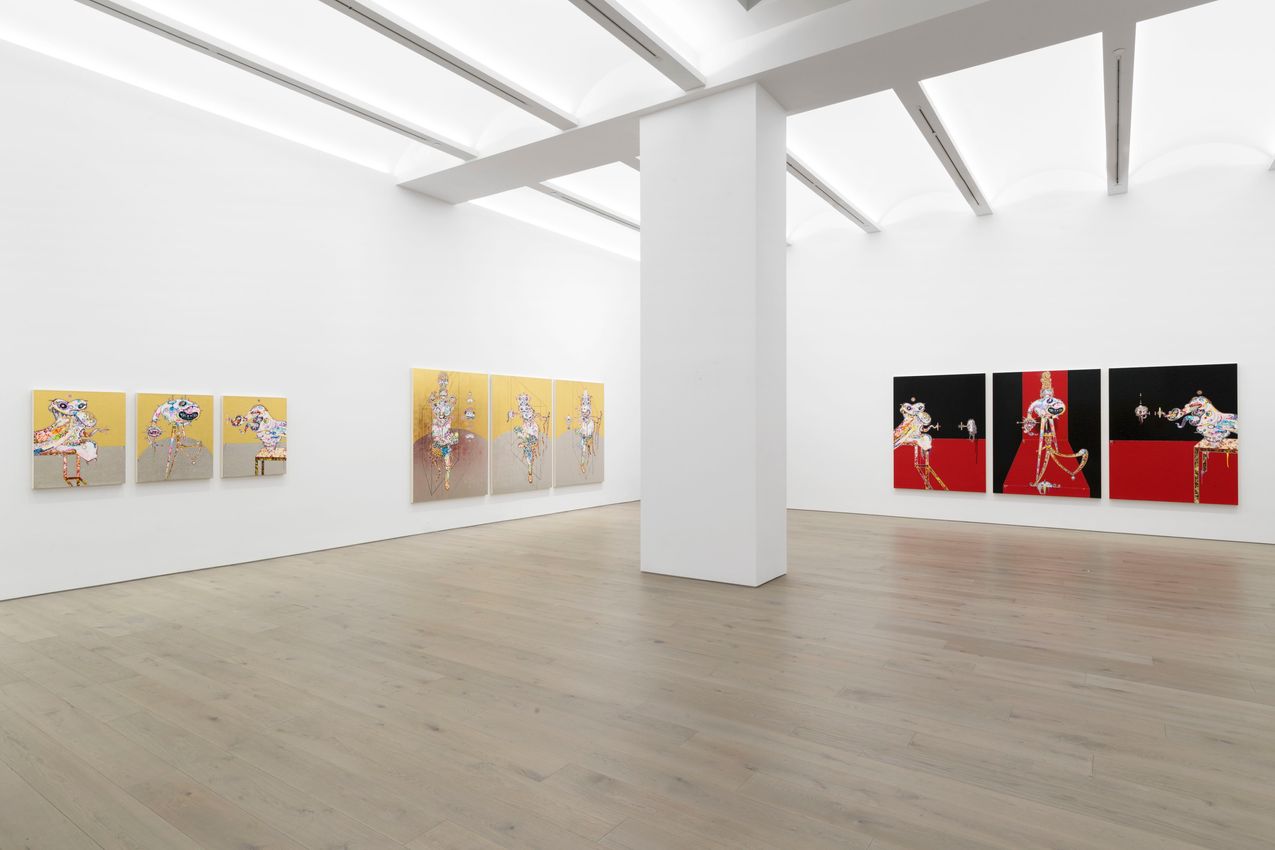
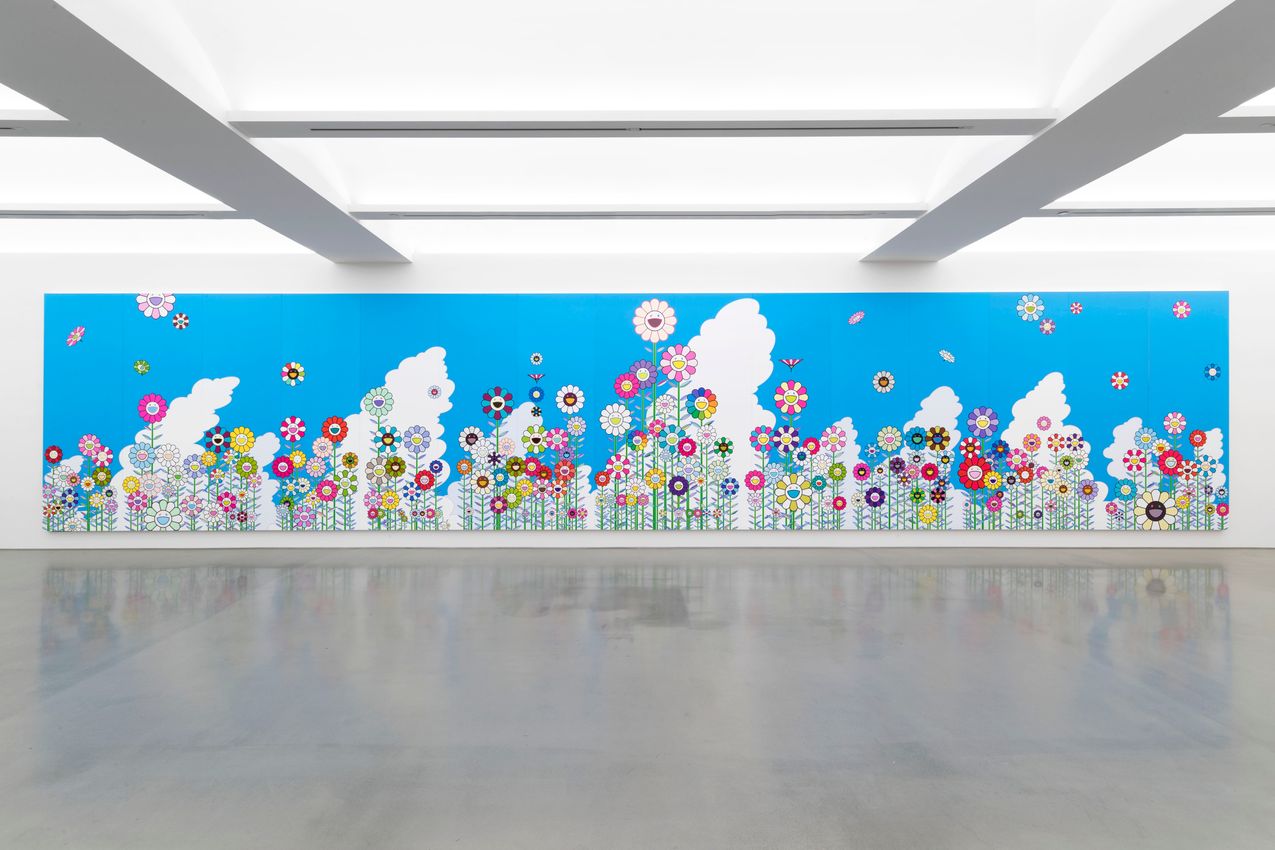
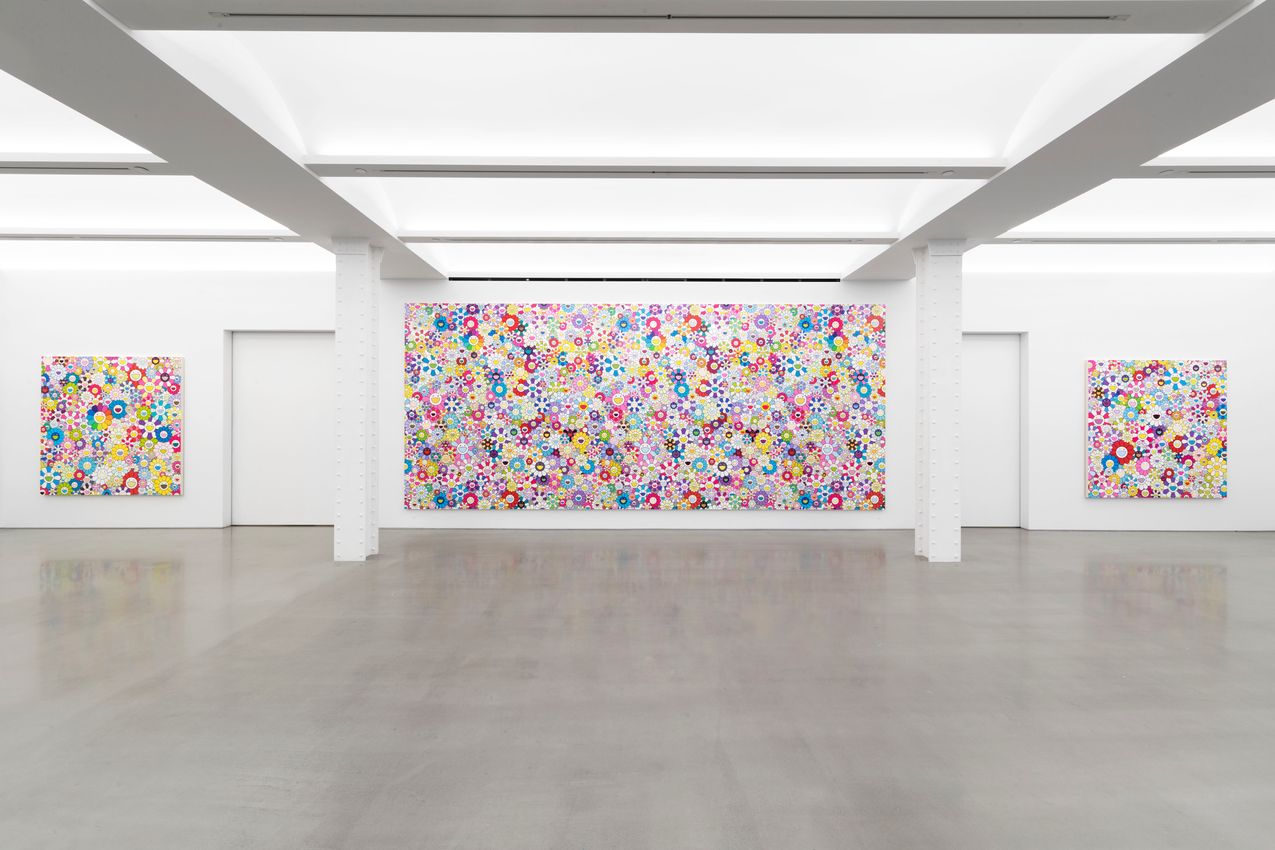
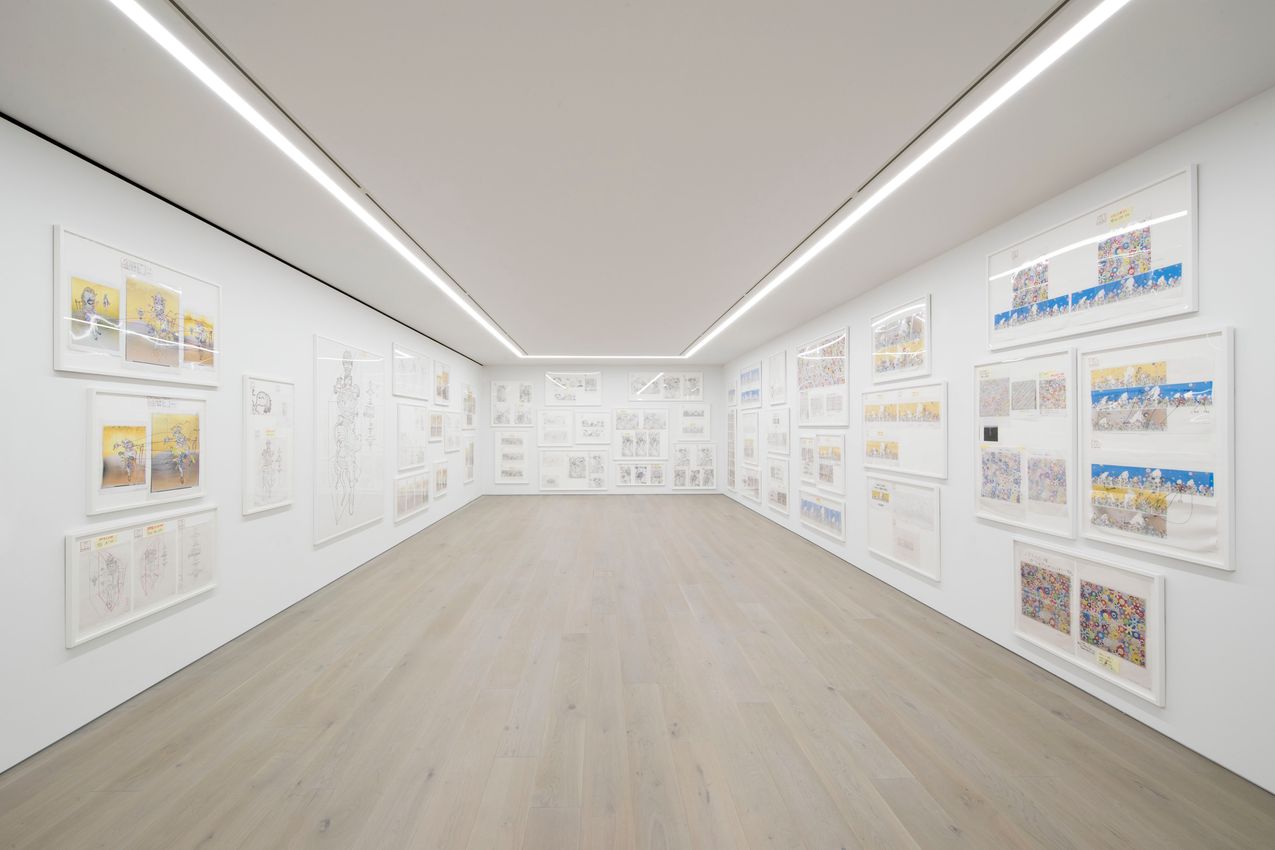
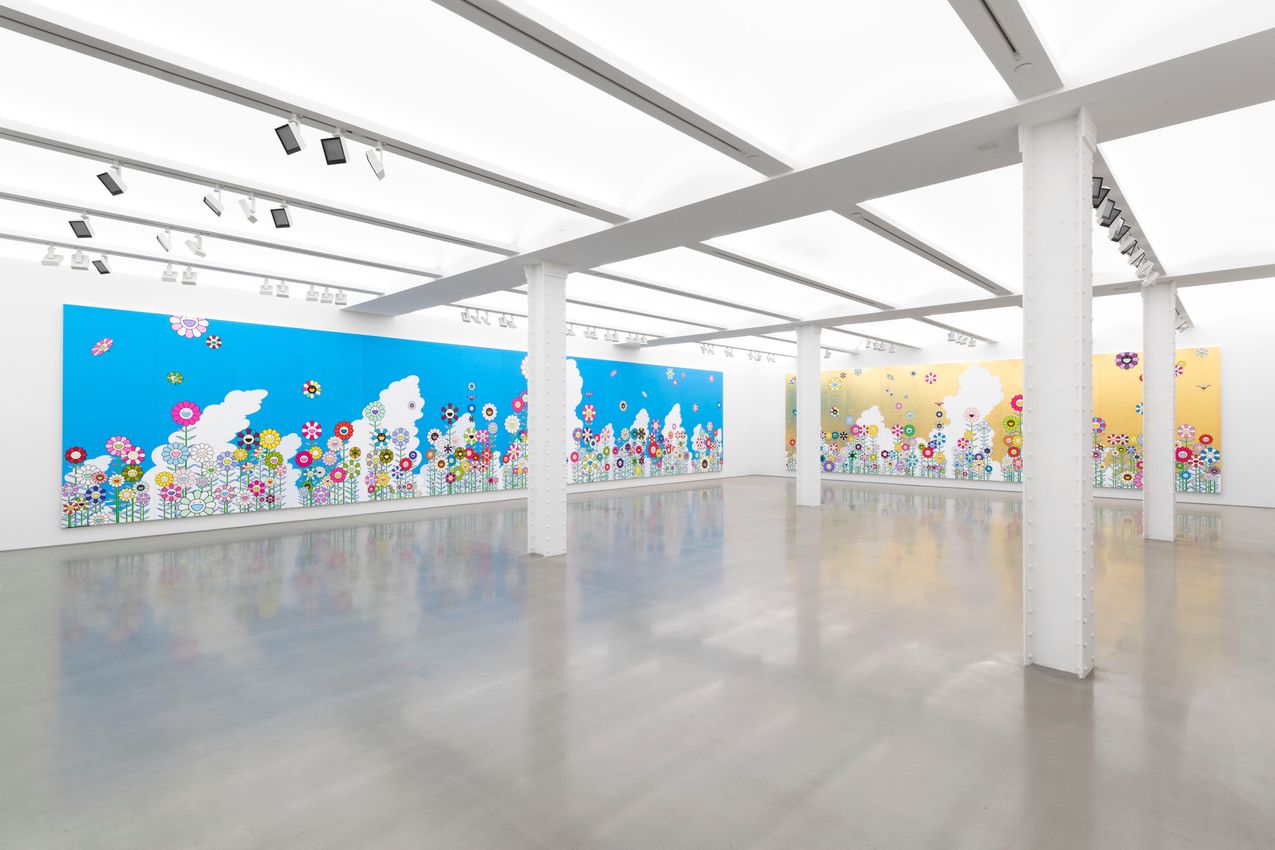
Perrotin New York is pleased to present a solo exhibition of the work of Takashi Murakami, the fourteenth in twenty-three years of cooperation with the artist. Spanning several floors, the exhibition presents for the first time in New York recent works from the series of Baka Paintings, Homage to Francis Bacon and the Transcendent Attacking a Whirlwind fresco, exhibited this past October at the Museum of Fine Arts Boston.
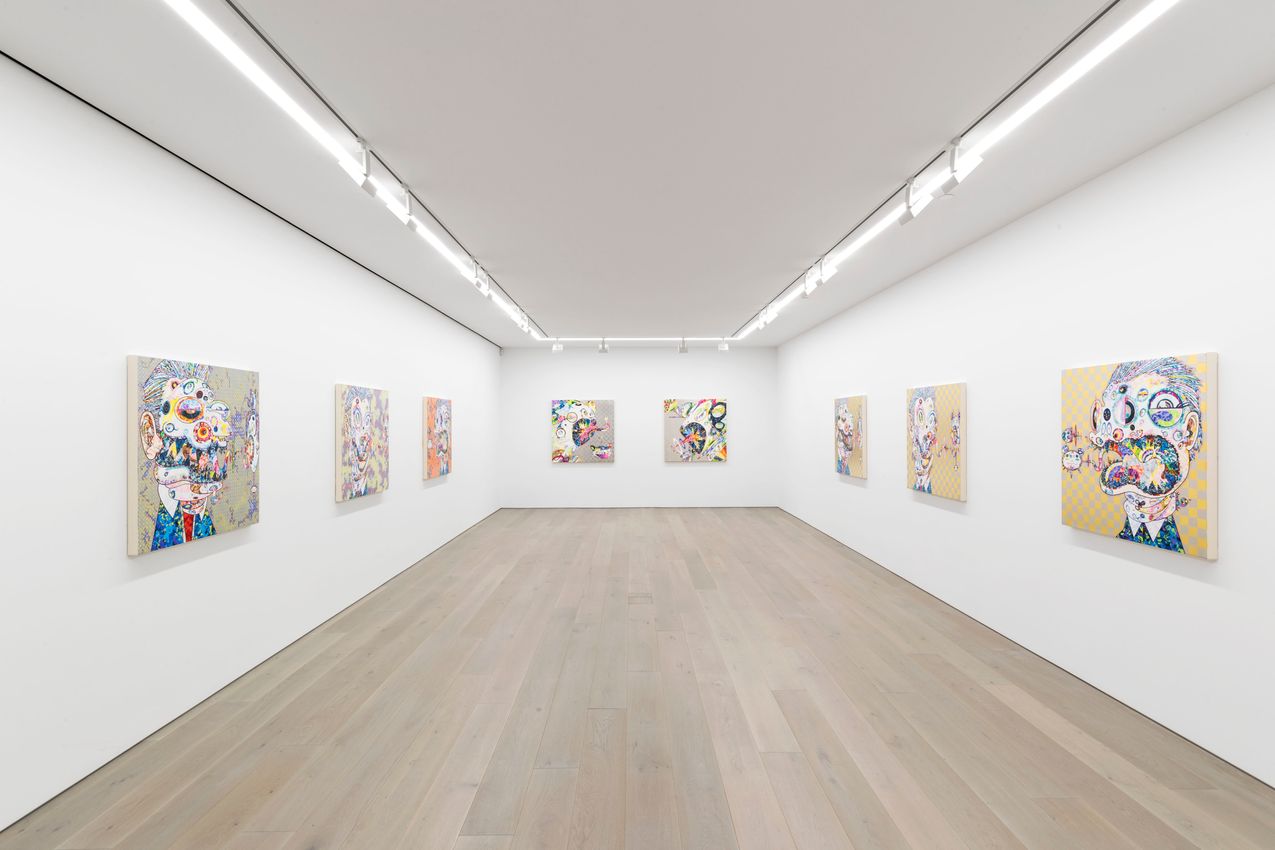
The exhibition opens with a brand new series of Baka Paintings presented as self-portraits of the artist, his face stylized like a manga at the center of the composition. Written in Japanese characters in the background is the artist’s manifesto describing different moments of his private and professional life. In the very first piece of the series, Idiot, 2012, he describes the critical situation of art in Japan, the ingenuousness of an overly insular cultural sector, devoid of any progressive vision or prospects for the young generations of artists.
In response, Murakami’s text suggests developing a quality art education system to inundate the world with talented Japanese artists. This declaration is offset by the word baka (idiot) written across the top of the painting like a watermark so the letters can only be seen from a distance. Murakami works a playful to-and-fro with the words, and even with body of the viewer who loses all bearings, caught between two messages.
He toys with his own image through ironic self-criticism. In the words of professor Hiroko Ikegami with regard to this piece: “Murakami’s rebellious spirit is best demonstrated in works like Baka”2. Does his desire to make a clean break with the system conflict with more realistic considerations? Or is the viewer the one caught in the vice of this somewhat hazy dilemma?
The strength of this intentionally off-beat piece also lies in its highly academic pictorial rendering, drawing upon traditional Japanese inking techniques to support his claims.
The exhibition continues with a new series of paintings inspired by the work of Francis Bacon. The dense compositions contain the recurring motifs of the artist’s iconography—eyes, mushrooms, characters—accentuated by multiple layers of colour on platinum leaf. In Murakami’s work, the representation of flesh in motion is the pretext for a cosmology of chaotic motifs and colours. The metamorphoses of faces recall the transformations of Mr. DOB, the whimsical character—sometimes cute, sometimes monstrous and fierce—that Murakami subjects to multiple variations in his artworks. With this series, started in 2002 and continued in 2016, the artist pursues his homage to artists—both occidental and oriental—who have influenced his work.
The exposition closes with Transcendent Attacking a Whirlwind, 2017, a monumental painting ten meters (33 feet) long, composed of ten wood panels painted in acrylic and highlighted with gold and platinum leaf. The work is a homage to Japanese artist Soga Shohaku, whose painting by the same title created in about 1764 is now part of the Boston Museum of Fine Arts collection. Caught in a storm, several characters in traditional dress surround a sea dragon whose coiled tail merges into the raging waves. The hypnotic motion of the colorful whirls structures the scene and emphasizes the dynamic nature of the composition. Colours and patterns—waves, scales, clothing—are delicately layered like a collage of Japanese paper beneath a shiny lacquer.
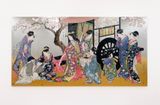
Transcending tradition through both a pop and scholarly approach to his art, Takashi Murakami brilliantly revives the principles expounded by his mentor, Professor Nobuo Tsuji: animation, ornamentation (kazari), playfulness (asobi), religiosity and eccentricity. This massive fresco calls to mind The 500 Arhats, 2012, a vast panorama 100 meters (330 feet) long in which Murakami revisits the Japanese tradition of scroll paintings. Created in response to recent ecological disasters in Japan, these simultaneously realistic and hallucinatory works marked a turning point in the artist’s career.
The pieces presented in this exhibition show the importance of history and tradition in the work of Takashi Murakami, who holds a Ph.D. in Nihonga painting. Incessantly moving between the past, present and future, his oeuvre combines the most modern iconography and techniques with the precision and sophistication of tradition Japanese art.
The artist deliberately maintains a wide gap among the immediate visual impact of his paintings, the apparent accessibility of his work, and the conceptual density of his discourse. His extensive knowledge and sense of irony are two major characteristics of his work: Murakami asserts a desire to mix high culture and popular culture indiscriminately in a «super flat» artwork devoid of prejudice or boundaries, a truly free expression of creativity.
Born in 1962 in Tokyo, Takashi Murakami lives and works in Tokyo, Japan. In 2018, Takashi Murakami will be exhibited at the Vancouver Art Gallery, at the Modern Art Museum of Fort Worth and at the Fondation Louis Vuitton. Since 2015, seven high-profile international museums have hosted major Takashi Murakami personal exhibitions: Mori Museum of Tokyo, Yokohama Museum of Art, Astrup Fearnley Museet of Oslo, Museum of Contemporary Art Chicago, Museum of Fine Arts Boston, Albright-Knox Gallery, Buffalo and Garage Museum of Contemporary Art Moscou. The exhibitions all brought a record number of visitors to the museums in which they were held.
1 –Takashi Murakami and Soyeon Ahn, The meaning of Superflat Always Remains Mysterious in Takashi in Superflat Wonderland, PLATEAU Samsung Museum of Art, 2013
2 –Hiroko Ikegami, ARTFORUM 54, February 2016, 232-233
Takashi Murakami, who has a PhD in Nihonga painting, combines the most cutting-edge techniques with the precision and virtuosity of traditional Japanese art. Inspired by manga and kawaii culture, his irresistible world is peopled by monstrous and charming characters alike, as facetious descendants of past myths. His theory of the Superflat aesthetic, which he introduced in 2001 with the trilogy exhibition he curated (the third part was entitled Little Boy, which refers to the codename for the atomic bomb dropped on Hiroshima in 1945), attempts to blur the boundaries between popular art and high art; it has explored the evolution of Japan’s understanding of its post-Hiroshima condition and the interrelationships between vanguard art, manga, anime and their forerunner, Ukiyo-e woodblock prints. The absence of perspective, the two-dimensionality of ancient Japanese art, filters in to every medium.


A respected voice in contemporary art discourse.
Focusing on ambitious storytelling and insightful art-world commentary. Ocula Magazine publishes in-depth interviews, critical essays and timely analysis on the artists, exhibitions and ideas driving the global art world.
Learn more about Ocula Magazine
Showcasing the best of the art world.
Ocula partners with galleries from around the world to highlight their artists, artworks and exhibitions. Gallery membership is by application and invitation, with each member vetted by an independent panel.
Learn more about Ocula Membership

Specialises in the sale of major artworks.
Led by a team with deep ties to the world’s leading auction houses, galleries and collectors. Ocula’s advisory team offers bespoke services to high-net-worth clients from around the world who are looking to acquire the best of contemporary and modern art.
Learn more about our team and services