


Press Release

Lee Ufan (b. 1936) has lived and worked in Japan since 1956. He became the leading figure of the Mono-ha movement in the late 1960s, and has remained active in the global art world ever since.

Recent major exhibitions by the artist include solo exhibitions at the Guggenheim Museum in 2011 and the Château de Versailles in 2014. In 2019, Centre Pompidou-Metz in France held a Lee retrospective and Dia Beacon in New York established a permanent exhibition space dedicated to his work. Also, the Hirshhorn Museum in Washington, D.C. currently has a long-term site-specific installation in the museum’s outdoor plaza featuring ten new sculptures by the artist.

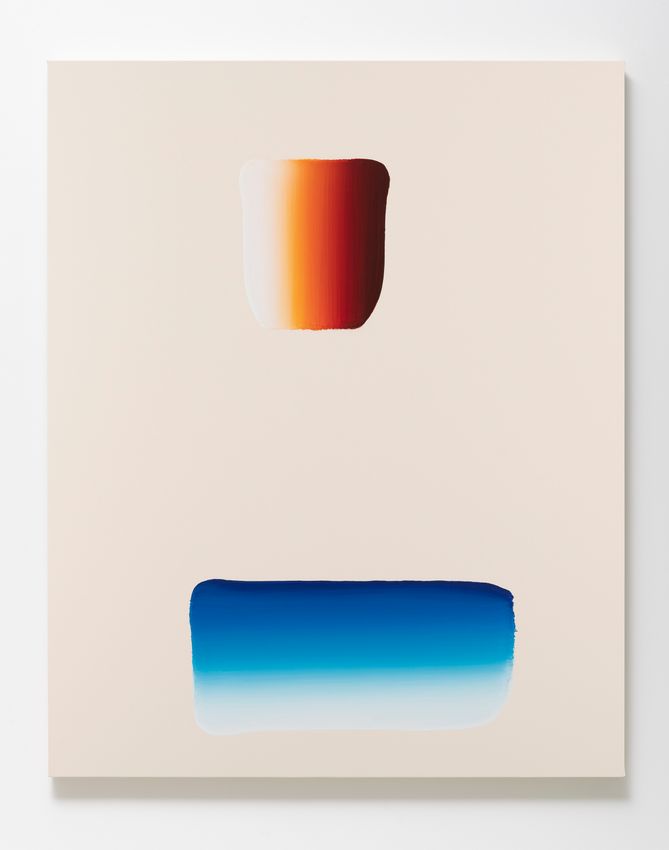
His latest exhibition at SCAI The Bathhouse opens on Friday, March 6. It consists exclusively of paintings, featuring Lee’s latest works from the Dialogue series that he has worked on since 2000.

Some may be surprised to see that the ‘Dialogue’ series that began with a monotone grey two decades ago has now become rich with colour.

Lee’s art is characterised by yohaku–empty spaces or margins–that the artist intentionally leaves unmade, and these paintings continue to be based on the concept of resonance between the parts that are painted and those that are not. The colour fields that appear to be single brush strokes have very simple forms giving the viewer a strong impression of white space. The part where nothing is painted makes the viewer aware of space, turning the entire exhibition space into a work of art, not just the part that was painted.

In that sense, although they appear extremely simple at first glance. Lee’s paintings can be said to be very three-dimensional and physical.

One gets the felling that the artist’s approach of continuing to create art through actual physical activity in this day and age when it has become less common for art to be made in such an ‘analog’ way is strangely in harmony with the era that produced the Mono-ha movement, which called into question the rapid modernisation of the 1960s. A factor that is always important with the artist is the the relationship between things that are made artificially, things that are made completely by hand, and things that only occur naturally.

Due to the universality of his art, Lee Ufan is seen as a leading artist in Japan who transcends eras and national borders. He has been selected as one of the participating artists of the group exhibition STARS: Six Contemporary Artists form Japan to the World. at Mori Art Museum, which opens on April 23, 2020.

This solo exhibition is a valuable opportunity to experience Lee Ufan’s latest works int he intimate space of the gallery.

Read More
About the Artist

As a progenitor of the Japanese Mono-ha, or School of Things, movement, Lee Ufan led a loose constellation of artists who championed the use of ordinary materials during the late 1960s, significantly altering the course of 20th-century Japanese art. Lee’s dense yet poetic text, Beyond Being and Nothingness—A Thesis on Sekine Nobuo, provided something of an intellectual foundation for the movement. The group eschewed representation, choosing instead to zero in on the relationship between perception and material. Its main aim—as expressed by its key figures—was to demonstrate the fluid coexistence of objects, ideas and encounters.

View Artist Profile

Also Exhibiting at SCAI THE BATHHOUSE

About the Gallery

SCAI The Bathhouse is a contemporary art gallery located in Yanaka, with a town ambience reminiscent of Old Tokyo. In walking proximity to Ueno, an area dense with museums and art schools, the gallery was converted from a venerable 200-year-old public bathhouse. Take a step inside, and you will find a white cube with soft natural light descending from the high ceiling.

View Gallery Profile
Address
Kashiwayu-Ato
6-1-23 Yanaka
Taito-ku
Tokyo
Japan
Opening Hours
Tuesday – Saturday
12pm – 6pm
(1)
Tokyo Kashiwayu-Ato, 6-1-23 Yanaka
SCAI THE BATHHOUSE
Kashiwayu-Ato, 6-1-23 Yanaka, Taito-ku, Tokyo, Japan

Opening hours
Tuesday – Saturday
12pm – 6pm
The art world in focus