Thesis, antithesis, synthesis
Life, death, their mutual bond, and the human effort to interpret them are the main recurring themes in the works of Wang Zhongjie. Personal growth, as well as the development of a deeper awareness and an inner freedom by way of great suffering, have forged a language capable of properly expressing the changes undergoing the painter’s soul, adapting to his ever-increasing maturity.
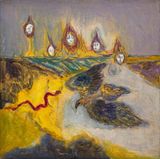
The works dating back to the first decade of the century swept us over with their power and innovative qualities; we were struck by the very unusual choices in colors and subjects, utterly different from the mainstream Chinese art world of the time. They were “figurative” paintings, alternating dark tones and strong shades, always juxtaposed in unexpected ways. Those works could not leave one indifferent, able as they were to strike a chord in the viewers’ rational as well as emotional sides.
As a self-taught painter, Wang Zhongjie has been able to enjoy greater expressive freedom than his academy-trained peers, his art not being compromised by externally imposed rules and restrictions. An extensive knowledge of art history tied with his extreme sensitivity has driven him to experiment ceaselessly with the endless possibilities of the pictorial medium, processed from an utterly personal perspective that steadfastly ignores any outside pressure.
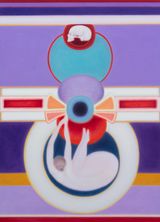
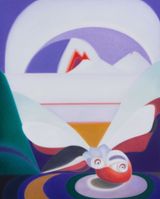
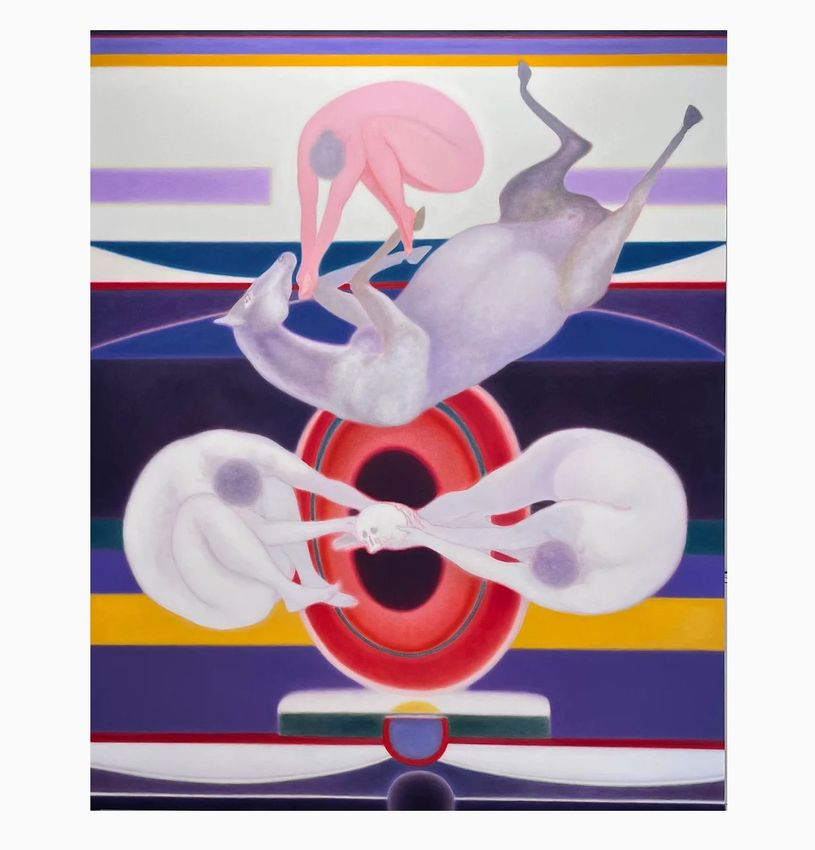
The first works are then followed by what could be conveniently described as a “metaphysical” phase, in which the same existential themes undergo a purifying and dematerializing process: on the one hand, they become more abstract (large monochromatic areas defined by straight or curved lines, geometrical shapes, doors, mysterious vessels with unknown content); on the other hand, they become strongly symbolic, in the guise of recurring animals such as the rooster, the dog/wolf, the monkey...
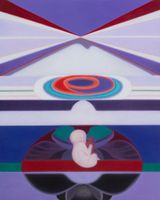
Wang Zhongjie’s intimate, peculiar relationship with painting—something akin to hand-to-hand combat, where every stroke is the result of a deeply felt inner experience—later brings him to simplify the appearance of his paintings even further, by suspending the color range into polychrome frames surrounding and defining an internal “void”. The latter is pure light, expressed with a vibrant quality that relates to a deeper reality, something before and beyond the individual exterior shapes we can perceive. These works, repeated and perfected by the artist for about a decade, hint at life energy in its primeval state.
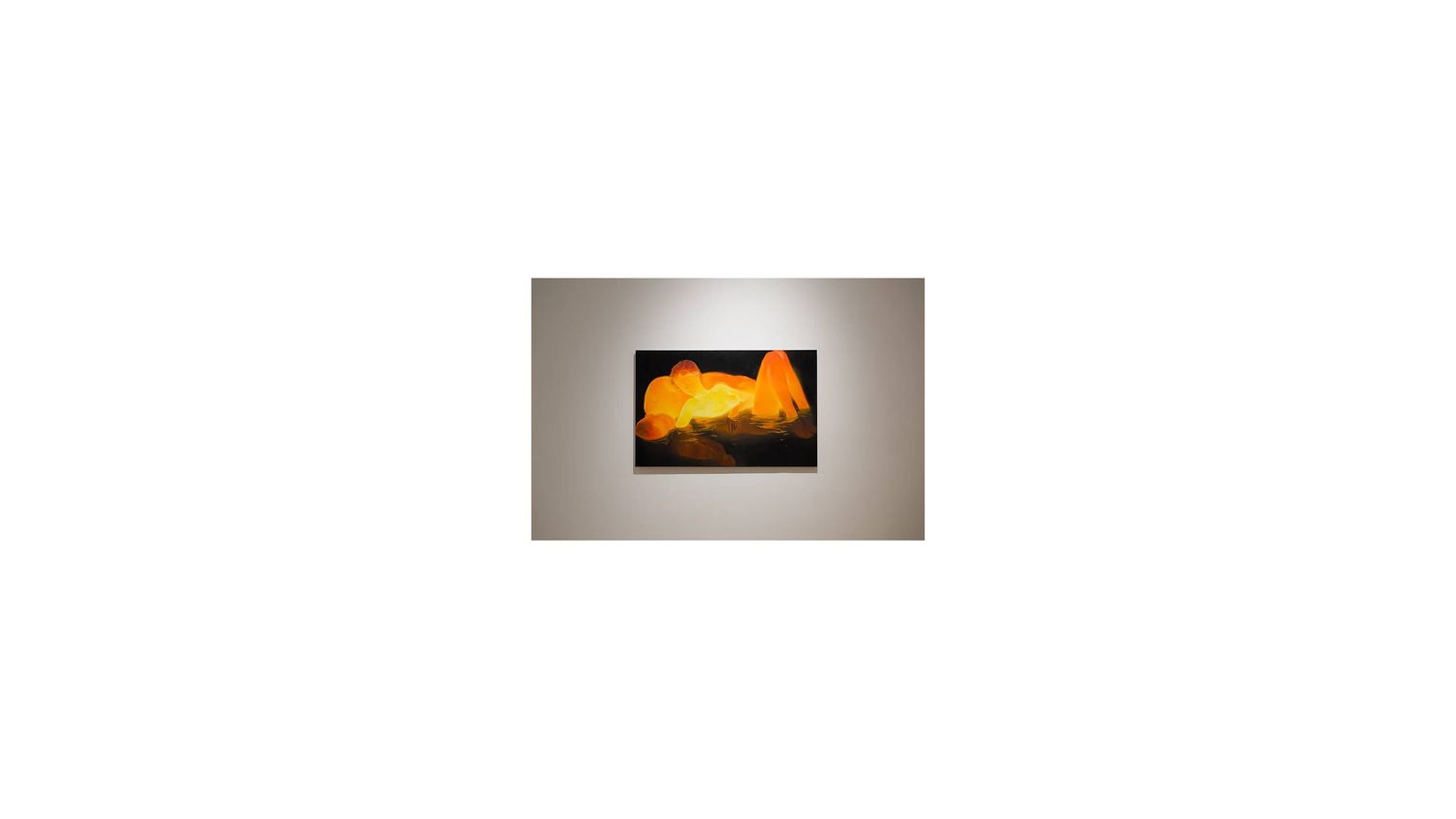
The most recent works, painted in the last two to three years, are a visual synthesis of both previous series, the result of a dogged, in-depth existential research applied to pictorial expression. The vibrations of light are paired with arcane symbols in a rarefied, allusive painting style. Smooth, softly-shaped female figures curled in on themselves, horses with their limbs projected heavenward, alongside the familiar skulls, dogs/wolves with painfully gaping jaws, and hieratic roosters, are all suspended over geometrical surfaces filled with supernaturally bright tones. Color combinations, with one hue blending into the next, use decades of experience to create a world that is not real nor contained within the edges of the painting. It is, rather, a mirror of existence, stretching before and beyond the myopic human eye that is limited by senses: a deeper reality, free of time and space (thus the recurring figure 8, the eternity symbol), a distillation of energy and light. In short, this is the all-encompassing life that embraces the precedency of death.
This reality, so deeply felt, is offered by Wang Zhongjie to his viewers through his masterful control of the pictorial medium.
Monica Dematté
Written at Bingzhongluo, Nujiang, Yunnan, October 26th, 2023
Wang does not want to be confined within time. He has remained in his hometown – Zhengzhou in Henan Province his whole life, contemplating the questions in life that he is most concerned about. Painting thus became his only thinking aid. “I do not exist, Xiaoshu (his seven year-old son) is the only thing that is real.” says the artist “A crowd of people pass by, many of them are fullfilled, but there’s one person who is not – I am one who is void of anything.” In his recent works, everything with any representation is dissolved in the center of the painting or overlapped or merged into graduated colours, and the inclining frames reveals his current anxieties and suffering.


Tang Contemporary Art was established in 1997 in Bangkok, later establishing galleries in Beijing and most recently Hong Kong. Tang Contemporary Art is fully committed to producing critical projects and exhibitions to promote Contemporary Chinese art regionally and worldwide and encourage a dynamic exchange between Chinese artists and those abroad.

A respected voice in contemporary art discourse.
Focusing on ambitious storytelling and insightful art-world commentary. Ocula Magazine publishes in-depth interviews, critical essays and timely analysis on the artists, exhibitions and ideas driving the global art world.
Learn more about Ocula Magazine
Showcasing the best of the art world.
Ocula partners with galleries from around the world to highlight their artists, artworks and exhibitions. Gallery membership is by application and invitation, with each member vetted by an independent panel.
Learn more about Ocula Membership

Specialises in the sale of major artworks.
Led by a team with deep ties to the world’s leading auction houses, galleries and collectors. Ocula’s advisory team offers bespoke services to high-net-worth clients from around the world who are looking to acquire the best of contemporary and modern art.
Learn more about our team and services