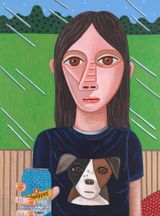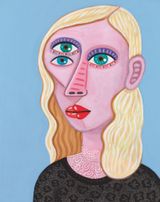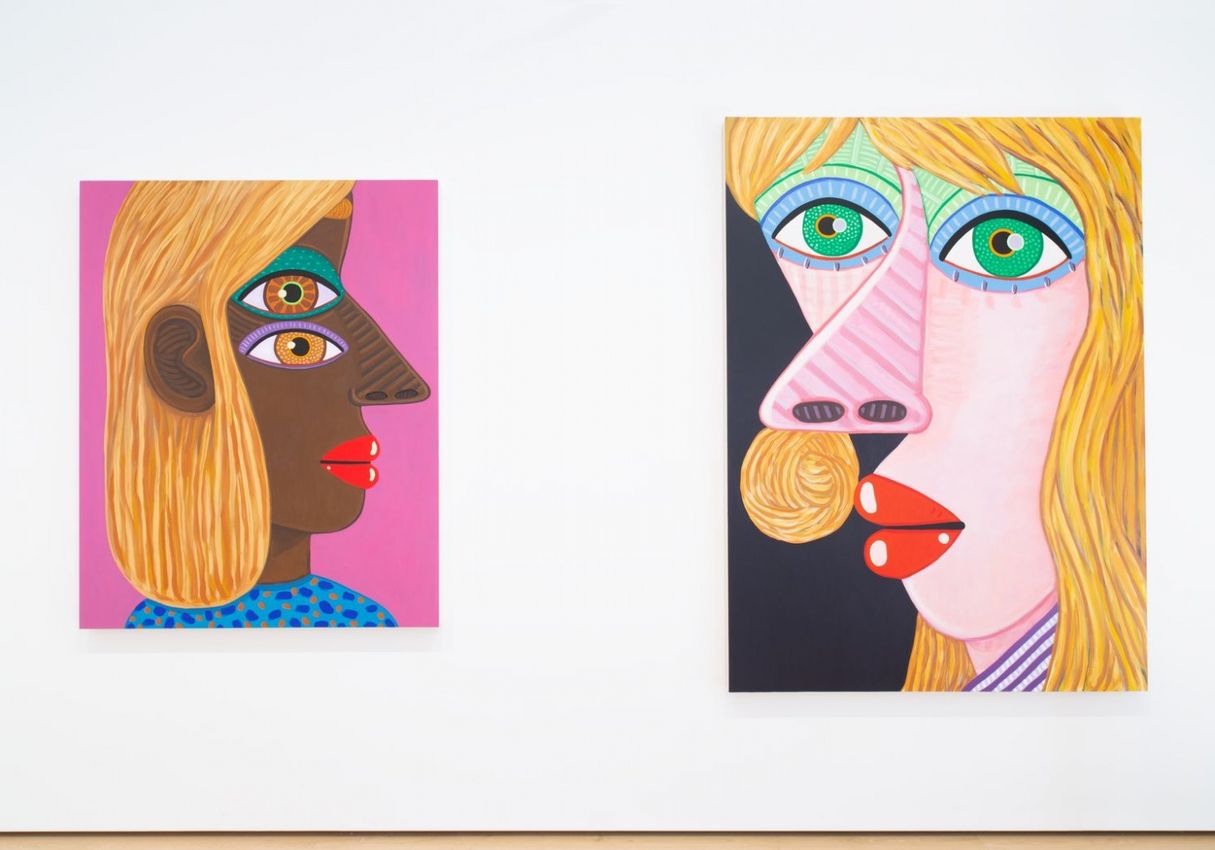
More Days, Brian Calvin‘s new exhibition at Almine Rech Gallery’s Matignon space, presents ten new paintings made especially for the occasion over recent pandemic months. The title inevitably alludes—or so it feels—to the period of forced seclusion we have collectively endured worldwide, a seemingly endless amorphous repetition of sameness in a physical and mental universe that shrank more and more as time went by.
Yet More Days also refers to the cumulative experience that constitutes Calvin’s practice, where every day brings new discoveries and renewed ways of applying paint to canvas, of envisioning compositions and arranging colours in a lifelong quest to create each new work with a fresh perspective. The title also harkens back to Days, one of Calvin’s first major solo shows at the now-defunct Marc Foxx gallery in Los Angeles in 2000, and with it an assessment of the time that has passed in a career that now spans decades and an oeuvre that has necessarily evolved in the process.
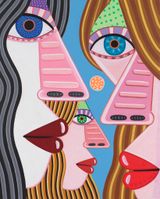
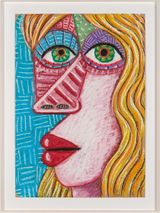
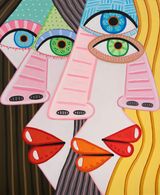
It turns the gaze outwards as well, to all the work that is still left to do, for a painter who has quietly forged his own path in a truly eccentric manner—that is, away from the major art capitals of the world—giving him freedom to explore how to take painting (his own and painting in general) further and to concentrate on formal issues. At a time that has seen a recent upsurge of figurative painters focusing first and foremost on content and subject matter, Calvin has instead continued day after day to condense pictorial concerns within established genres with a defined history (mostly portraiture and landscape), to reinvent them into elements that are recognizable within these categories while not totally belonging to them. His paintings are images of invented figures or places but not actual depictions of real people or real scenery. The new paintings presented in this exhibition thus all continue the work Calvin has done with his ‘portraits,’ the elongated, hieratic characters for which he has become well-known, with pictures of various sizes that often draw from historical Cubism, where for example reminiscences of Picasso’s Portrait of Dora Maar (1937) can be found, as with Big Scene or Middle Distance.
Beyond the obvious references it soon becomes clear however that what is at stake is an exploration of composition and colour, with facial features acting as anchors or signifiers destined to draw the viewer in. Figurative elements serve in fact as devices to explore a more abstract and formal way to reflect on what constitutes a painting. Where the eye would be tricked at first into taking Close Quarters for a mirrored image, attentive observation reveals an even more complex sequence of figures where one colour or one line does not exactly answer the other and where the actual number of depicted faces is not easy to determine. Symmetry is off, and this so decidedly that it produces a vibration that might even prove visually disturbing or upsetting to some.
Sometimes a face will sport too many eyes or mouths (Face Paint), or both eyes will be depicted on the same side of the face (Bobbi, Big Scene), while skin colours in scenes where several characters are present are likely used to provide compositional balance rather than anything else, as is most evident in Big Scene. Close inspection shows a wide array of graphic effects and patterns in aid of this constant quest for compositional perfection, as with the hatchings or dots often used near the eyes, in addition to the lovely brushwork that serves to indicate volume on some of the faces (Robin, or in the delicate work for the hair in Bobbi).
Overall, the ten paintings in this exhibition underline the wide range of pictorial developments Calvin has been exploring. They vary in size, with the two smaller paintings on linen (Bobbi and Bonny) showing an (almost) classic motif of a face in profile detached on a coloured, empty background, which is also the case for Twilight Glow, while on the contrary larger pictures such as Close Quarters, Big Scene and Face Paint would present a near boxed-in effect as the entire surface of the canvas is entirely taken by giant faces. Calvin’s paintings have often been described as the epitome of cool or even hipness, when in reality the overall general effect is rather uncanny, a mix of seductive strangeness and humble radicalism in which vibrant, bright colours and schematic giant faces collide to pull the viewer in. To arrive at this brilliant moment in his career, day after day after day Calvin moves painting forward. Let us only hope, in the immortal words of seminal German band Can, that future days will look ever so bright and bring us even more of Calvin’s painting:
I don’t have to say no more
You know what I’m aiming for
Don’t care if I break a law
I want more and more and more
—Noëllie Roussel
Back in the 1990s, Brian Calvin began developing a figurative, non-narrative, pictorial style. Landscapes and portraits steeped in his Californian roots dominated this work. Close-up treatment of subjects, highly composed structures, as well as luminous colours laid flat endow these large-scale paintings with a strange temporality. In observing his technique of pictorial economy, one gradually comes to see a type of abstraction in his representation of certain details. They reveal, even greater still, the true finality of his work, reaffirming the primacy of a visual reflection on painting itself and its possibilities. ‘I prefer to experience abstraction through the creation and tending of images. Painting provides the medium.’


Almine Rech opened its doors on April 1st, 1997 in the 13th arrondissement in Paris. The gallery was founded on an axis of California Minimal, Perceptual art and Conceptual art, representing artists such as James Turrell, John McCracken and Joseph Kosuth.

A respected voice in contemporary art discourse.
Focusing on ambitious storytelling and insightful art-world commentary. Ocula Magazine publishes in-depth interviews, critical essays and timely analysis on the artists, exhibitions and ideas driving the global art world.
Learn more about Ocula Magazine
Showcasing the best of the art world.
Ocula partners with galleries from around the world to highlight their artists, artworks and exhibitions. Gallery membership is by application and invitation, with each member vetted by an independent panel.
Learn more about Ocula Membership

Specialises in the sale of major artworks.
Led by a team with deep ties to the world’s leading auction houses, galleries and collectors. Ocula’s advisory team offers bespoke services to high-net-worth clients from around the world who are looking to acquire the best of contemporary and modern art.
Learn more about our team and services