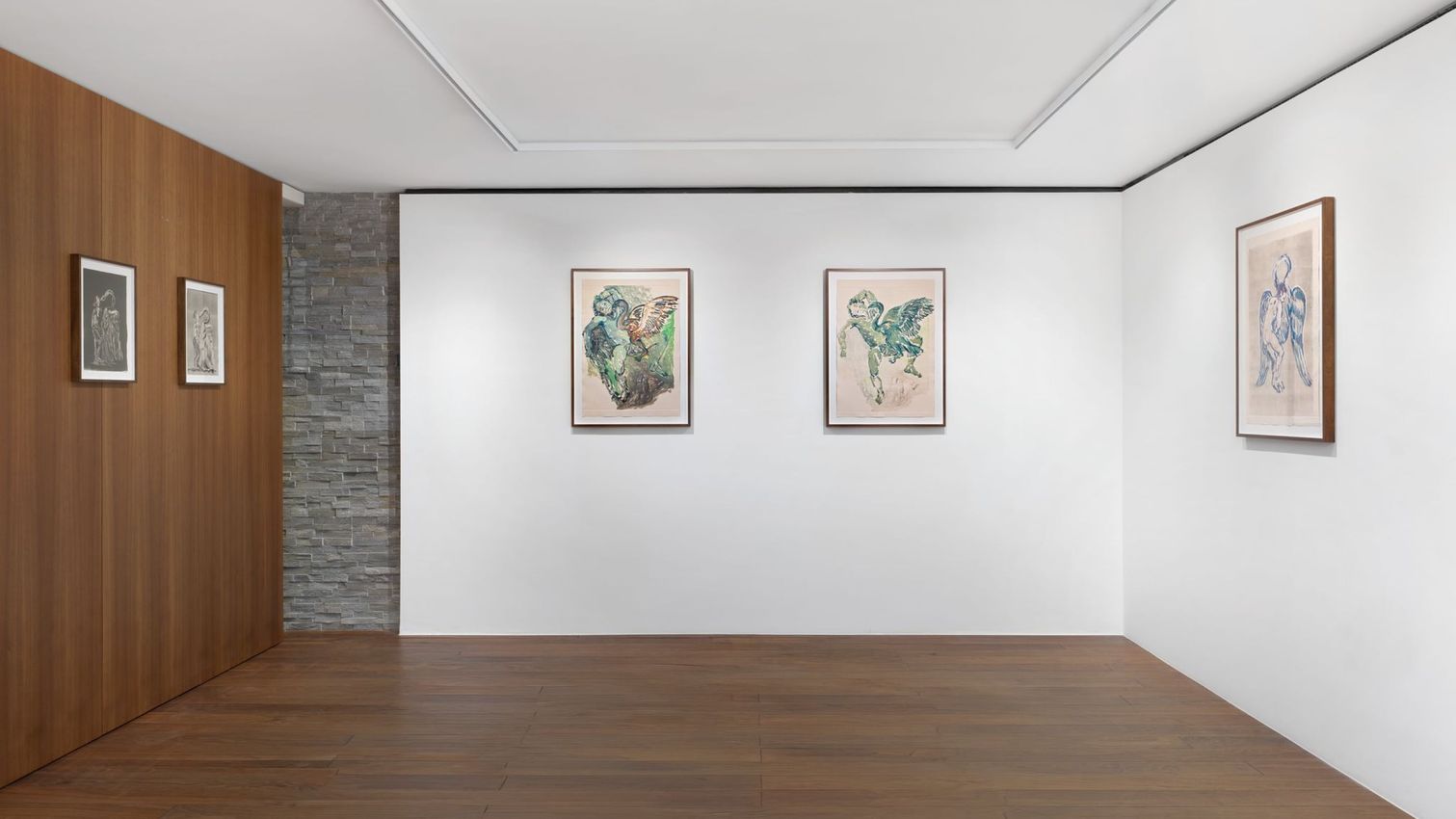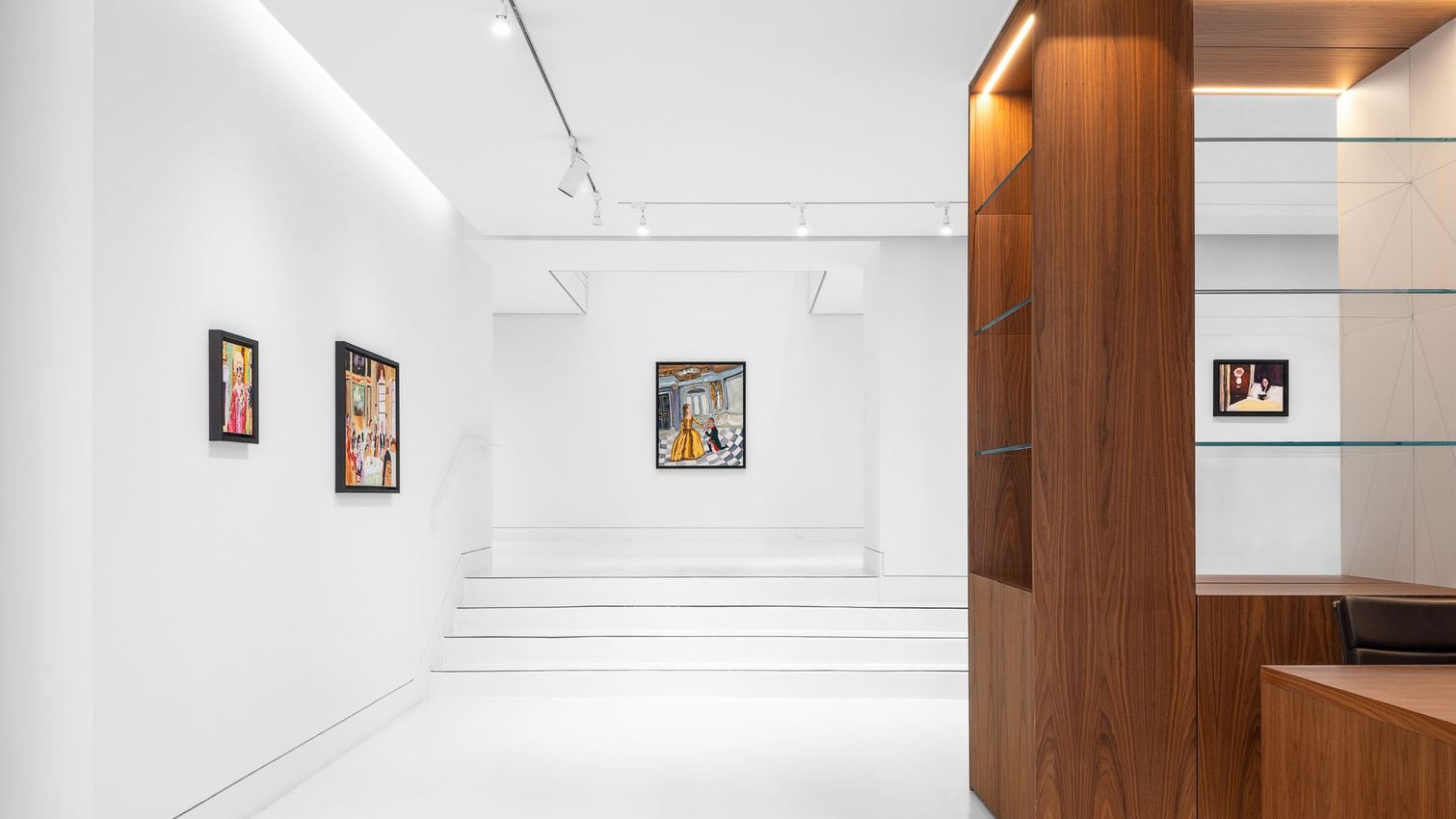
These new paintings are dedicated to the early 19th-century Norwegian Romantic painter Peder Balke, whom Erik Lindman describes as a fellow bricoleur: Balke utilised balled up rags, strié swipes—a host of decorative painting tricks, to execute his fantasy-charged Northern landscapes. ‘Balke’s paintings are not overstated at all,’ Lindman argues ‘they are the result of a man using what is at hand...’ positioning this little known Scandinavian in line with contemporary practices that open the pictorial to signs appropriated from everywhere, adjacent vocabularies to far-flung syntactical realms.
In Lindman’s works there has almost always been a prize at the centre, something retrieved from elsewhere then repurposed within, providing a subject, figure or contrast with the surrounding frontal plane, be it painted or another surface, such as plywood or burlap.
His first mature works began with scraps of aluminium, plastic or other materials—coloured, distressed fragments jettisoned from construction sites or abandoned projects—picked up from the curbs and alleys of New York City. These shards, once reconstituted within a new work, performed a pivotal role both as accent and structural element.
These re-incorporations might be called spolia, to use a term borrowed from archaeology, as when an architectural embellishment, cameo or chip from a building’s decorative frieze, or a temple, a statue or sarcophagi, is reused in a new context in a construction or monument—any kind of significant object that has been re-dedicated or utilised for a different purpose in a new setting.
Traditional spolia came about due to expediency, it was more convenient to build with used materials than new ones, similar to Lindman’s Balke using things ‘at hand’ but there were also overtones of the reliquary and of anachronism.
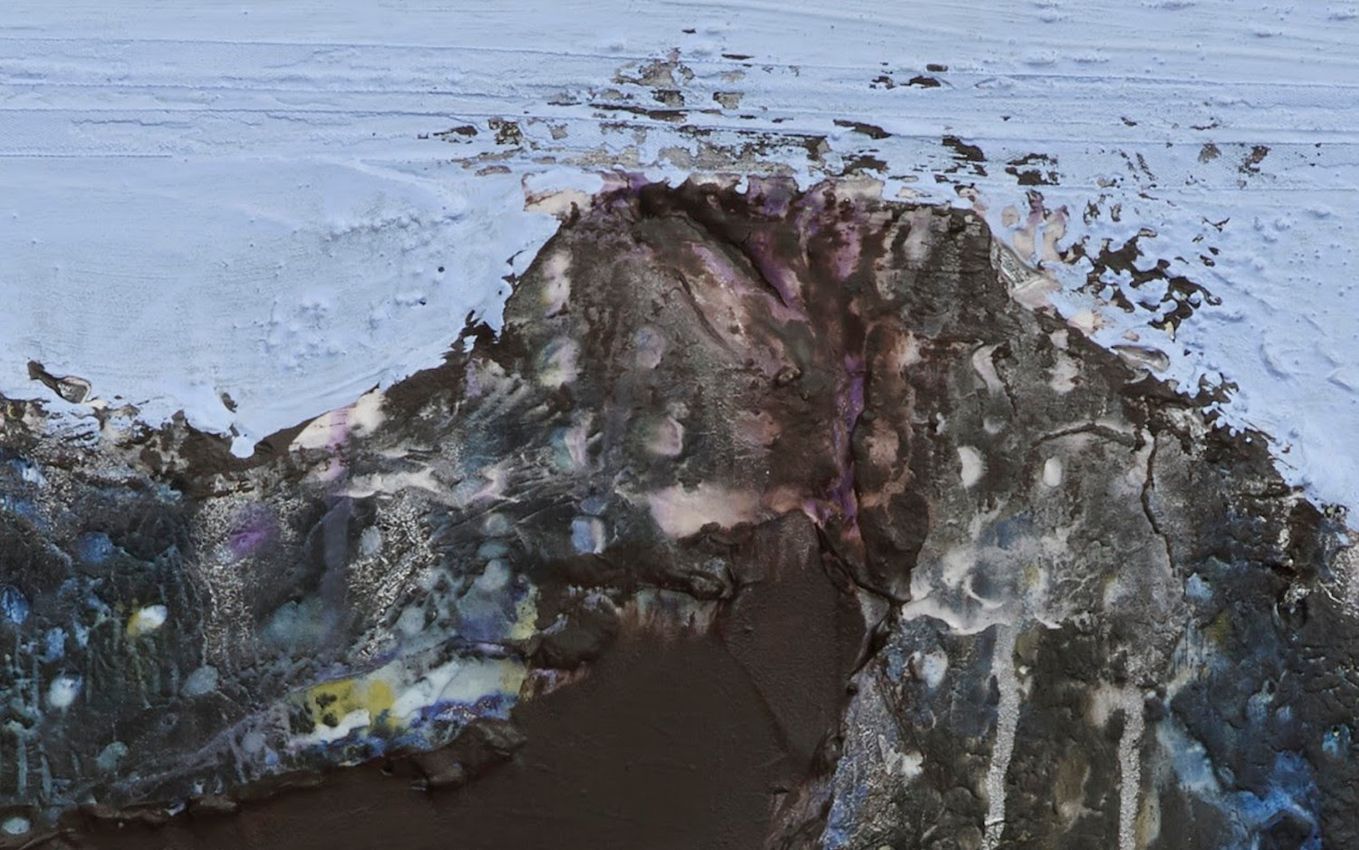
Which brings us to the recent works and their distinctive relief areas of putty-like, perforated epoxy resin adhered to the centre. These forms replicate some weird lump of organic matter straight from surgery, or grabbed from an animal’s mouth—a different kind of trophy (which incidentally, was the original meaning of spolia, from the spoils of war) on which Lindman imparts a nobility conferred through an exterior bracketing of aluminium bars and an interior bracketing with strips of cloth.
He paints around the centre and often drags the brush over the middle, and then paints it again. And again. Lindman has always been a sensual but matter of fact painter; avoiding the flourish; anti-spectacle; but he has begun to utilise gel that changes colour, metallic paints, reflective glass beads and textural pumice. Though the centre area is a fictional rather than a found form, it seems an offspring of his more recent forays of observing, for example, birds and trees. He recently published a book of drawings based on leaf and branch shapes, and his new sculptures converse with both plant structures and animal carcasses.
Lindman’s embrace of the artificial, of beautifying acrylic mediums and fillers, seems meant to both undermine and underline his journey towards the complexity of nature. The variations of iridescence and transparency around what is perhaps meant to be a putrefied fragment of nature submits to an aesthetic of the repulsive, depicting urban detritus like dead pigeons and smashed rats, tempered by a simultaneous state of petrification in paint. There is a further interest here in Lindman’s determination to merge base materialism with the charms of the cosmetic and the incongruous.
Text by Joe Fyfe, painter and writer. Courtesy Almine Rech.
Erik Lindman is by his own admission a painter who is not trying to change things as such. From his writing alone, one can gauge that his is a serious intent, nonetheless to add meaningfully, for his own time and generation, to the complex discourse of abstract painting in terms of its inherent content and subject matter. His earlier paintings reminded this viewer of the more simplified advanced abstractions, executed both as painting and as coloured paper collages, by Ljubov Popova and Olga Rosanova–two of the so-called Amazons of the Russian Avant-Garde. Today, Lindman attempts to achieve in his paintings a personal imagery that in its own way is part reminiscent of the Russian icon tradition. He amazingly succeeds in doing this in spite of the heavy burden of the abstract tradition of the last hundred years.


Almine Rech opened its doors on April 1st, 1997 in the 13th arrondissement in Paris. The gallery was founded on an axis of California Minimal, Perceptual art and Conceptual art, representing artists such as James Turrell, John McCracken and Joseph Kosuth.

A respected voice in contemporary art discourse.
Focusing on ambitious storytelling and insightful art-world commentary. Ocula Magazine publishes in-depth interviews, critical essays and timely analysis on the artists, exhibitions and ideas driving the global art world.
Learn more about Ocula Magazine
Showcasing the best of the art world.
Ocula partners with galleries from around the world to highlight their artists, artworks and exhibitions. Gallery membership is by application and invitation, with each member vetted by an independent panel.
Learn more about Ocula Membership

Specialises in the sale of major artworks.
Led by a team with deep ties to the world’s leading auction houses, galleries and collectors. Ocula’s advisory team offers bespoke services to high-net-worth clients from around the world who are looking to acquire the best of contemporary and modern art.
Learn more about our team and services