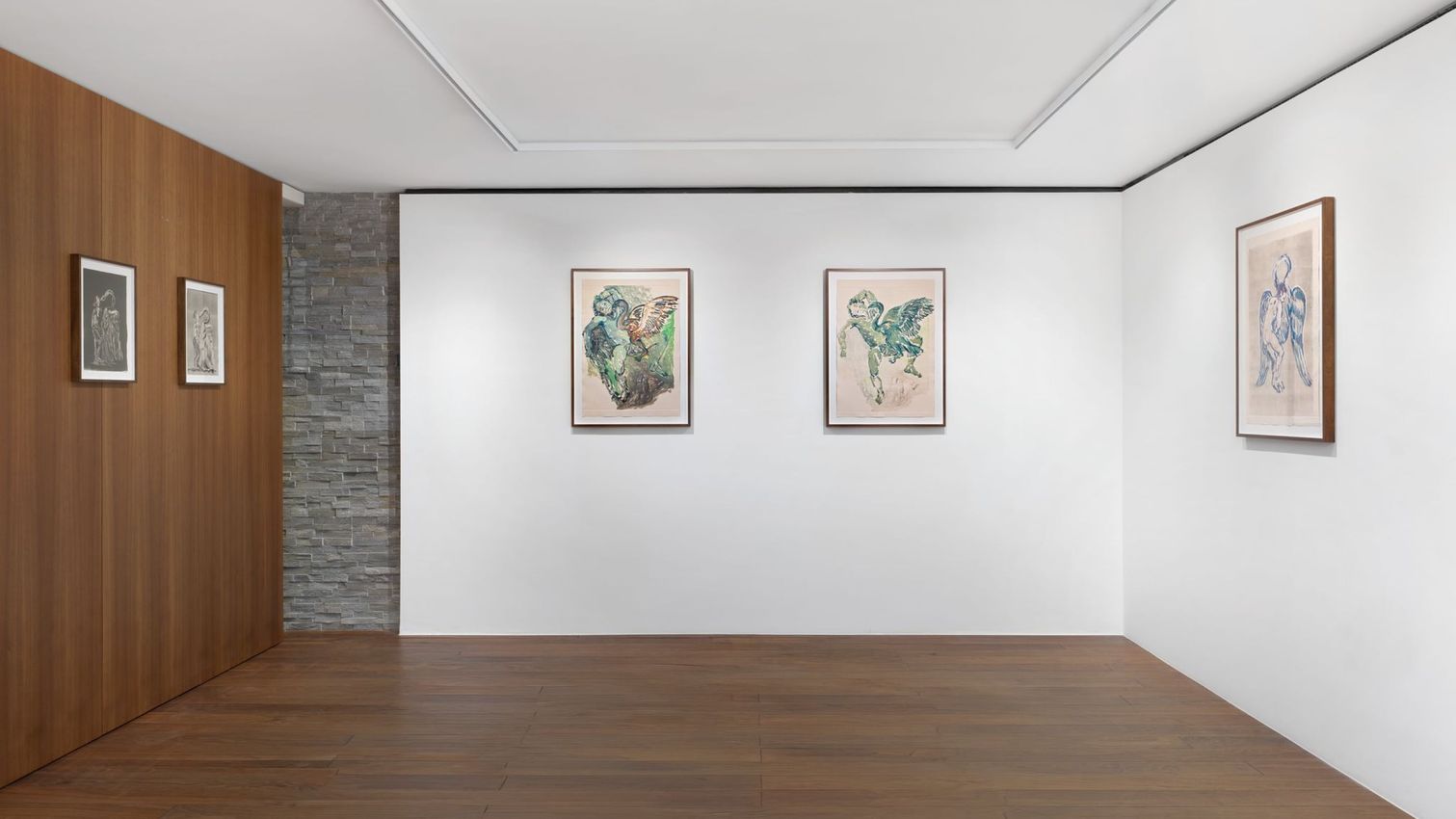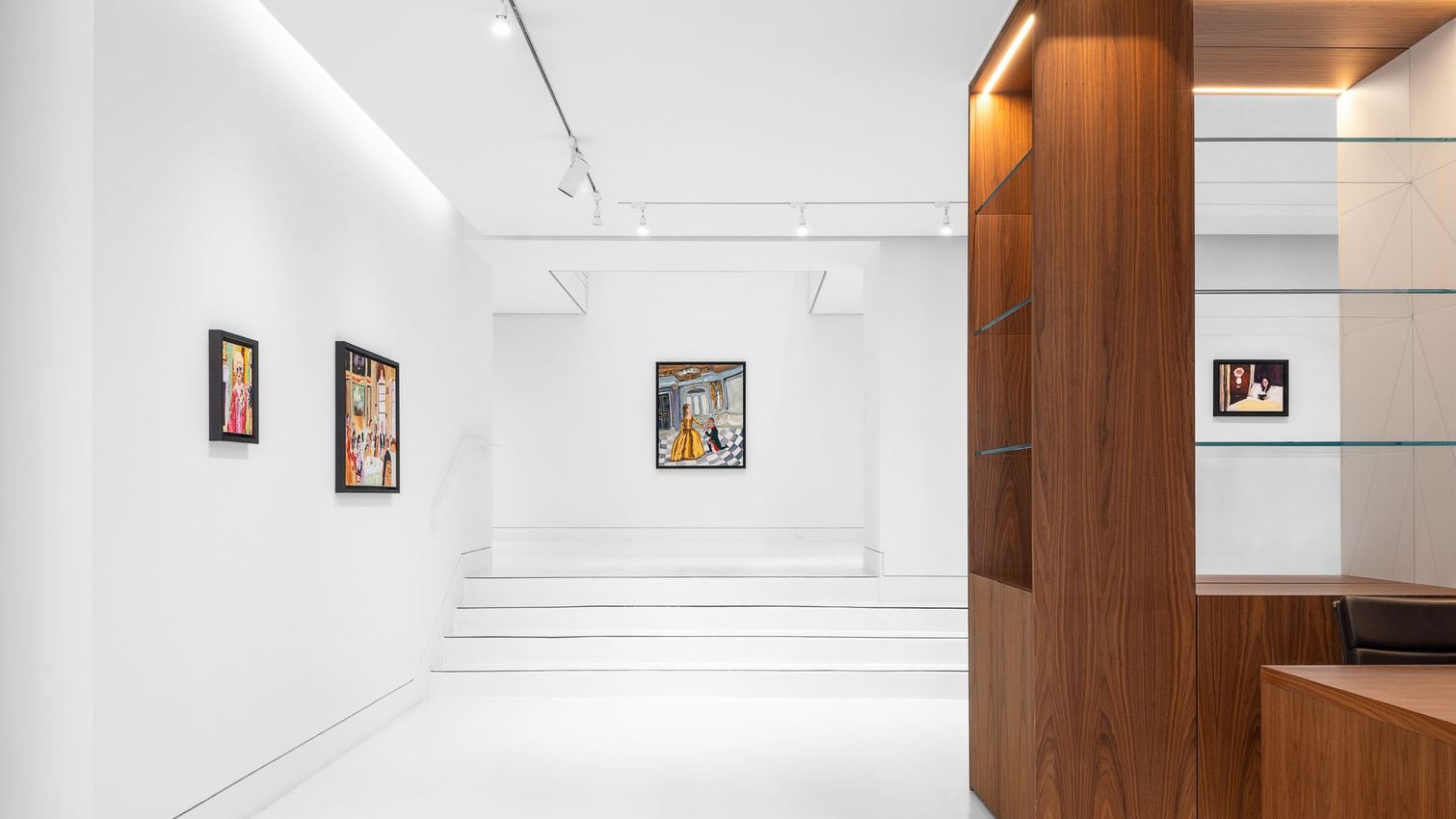
Almine Rech New York, Tribeca is pleased to present Resonance Paintings – Cat Orchestra, Oliver Beer’s second solo exhibition with the gallery, on view from March 14 to April 27, 2024.
Everything sings, and in the beginning, a song was everything: the Word, the Om, a bang that echoes still today. The word you use for it may depend on your belief system. What’s certain, however, is that the universe is a symphony of cosmic vibrations, from the first murmurs of an infant’s heartbeat to the thunderous death of stars. Oliver Beer’s work shows us that if we listen carefully, we can hear them. He’s been listening for as long as he can remember, since the days he would modulate his own voice to match the harmonic pitch of his childhood bedroom. Every room – indeed, every vessel – has such a note, known as a Helmholtz resonance, and for several years the artist, who trained as a musician before studying fine art at the Ruskin School of Art, Oxford, has been trying to tune them.
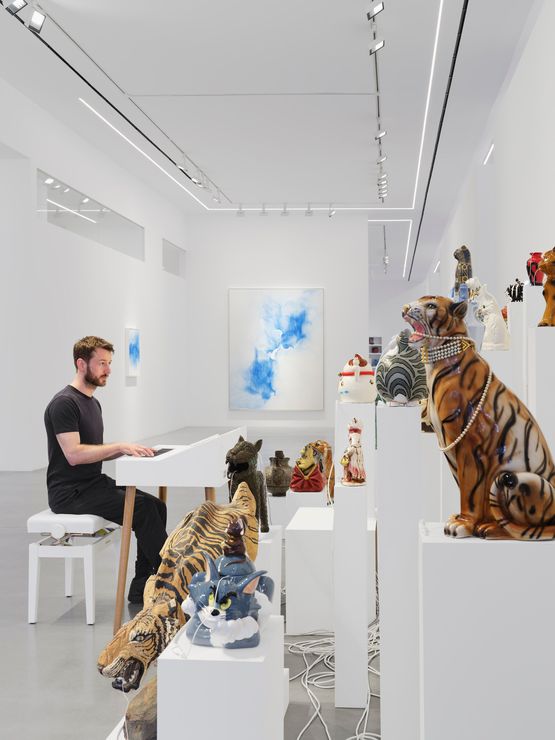
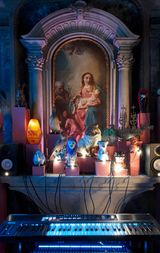
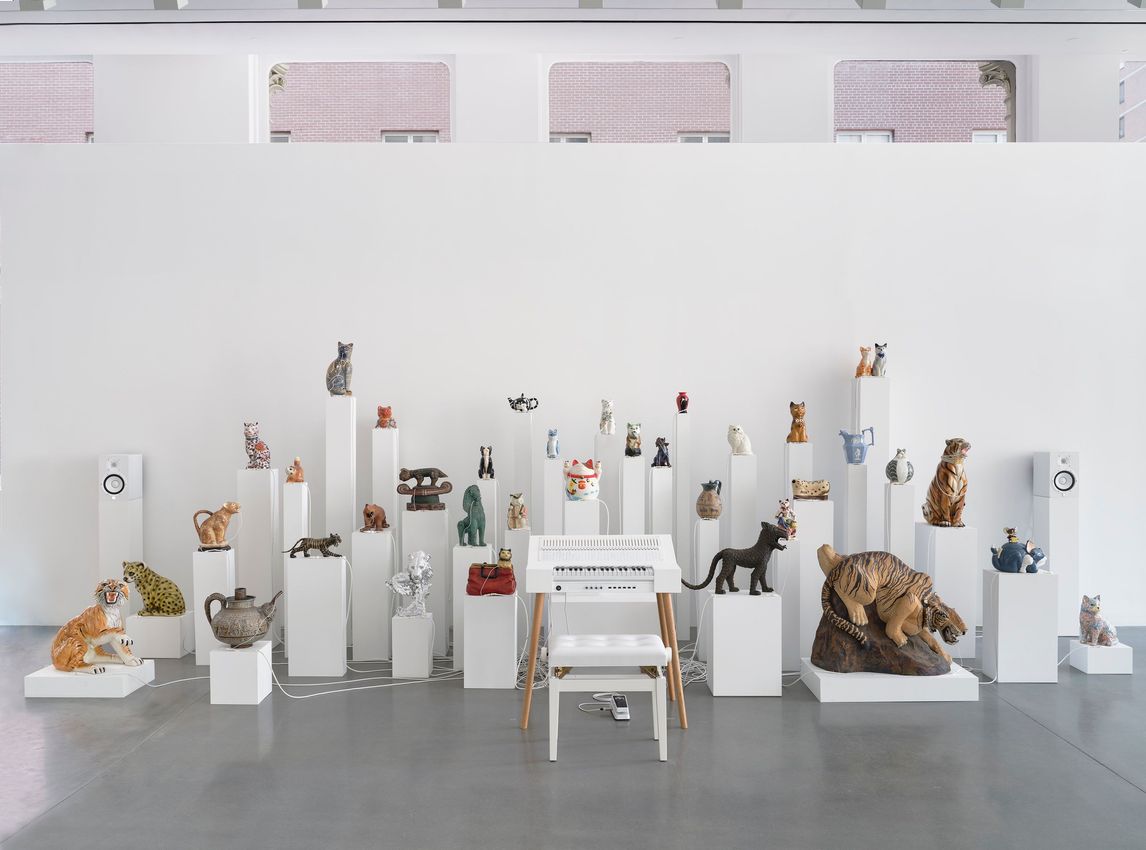
For ‘Cat Orchestra,’ Beer has tuned an entire band. A chorus of cat- shaped vases, ranging from the classical to the kitsch, are connected to live microphones that feed to a custom-built keyboard and synthesiser. Each key, when played, activates the microphone in the vessel whose resonance corresponds to that note, so that a fin-de-siecle French absinthe pitcher in the form of a cat playing a mandolin sings an F sharp, and a Japanese Maneki-neko sings a D. With this, Beer has achieved the dream of Athanasius Kircher, the 17th century occult philosopher who first imagined the cat organ, or ‘Katzenklavier.’ That hypothetical instrument corralled a group of live cats inside a piano, arranged by voice pitch, so that when keys struck their tails, they would cry out in pain. Beer’s real version is far kinder to animals and far more revealing of the sounds we hold within ourselves.
An organ must be played, but orchestras can only be conducted. Beer amplifies the acoustics, but the sounds are already there. ‘Cat Orchestra’ continues an inquiry Beer began at the Metropolitan Museum of Art in 2019, when he used similar engineering to amplify the ambient tones of historical vessels from the museum’s collection. One of the oldest objects that Beer turned his ear to was an Egyptian cosmetic jar in the shape of a cat from the 20th century B.C.E. ‘Everybody’s picking up on that feline beat,’ sings Tom O’Malley in the 1970 Disney classic ‘The Aristocats,’ as he introduces a pack of Parisian strays to the gospel of jazz. The line can be heard scoring Everybody wants to be a cat, a 16mm animation of the same scene from the film, each frame reimagined by schoolchildren at Beer’s invitation. Different hands, different beats, conducted together in delirious harmony.
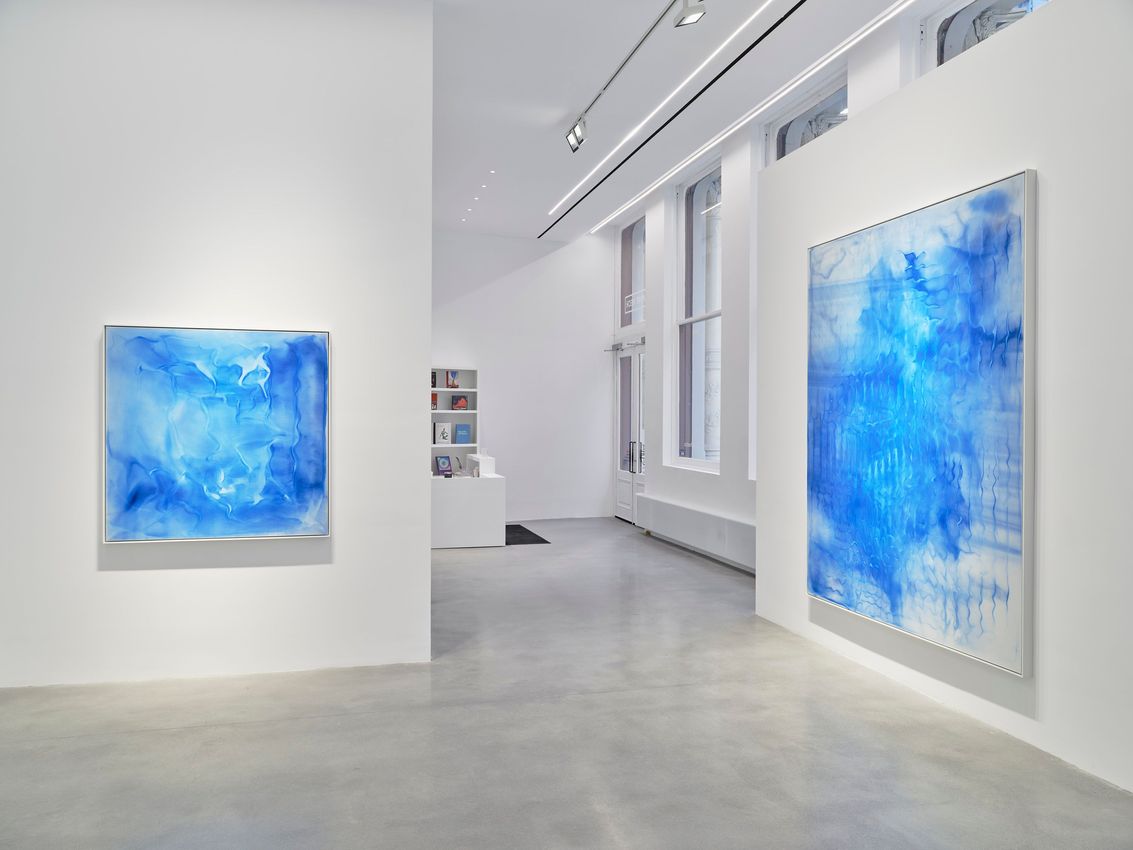
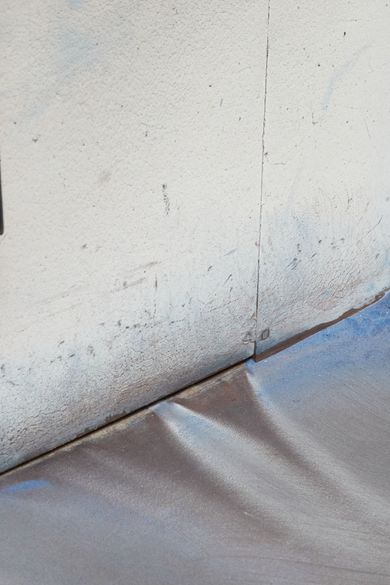
If the otherwise inaudible vibrations within these vessels are difficult tocomprehend, Beer has devised a way for us to see them. He created the ‘Resonance Paintings’ on view in this exhibition by casting powderedpigment onto a canvas laid flat over an amplifier, on which distortions ofthe cats’ voices are played. Their abstract, lyrical forms are made by thecareful manipulation of sound waves and musical harmonies alone. Thesesingular works, perhaps the first in history to be painted by an invisiblehand, are a demonstration of the science of cymatics, discovered in 1680by Robert Hook, a near-contemporary of Kircher’s, who was also first toobserve bacteria beneath a microscope. Their organic symmetriesreinforce our modern understanding of the world as being shaped byunseen forces. Beer can tune canvases, too.
Kirchner was a famed alchemist, and in a way, so is Beer. Both transformcosmic energy into physical matter. Every atom in your body vibrates insynchrony with music, but only the bone in your ear translates it into theelectrical current that reaches your brain. Beer’s work invites both oureyes and our ears to perform the same translation, and in the processcome closer to grasping the ineffable. It’s the principle underlying stringtheory and countless faiths. A feline beat, if you will. According toO’Malley, ‘Everything else is obsolete.’
— Evan Moffit, writer, journalist and critic
Press release courtesy Almine Rech

Oliver Beer (British, born 1985) creates sculptures, installations, videos, and immersive live performances that reveal the hidden properties and musicality of objects, bodies, and architectural sites. His social and familial relationships often become the blueprint for multidisciplinary works that engage with intimate and universal concerns, such as the transmission of musical memories and the personal and cultural meanings invested in the objects we possess. For his Resonance Project (2007‒), vocal performances stimulate the natural harmonics of built structures, creating a disarmingly visceral relationship between the audience and interior space. Beer’s sculptural practice dissects the material world and the traces we leave on it by slicing and reassembling common objects to create new meanings and forms.


A respected voice in contemporary art discourse.
Focusing on ambitious storytelling and insightful art-world commentary. Ocula Magazine publishes in-depth interviews, critical essays and timely analysis on the artists, exhibitions and ideas driving the global art world.
Learn more about Ocula Magazine
Showcasing the best of the art world.
Ocula partners with galleries from around the world to highlight their artists, artworks and exhibitions. Gallery membership is by application and invitation, with each member vetted by an independent panel.
Learn more about Ocula Membership

Specialises in the sale of major artworks.
Led by a team with deep ties to the world’s leading auction houses, galleries and collectors. Ocula’s advisory team offers bespoke services to high-net-worth clients from around the world who are looking to acquire the best of contemporary and modern art.
Learn more about our team and services