



For a long time, I’ve been curious about applying the methodology of art as one way–which I think is equal to science and other powerful explanatory concepts–for us to understand what is surrounding us and what we are.–Carsten Höller
Gagosian is pleased to announce Clocks, an exhibition of new and rarely seen earlier works by Carsten Höller. Occupying the gallery at rue de Castiglione and the exterior-facing vitrine at rue de Ponthieu, the exhibition focuses on how the measurement of time impacts human ways of being.
Höller applies scientific procedures to his work as an artist with playful and sometimes dark humour. Many of the projects that comprise his Laboratory of Doubt–from twisting slides to vision-flipping goggles—incorporate disorienting experiences to be conducted on oneself.
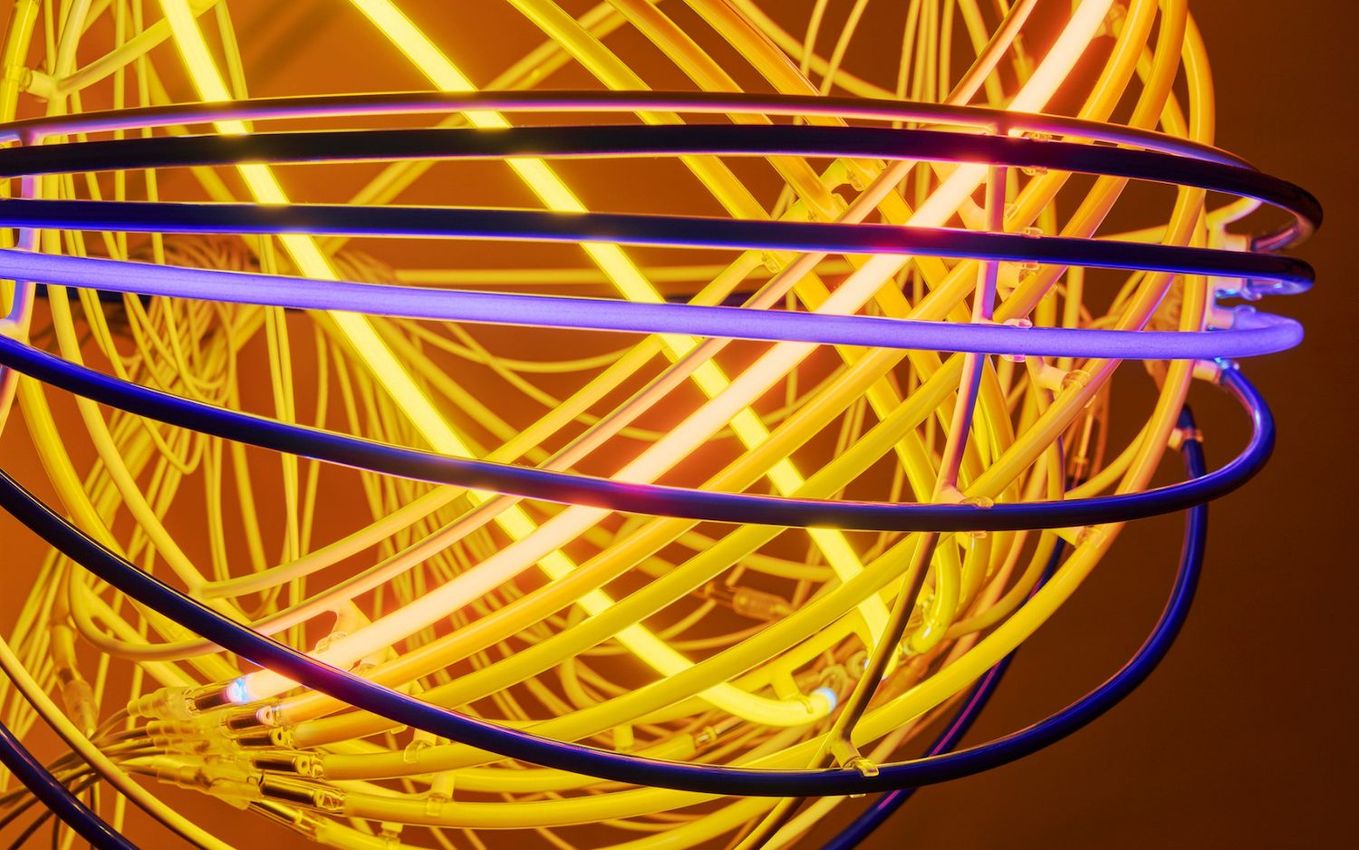
‘I wanted to make the most complicated clock on earth,’ says Höller of _Half Clock _(2021). In this neon sculpture, three encapsulated spheres of curved lighting tubes represent seconds, minutes, and hours. Time is indicated by the division of the surface of each sphere into spatial units, which are themselves divided into consecutively smaller parts. While half of the time is not represented at all–hence the work’s title–the clock’s accuracy increases with each subsequent division of space.
Another neon work, Decimal Clock (2023), also registers time in an unfamiliar manner, applying the decimal system to a numberless illuminated disc composed of twenty blue and orange neon rings, which account for ten decimal ‘hours,’ one hundred decimal ‘minutes,’ and one hundred decimal ‘seconds.’ This calibration reverts to one proposed during the French Revolution, reminding us that the variant to which we are accustomed is a rather clumsy construction.
The darkened glass panels of Black Sliding Window (2023) mark time by opening on the hour, as well as whenever they are approached. Making the behaviour of the viewer its subject, the work also enacts an explicit, active connection between chronology, movement, and space.
On view in the vitrine at the rue de Ponthieu gallery is Giant Triple Mushroom (2023), a two-metre-high sculpture in polychrome aluminium. The work’s form combines enlarged cross-sections of three different species of mushroom, including the red-capped fly agaric, reflecting Höller’s fascination with the idea that this notoriously toxic and hallucinogenic fungus may have played a role in the development of shamanism, and thus constitutes a link to ancient proto-religious culture. The three species also represent evolutionary time, as the different shapes, colours, and psychoactive ingredients of their fruiting bodies most certainly evolved from those of a common ancestor. Finally, Giant Triple Mushroom resonates with Höller’s continued exploration of doubling and rupture, and hence to the division and subdivision of time that is visualised in the clock works.
Carsten Höller applies his training as a scientist to his work as an artist, concentrating particularly on the nature of human relationships. Major installations include Flying Machine (1996), an interactive work in which viewers are strapped into a harness and hoisted through the air; Test Site (2006), a series of giant slides installed in Tate Modern’s Turbine Hall; Amusement Park (2006), a large installation at MASS MoCA of full-sized carnival midway rides operating at dramatically slowed speeds; The Double Club (2008–2009), a work designed to create a dialogue between Congolese and Western culture in the form of a London bar, restaurant, and nightclub; and Upside-Down Goggles (2009–2011), an ongoing participatory experiment with vision distortion through goggles. Höller’s Revolving Hotel Room, an installation that became a fully operational hotel room by night, was featured in the exhibition theanyspacewhatever at the Guggenheim Museum, New York (2008–2009).


A respected voice in contemporary art discourse.
Focusing on ambitious storytelling and insightful art-world commentary. Ocula Magazine publishes in-depth interviews, critical essays and timely analysis on the artists, exhibitions and ideas driving the global art world.
Learn more about Ocula Magazine
Showcasing the best of the art world.
Ocula partners with galleries from around the world to highlight their artists, artworks and exhibitions. Gallery membership is by application and invitation, with each member vetted by an independent panel.
Learn more about Ocula Membership

Specialises in the sale of major artworks.
Led by a team with deep ties to the world’s leading auction houses, galleries and collectors. Ocula’s advisory team offers bespoke services to high-net-worth clients from around the world who are looking to acquire the best of contemporary and modern art.
Learn more about our team and services