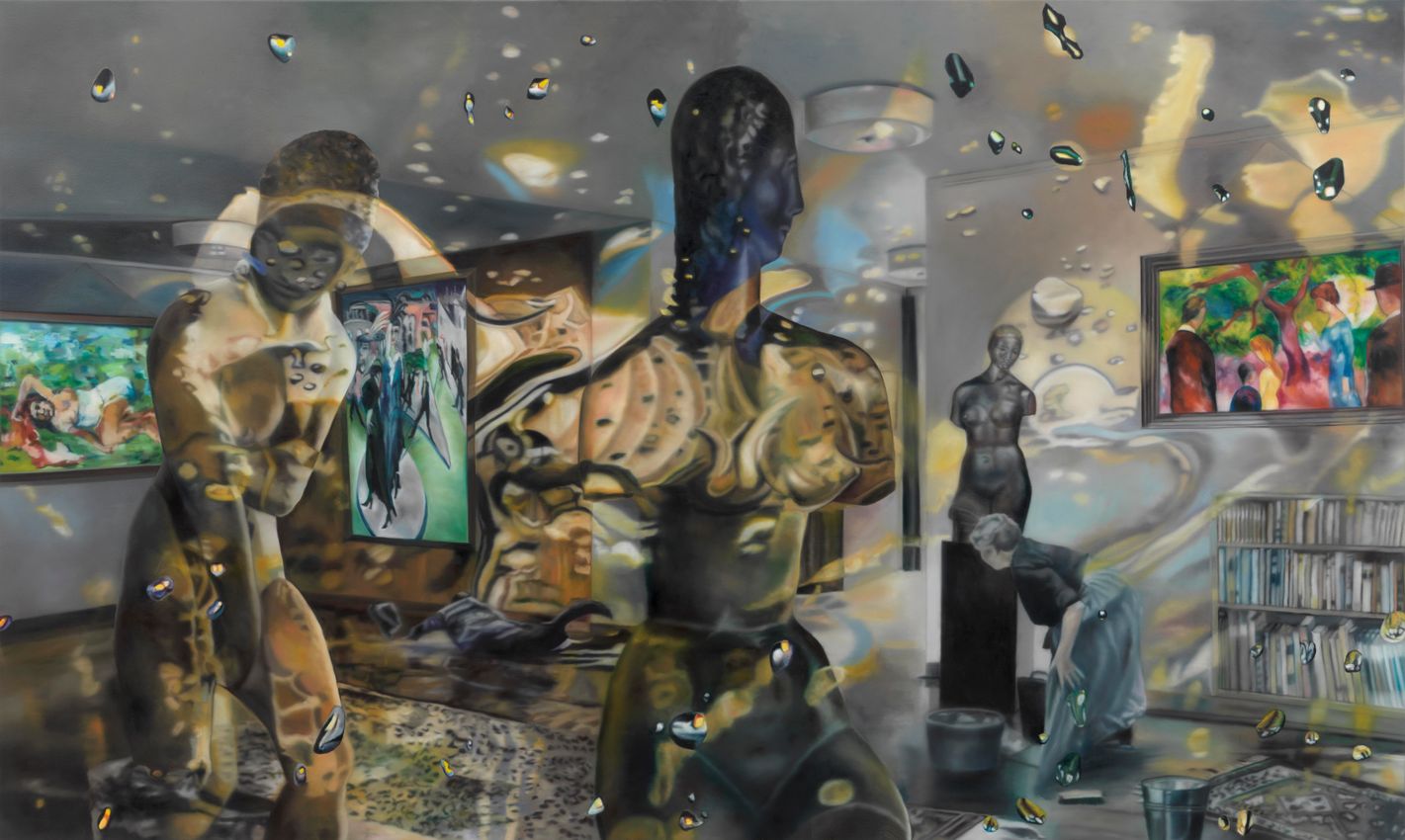
I paint temporalities that are sometimes factual and sometimes imagined, or sometimes about the slip in our own imaginings of what was or was not there, or how it appeared.
— Karin Kneffel
Gagosian Gallery is pleased to present new works by Karin Kneffel. This is her second exhibition with the gallery and her first in Los Angeles.
Kneffel’s lush and eloquent pictures are perfectly constructed impossibilities, where different places and incidents are collapsed together in a seductively realist manner. Although many of her sources actually exist, the resulting images are cunningly wrought scenes inspired by the many lives of art, and which highlight painting’s unique ability to simultaneously uphold and destroy illusions.
In 2009, Kneffel presented an exhibition at the Kunstmuseen Krefeld in Germany, housed in a pair of modernist villas designed by Ludwig Mies van der Rohe and named for their former owners, Hermann Lange and Josef Esters. Intrigued by the process of transformation by which these domestic dwellings became art museums, Kneffel commenced work on a highly evocative series of paintings—which concludes with the current exhibition. In Mies’s buildings and their histories she had found not only potent subject matter but also a conceptual equivalent that allowed her to work through her own concerns as a painter.
In subsequent interrelated bodies of work, Kneffel fused history, anecdote, and artefact into mysterious glimmering palimpsests of time and space. In some, random drops of water depicted on the painting surface contain reflections and visual echoes of disparate details that ultimately develop lives of their own, recalling the use of bubbles and droplets as microcosms in seventeenth-century nature morte painting. In others, words, phrases and doodles, apparently traced with a finger in the condensation on a windowpane, become the means through which the eye glimpses the scene within. This last formal conceit is further intensified in the new paintings where the graffiti takes on an almost spectral presence.
In the current exhibition, Kneffel looks beyond her fascination with Mies’s architecture to examine more closely the artworks that Lange collected—by Ernst Ludwig Kirchner, Wilhelm Lehmbruck, August Macke, Marc Chagall, and other luminaries of the early modern period—and to reflect on taste-making and how art lives in the world through the fallible lens of what we think we perceive and know. This is an artist’s story in pictures about a collector’s house and the art that filled it; the transformation of a private home into a public art museum; and, finally, the many twists and turns in Kneffel’s search to identify, physically track down, and imaginatively reunite, in paint on canvas, key artworks that once lived in Haus Lange, and which are now dispersed into other museum collections throughout Europe. Like the influence of American film noir in earlier bodies of work, one becomes aware of Kneffel’s negotiation with the conditions of contemporary art production—from mediated images in film, photography, and the Internet to painting itself—the most artificial medium of all.
Kneffel’s flawless and highly distinctive painting technique moves between materialisation and dematerialisation, in multi-layered pictorial spaces. On a quadruple-grounded canvas, she applies up to four layers of oil paint with a fine brush. Like veils, each covers the entire surface. Her acute handling of colour, texture, form, and space is resolutely apparent, equal to the visual games and enigmas that pervade Rococo and Mannerist painting, yet firmly rooted, formally and conceptually, within her critical observations as an artist of our time.
Karin Kneffel was born in Marl, Germany and studied at the Staatliche Kunstakademie Düsseldorf between 1981 and 1987. She lives and works in Düsseldorf and is a professor of painting at the Kunstakademie München.
Her work is included in museum collections such as Museum Frieder Burda, Baden-Baden; and Kunstmuseum Bremerhaven in Germany. Recent solo exhibitions include Seduction and Distance, Ulmer Museum, Ulm, Germany (2006); Karin Kneffel: 1990–2010, Kunsthalle Tübingen, Germany (2010); Karin Kneffel: House on the Edge of Town, Museum Haus Esters, Krefeld, Germany (2010); Karin Kneffel. La ventana y el espejo, El Museo de Arte Contemporáneo, A Coruña, Spain (2014–2015); and KARIN KNEFFEL—Fallstudien. Käthe Kollwitz Museum Köln, Germany (2015, travelled to Kunsthalle Bremerhaven and Kunstmuseum Bremerhaven, Germany, in 2015). In 2014 she presented Pavilion, a painting installation in the Barcelona Pavilion, Fundació Mies van der Rohe, Barcelona.


A respected voice in contemporary art discourse.
Focusing on ambitious storytelling and insightful art-world commentary. Ocula Magazine publishes in-depth interviews, critical essays and timely analysis on the artists, exhibitions and ideas driving the global art world.
Learn more about Ocula Magazine
Showcasing the best of the art world.
Ocula partners with galleries from around the world to highlight their artists, artworks and exhibitions. Gallery membership is by application and invitation, with each member vetted by an independent panel.
Learn more about Ocula Membership

Specialises in the sale of major artworks.
Led by a team with deep ties to the world’s leading auction houses, galleries and collectors. Ocula’s advisory team offers bespoke services to high-net-worth clients from around the world who are looking to acquire the best of contemporary and modern art.
Learn more about our team and services