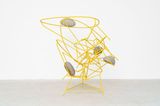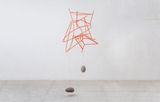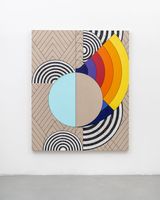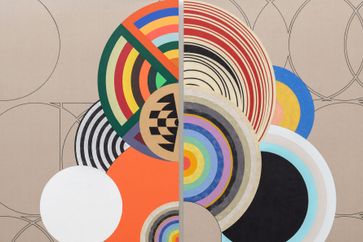
Nara Roesler is pleased to present A pirate, a poet, a pawn and a king, the first solo exhibition by Mexican artist Jose Dávila (Guadalajara, 1974) in Brazil. Marking the beginning of the gallery’s representation of the artist, the show brings together recent works by Dávila, with around 20 pieces, including installations, sculptures, paintings, and drawings. Accompanied by a text by Julieta González, the exhibition reveals intrinsic aspects of the artist’s practice, marked by an approach to language and the sculptural tradition from a perspective centered on the articulation between the ‘constructive will’ and the physical principles that govern nature.
The title of the exhibition alludes to the idea of transformation and mutation present in Dávila’s work and refers to the way he deals with materials, based on a poetic approach to the Frank Sinatra song ‘That’s Life’. According to Dávila: ‘A person can be a pirate, then a poet, also a pawn and end up being a king... the same person. [...] I’m very interested in the notion that all things evolve and transmute over time: us as people, things as objects and materials, symbolic meaning. This constant evolution is fertile ground for new meanings to emerge, for changes to be accepted and for new beginnings to take place. This is an essential quality and characteristic of the nature of art, the capacity for transformation.’
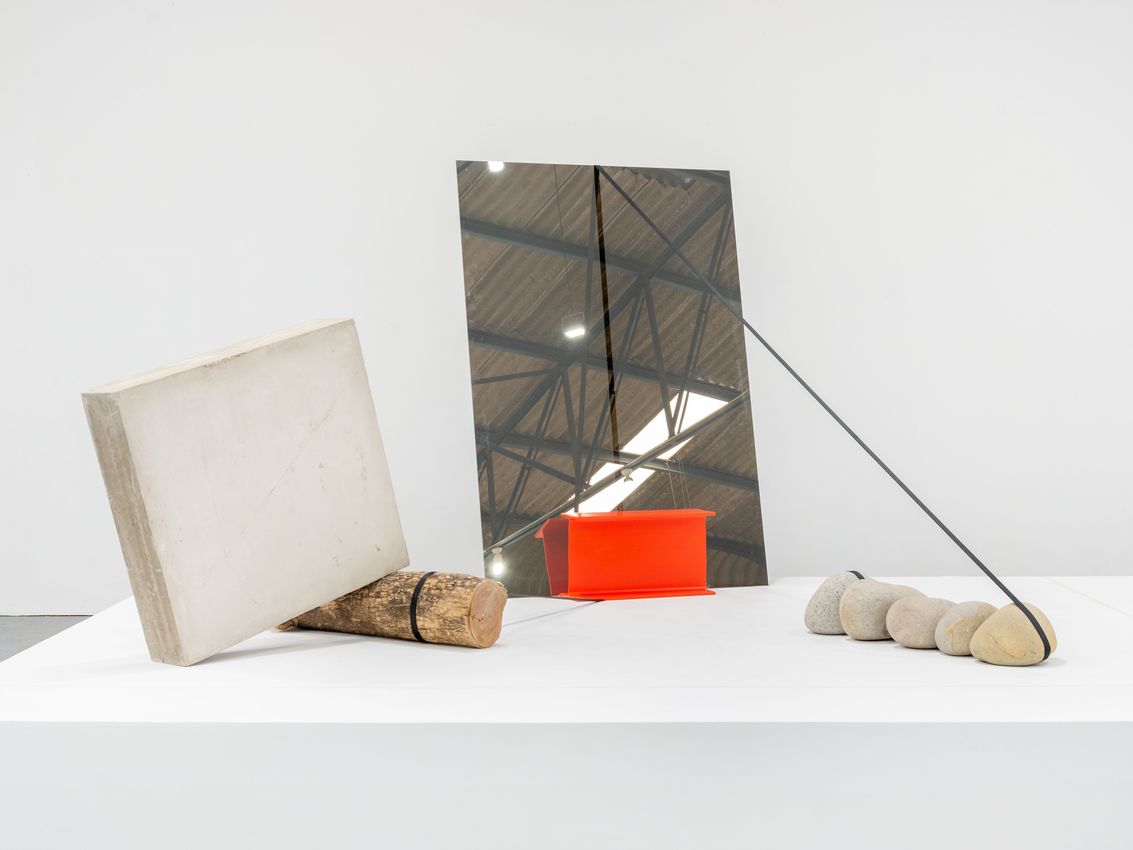
Although the central element of his poetics is the field of sculpture, he is not interested in the stability, or often ‘solid,’ character of this type of language; his attention is much more directed towards impermanence and instability. ‘The way I approach materials, why I choose them and how I use them afterwards, is related to these concepts, summarized in the title of the exhibition, from a poetic approach,’ the artist adds. This can be seen in works such as Joint Effort (2015), in which Dávila, using a ratchet handle, joins two unilateral mirrors at an oblique angle. The material responsible for pulling the handle down and preventing the mirrors from falling is a set of stones. In this way, the artist creates a composition using completely different and even opposing materials, which gives it a latent sense of fragility and imminent collapse. The effort put into each part, however, is what holds the elements together. A similar principle occurs in the work Trophic Chain (2023), whose title refers to the process of transferring matter and energy within an ecosystem. In this ensemble, a mirror stands obliquely and imposingly at the expense of a concrete block and a set of stones.
Dávila’s keen eye for space and the analysis of physical forces such as mass, balance, and materiality are constantly present in his work. The elements of his poetics are explored through the most diverse media and languages, working with sculpture and installation, in which he uses rigid materials such as stones, glass, and concrete, to flexible materials such as wire, cardboard, ribbons, and straps, to pictorial elements. A recurring procedure in his work is the re-readings he makes of the productions of well-known figures in art history, such as Donald Judd and Roy Lichtenstein. The exhibition includes works from the Homage to Square series, in which Dávila transforms Josef Albers’ eponymous series of paintings into kinetic mobiles.
Painting also enters the artist’s poetic radar, equally based on the search for impermanent or tense situations. In the series The fact of constantly returning to the same point or situation, Dávila creates a set of circles with different colors and consistencies. Almost always incomplete, or framed in such a way that they cannot be seen as a whole, they end up provoking sensations of incompleteness and disorientation in the viewer. Orden Discontinuo, a series of prints made on different types of paper, brings similar compositions and evokes similar sensations, but also incorporates the qualities of the supports in which they are inserted, such as folds/tears and textures.
For more than two decades, Jose Dávila (b. 1974, Guadalajara, México) has been working in the sculptural field, creating works that bring together materials in precarious compositions. By studying and understanding how gravitational energy works, the artist plays with balance. That is one of his most important compositional methods, as well as seriality and stacking, which he employs to create not only visual but physical tensions. The apparent instability of his pieces claims the public’s attention, demanding a deep perception of space and spatiality. Dávila challenges the viewer to face the elements and construction of the work from different perspectives, observing how they are capable of making rawness and fragility coexist, as well as organic and artificial form, system and chaos, danger, and peace.


Founded in São Paulo in 1989, Galeria Nara Roesler is a leading Brazilian gallery dedicated to showing the work of contemporary Brazilian and international artists. The gallery established another branch in Rio de Janeiro in 2014, followed by its first international outpost in New York City in 2015.

A respected voice in contemporary art discourse.
Focusing on ambitious storytelling and insightful art-world commentary. Ocula Magazine publishes in-depth interviews, critical essays and timely analysis on the artists, exhibitions and ideas driving the global art world.
Learn more about Ocula Magazine
Showcasing the best of the art world.
Ocula partners with galleries from around the world to highlight their artists, artworks and exhibitions. Gallery membership is by application and invitation, with each member vetted by an independent panel.
Learn more about Ocula Membership

Specialises in the sale of major artworks.
Led by a team with deep ties to the world’s leading auction houses, galleries and collectors. Ocula’s advisory team offers bespoke services to high-net-worth clients from around the world who are looking to acquire the best of contemporary and modern art.
Learn more about our team and services