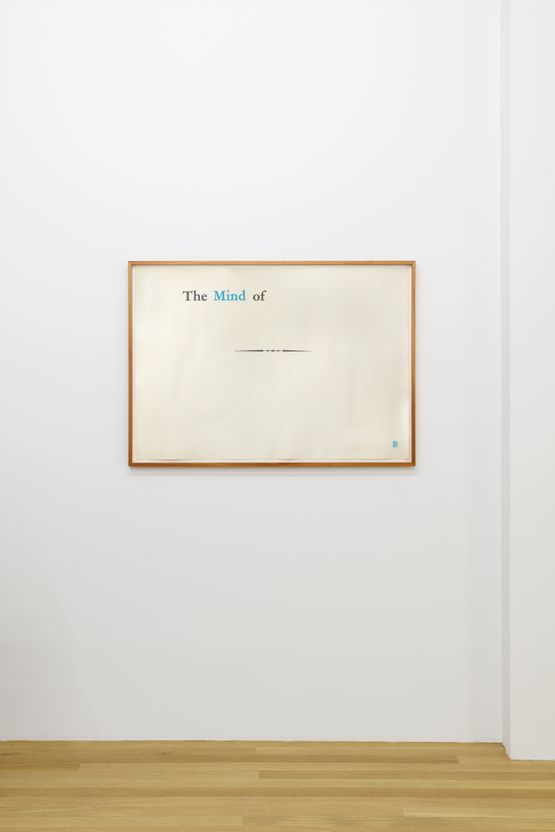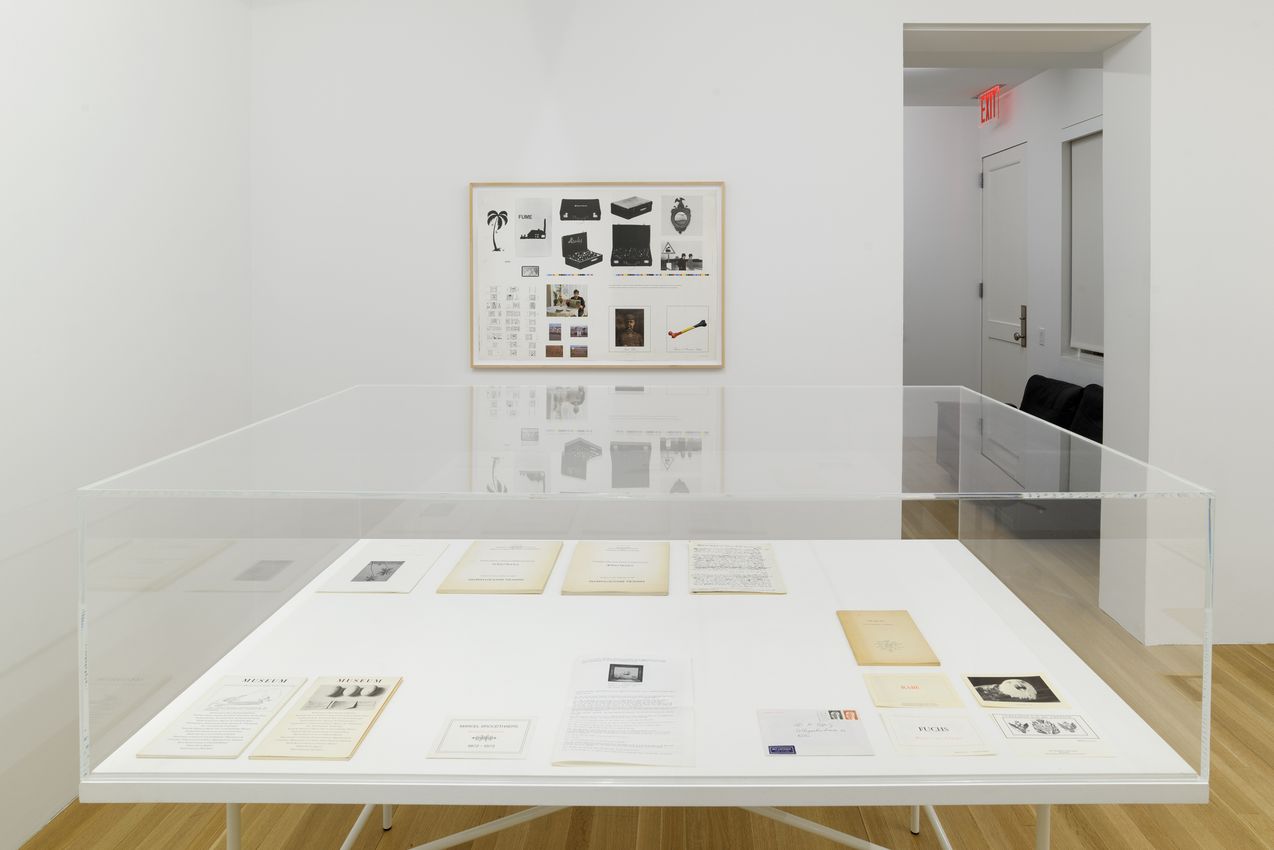
Michael Oppitz met Marcel Broodthaers at Broodthaers’ exhibition Der Adler vom Oligozän bis heute (The Eagle from the Oligocene to the Present) at the Kunsthalle Düsseldorf in 1972. As the first presentation of his museum fiction in the Rhineland, Broodthaers’ exhibition exercised considerable influence on the art scene in the area. Impressed by the Belgian artist’s work, the young ethnographer left a note of appreciation in the guest book. Broodthaers then contacted Oppitz on the basis of this note and asked him to write a text – Adler Pfeife Urinoir (Eagle Pipe Urinal) – for the second volume of the catalogue.
This marked the beginning of a friendship defined by mutual respect which lasted until Broodthaers’ death in 1976. When he attended the opening at the Kunsthalle Düsseldorf, Oppitz was accompanied by his friend Benjamin H. D. Buchloh, with whom he was living at the time. Buchloh worked at Galerie Rudolf Zwirner in Cologne and organised an exhibition there with Broodthaers in 1973. This exhibition, Peintures Littéraires. 1972-1973 (Literary Paintings. 1972-1973), included an interview between Broodthaers, Buchloh, and Oppitz as a press text.
Another friend during these years was the artist Lothar Baumgarten, who shared Oppitz’s interest in ethnography. In 1974, Oppitz and Baumgarten held a collaborative exhibition with Konrad Fischer in Düsseldorf. This exhibition was conceived as an addendum to Broodthaers’ Der Adler vom Oligozän bis heute; their aim was to extend the critical principles of Broodthaers’ museum fiction to the iconography of the eagle in American Indian mythologies. In a nod to the bird motif, Baumgarten and Oppitz called the exhibition Rabe (Raven).
On the occasion of this exhibition, Broodthaers made a friendly jab at his young colleagues by himself producing a card as an answer to their invitation. In reference to Jean de la Fontaine’s fable ‘Le Corbeau et le Renard’ (The Crow and the Fox), he printed the German word ‘Fuchs’ (Fox) on the front of the card, mimicking the layout of the invitation for Rabe. Underneath is the statement: ‘Mais qui mangera le fromage?’ (But who gets the cheese?), a nod to the fact that Baumgarten and Oppitz’s exhibition was held at a commercial gallery and their work was for sale.
Oppitz’s last collaboration with Broodthaers was a contribution to the catalogue for his exhibition at the Palais des Beaux-Arts in Brussels in 1974. For this publication, Catalogue-Catalogus, Oppitz wrote the text Rubens und der Wintergarten (Rubens and the Winter Garden).


Michael Oppitz was born in 1942 near Schneekoppe on the Czech-Polish border (Silesia). He grew up in Cologne and studied in Berkeley, Bonn, and Cologne; he earned his PhD in 1974 with a book on the history of structural anthropology, followed by a habilitation on cross-cousin marriage in 1986. He held visiting professorships in England, France, the United States, and was professor of anthropology at the University of Zurich and director of the Ethnographic Museum, Zurich, from 1991 until 2008, when he retired. He conducted fieldwork in the Himalayas among the Sherpa (1965), the Magar (1977–1984), the Naxi of Yunnan (1995–1996), and the Qiang of Sichuan (2000–2001). Studies on kinship, mythology, ritual, shamanism, visual anthropology, and material culture were released by various publishers; his most recent book, Morphologie der Schamanentrommel, came out in 2013. He is currently working on a study on the myth of lost writing.


Galerie Buchholz is an art gallery specializing in international contemporary art, with exhibition spaces in Cologne, Berlin and New York City. The gallery was founded in Cologne in 1986 by Daniel Buchholz, and today is run jointly with Christopher Müller.

A respected voice in contemporary art discourse.
Focusing on ambitious storytelling and insightful art-world commentary. Ocula Magazine publishes in-depth interviews, critical essays and timely analysis on the artists, exhibitions and ideas driving the global art world.
Learn more about Ocula Magazine
Showcasing the best of the art world.
Ocula partners with galleries from around the world to highlight their artists, artworks and exhibitions. Gallery membership is by application and invitation, with each member vetted by an independent panel.
Learn more about Ocula Membership

Specialises in the sale of major artworks.
Led by a team with deep ties to the world’s leading auction houses, galleries and collectors. Ocula’s advisory team offers bespoke services to high-net-worth clients from around the world who are looking to acquire the best of contemporary and modern art.
Learn more about our team and services