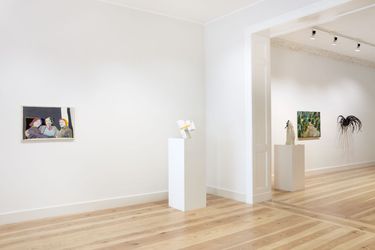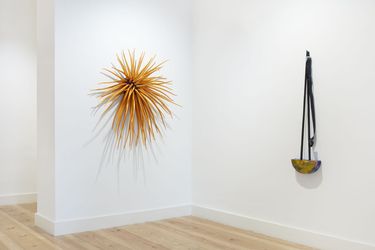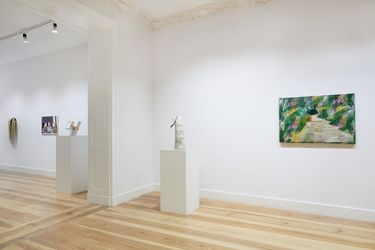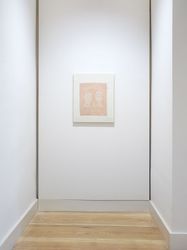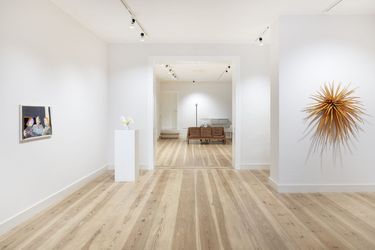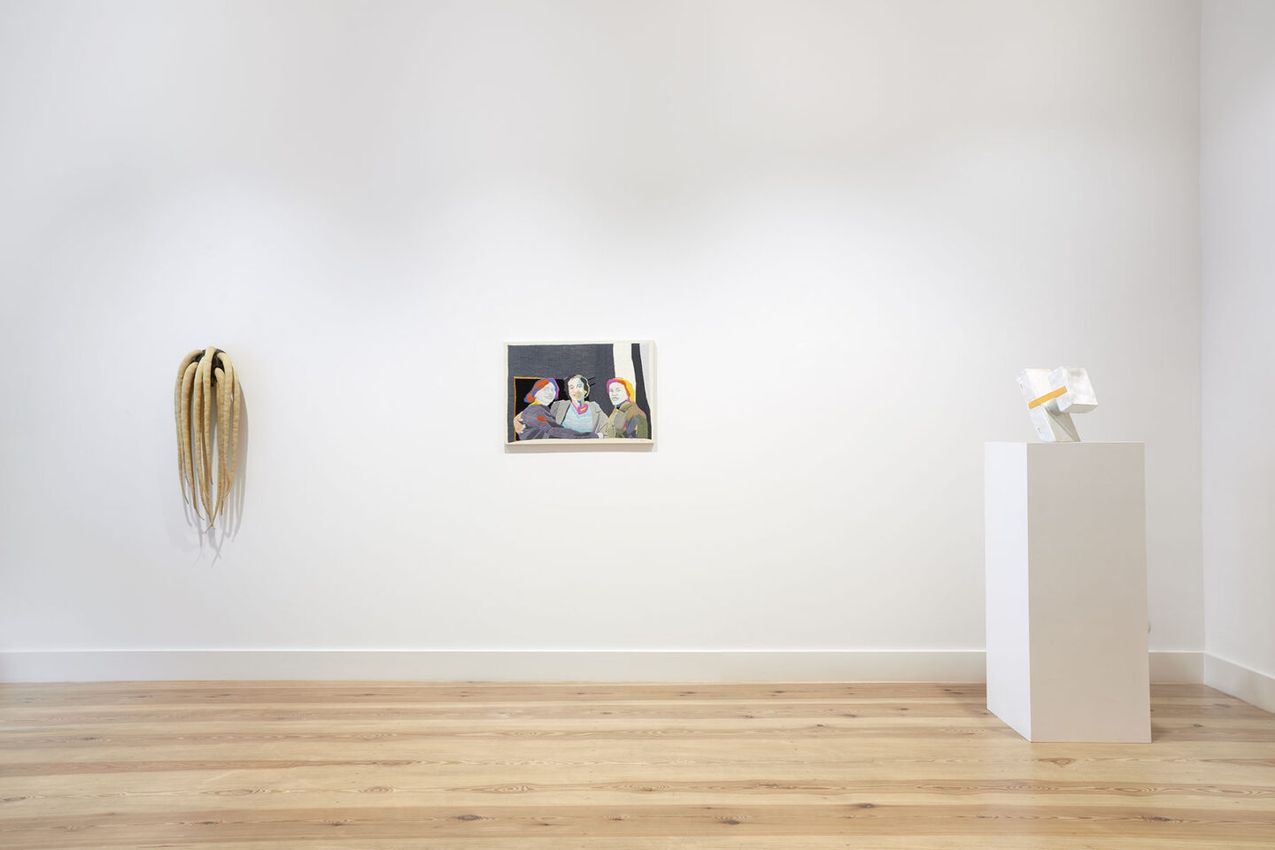
It is the business of humans to question limits. They are expanded, shifted, and transgressed. Limits make us discontent. Therefore, it is also the business of artists to expand and transgress the limits of their own medium. In the works shown, the artists Carlos Arias, Frank Mädler, and Grit Schwerdtfeger expand limits by working with textiles and ceramics.
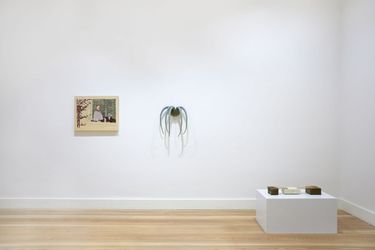
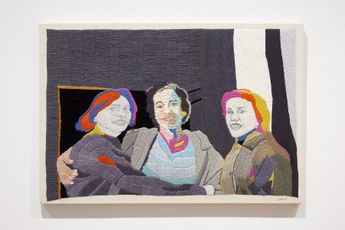
Carlos Arias uses the intimacy of needlework for the artistic translation of old, found family photographs. Usually, he paints with a brush and paint, but for this work he put those aside and uses needle and thread instead. With great patience, he embroiders a face or body and carefully traces its emergence. Carlos Arias lives in Mexico, a culture where embroidery is highly valued. It is an art practiced mainly by women and queer men who received social recognition through this work. They designed and executed the elaborate embroideries of the indigenous population. By embroidering these images, Carlos Arias questions preconceived notions about gender-specific work.
During the time of the lockdown, Grit Schwerdtfeger gave up her work as a photographer for a while, and exchanged the camera for a sewing machine. Using colourful textiles, she created tubes of various lengths that she stuffed with filling material and put into supports made of ceramic. Are these tentacles or succulents? The teeth of a walrus or hair? In their supports, they can be interpreted in a variety of ways: they might be plants, bodies, or even extraterrestrial, celestial bodies.
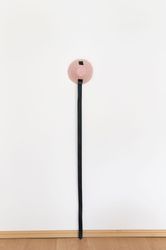
From the outset, the artist Frank Mädler saw photography not as a form of documentation, but as a means for artistic expression. For him, the step into another medium means an expansion of artistic possibilities. Independent of any ceramic tradition, he has created objects that are partly linked to his photographic works by realising elements sculpturally that he had already developed in his photographs, but some sculptures have no model at all. One innovation are the straps and buckles that he adds. As a colourful addition to the glazed objects, they have numerous functions. They can be used to hang the objects up, to tie them, and sometimes they simply serve as a graphic line.
Carlos Arias Vicuña (born in 1964 in Santiago) studied art at the Universidad de Chile. He lives in Mexico, where he has taught painting at the Universidad de los Americas in Puebla since 1988. He has had numerous solo and group exhibitions, including at the First Liverpool Biennale, ARS 01 Kiasma, Helsinki, the San Diego Museum of Art, USA, und Museum Beelden an Zee in The Hague, Neomexicanismos, MAM, Mexico City, UDLAP Puebla, Mexico, and the Museo de Artes Visuales Santiago, Chile. His works can be found in renowned public and private collections.
Grit Schwerdtfeger (born in 1971 in Anklam) lives in Leipzig, where she studied photography at the Hochschule für Grafik und Buchkunst. Grit Schwerdtfeger has received numerous prizes, including a DAAD fellowship for Cuba and studies at the Faculty for Fine Arts in Madrid. Her works can be found in private as well as public collections, in Dresden in the Staatliche Kunstsammlungen and the Kupferstichkabinett, the collection of the Lentos Kunstmuseum Linz, as well as in collections in England, France, Austria, Belgium, Germany, and Canada. She is a member of the photographers’ collective Lux. From 2012 to 2022, she taught photography at Ostkreuzschule in Berlin.
Frank Mädler (born in 1963 in Torgelow) studied photography at the Hochschule für Grafik und Buchkunst Leipzig, the Universidad Complutense de Madrid, and the Universidad Castilla-La Mancha, Cuenca. Today he lives in Leipzig. He has received numerous awards, including the Villa Massima Fellowship in Rome, a scholarship from the Cultural Foundation of the Free State of Saxony, and the residency Al Lado in Lima, Peru. His works are in numerous public and private collections, including the American Bank Collection, the Fondation Antoine de Galbert Paris, the Art Gallery of Ontario, Canada, the Kupferstichkabinett Dresden, the Altana Kunstsammlung, the collection of Deutsche Telekom, as well as Staatliche Kunstsammlungen Dresden.


Established by Susanne Albrecht in 1986 off the heels of her studies in philosophy, art history, and Italian philology at Freie Universität Berlin and Ludwig-Maximilians-Universität München, Galerie Albrecht represents young European and Asian artists as well as influential established European and American post-War and contemporary artists.

A respected voice in contemporary art discourse.
Focusing on ambitious storytelling and insightful art-world commentary. Ocula Magazine publishes in-depth interviews, critical essays and timely analysis on the artists, exhibitions and ideas driving the global art world.
Learn more about Ocula Magazine
Showcasing the best of the art world.
Ocula partners with galleries from around the world to highlight their artists, artworks and exhibitions. Gallery membership is by application and invitation, with each member vetted by an independent panel.
Learn more about Ocula Membership

Specialises in the sale of major artworks.
Led by a team with deep ties to the world’s leading auction houses, galleries and collectors. Ocula’s advisory team offers bespoke services to high-net-worth clients from around the world who are looking to acquire the best of contemporary and modern art.
Learn more about our team and services