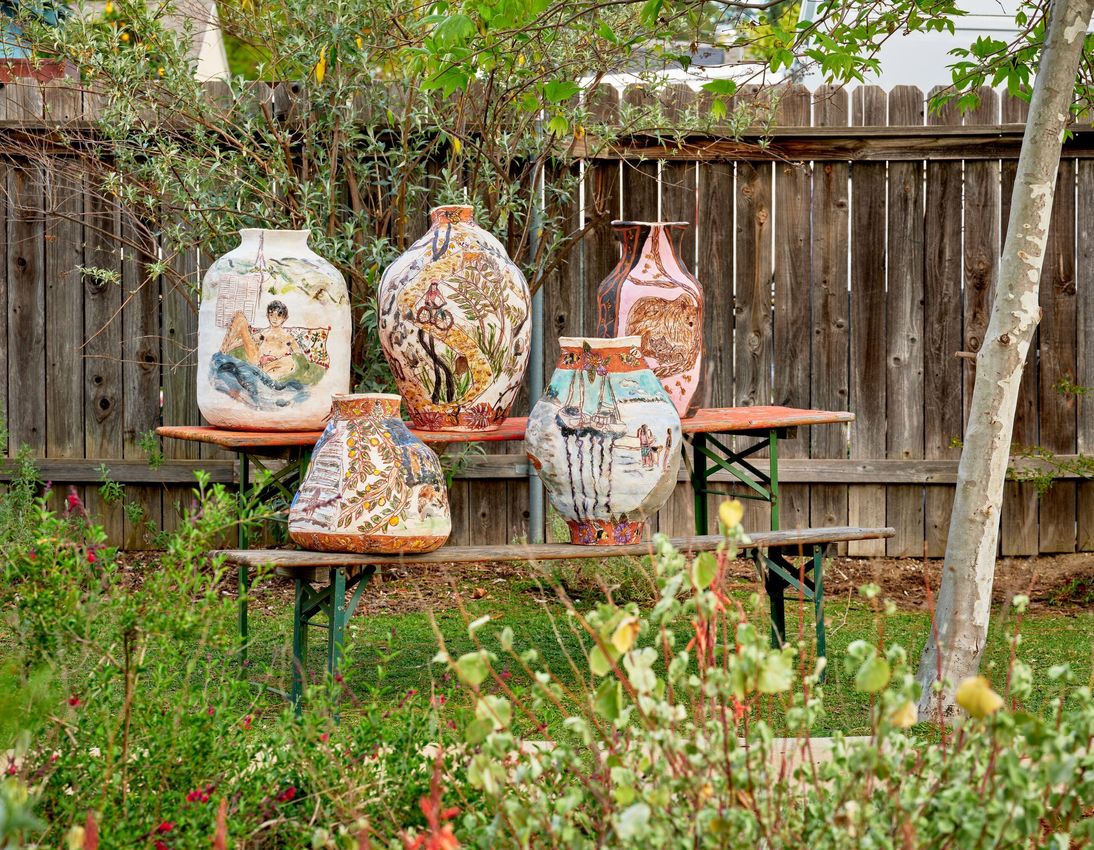
Los Angeles-based painter Jennifer Rochlin embarked upon a shift toward three-dimensionality sixteen years ago when an unexpected teaching opportunity brought her into close contact with clay for the first time. Enchanted by its tactility and unpredictability, she discovered in the material a new channel for expression. Rochlin’s now-celebrated voluptuous clay vessels dominate the artist’s practice as canvases for her memories, idealised visions and the unfiltered biographical narratives she unspools over their undulating forms with palpable libidinal force. In her painted and glazed scenes, family, friends and partners are intertwined with trees and leaves that signify the passage of time through changing seasons. Wistfulness transitions seamlessly into humor or fades into unabashed adoration of nature’s enveloping beauty. Fluctuating between idealised depictions and unembellished honesty, Rochlin’s imagery conveys a tender and genuine sense of longing.
Beginning 2 May, Hauser & Wirth New York will present Rochlin’s most recent series of large-scale hand-built terra cotta vessels on which she offers up an autobiographical journey—intimate scenes of her life and loves, of nature observed and of her own responses to the greats of art history. ‘Jennifer Rochlin. Paintings on Clay’ will remain on view on the second floor of the gallery’s 22nd Street building through 12 July.
Rochlin’s three-dimensional compositions coalesce largely without planning. While sketched in advance, the shapes of her vessels ultimately depart from classical form and symmetry through a laborious hand-building process that permits—indeed, encourages—distortion. Bodily, eccentric and imposing, the vessels’ commanding physicality prompts viewers to trace their curves and walk around them to follow the sequence of vignettes that travel their circumferences.
Influenced by a background in experimental filmmaking, Rochlin’s paintings on clay have a distinct sense of movement and progression. She weaves together brief scenes with decorative patterns and natural elements, crafting cinematic montages in the round. ‘Trans-Siberian Railway’ (2023), for example, encapsulates a moment Rochlin captured on Super 8 film during her early travels along the Trans-Siberian Railroad in Russia. Steadying her camera on a man loitering by the tracks, she immortalized the instant he plucked purple irises from the ground and offered them to a woman leaning out of a passing train window. But in transferring this filmed story to a vessel, Rochlin has painted herself as the woman in the window, assuming the dual role of voyeur and protagonist. The train and its succession of windows ascend in a spiral reminiscent of a flickering film reel. Rochlin’s inclination toward romance is most evident here; always enlisting others, it serves as a driving force that propels her art forward.
Rochlin likewise draws on her experiences in different parts of the world by incorporating tapestries and carpets encountered during her travels. Geometric patterns and decorative borders appear on such works as ‘Green Tapestry with Poppies and Bites’ (2024), in which rich green and chartreuse hues and delicate etched ornamentation travel along the wide curves of a bulbous form accented by three orange blossoms and three human bite marks.
In 2018, Rochlin developed the unique method of biting into unfired clay and inviting others to participate in this form of mark making. The resulting imprints, often embellished with touches of purple and gold, resemble both bruises and blossoms. These bites, which appear on multiple vessels on view, indicate a chorus of willing collaborators and reflect Rochlin’s ongoing interest in seeking means to express erotic desire in gesture as well as image.
This collaborative impulse continues in other works, too, such as ‘Honey Pot’ (2024), where more than twenty fellow female Los Angeles artists have intricately etched genitalia onto an imposing clay vessel, or in Rochlin’s loving visual quotations paying homage to Matisse and Giacometti. Whether through direct or indirect engagement, collaboration with other artists—both living and deceased—pervades her practice. Thus, Rochlin firmly asserts that she is not solitary in her pursuits but instead a member and beneficiary of a community formed across time.
‘Jennifer Rochlin. Paintings on Clay’ will include small recent paintings by the artist, each corresponding to a s pecific vessel on view. Rochlin often makes such paintings of her pots, placing them in the landscape surrounding her house and studio to work plein air, rendering the very plants and colors that envelop the vessels’ surfaces. Since Rochlin does not create preparatory sketches for the figural narratives on her pots—she instead makes images spontaneously and intuitively in response to their forms—her vessels become veritable pages of a sketchbook, studies for paintings in a constant circuit of storytelling.
Press release courtesy Hauser & Wirth
Born in 1968, Jennifer Rochlin grew up in Baltimore, Maryland and is currently based in Los Angeles, California. She received her MFA in painting from the School of the Art Institute of Chicago in 1999. Inspired by a ceramic program that she was developing at a local school, she started experimenting with transposing her imagery from the canvas to the clay. Gradually Rochlin became more interested in the way that sculptures could work with narrative, so the vessels became the container of the story.Rochlin’s pots are created by gradually building up coils of clay in a spiraling fashion, through which the marks of her hand are left imprinted on the surface of the clay. For this reason, her pots possess a distinctive form, with their motifs at times depicted in response to those forms, weaving a story in three-dimensional space. The lush flora and fauna of California is often taken up as a motif. Other motifs include pop-cultural references, decorative patterns, personal narratives and more recently, art-historical references such as Botticelli’s ‘The Birth of Venus’, giving a new context to a world-famous artwork that has been prized for centuries.


A respected voice in contemporary art discourse.
Focusing on ambitious storytelling and insightful art-world commentary. Ocula Magazine publishes in-depth interviews, critical essays and timely analysis on the artists, exhibitions and ideas driving the global art world.
Learn more about Ocula Magazine
Showcasing the best of the art world.
Ocula partners with galleries from around the world to highlight their artists, artworks and exhibitions. Gallery membership is by application and invitation, with each member vetted by an independent panel.
Learn more about Ocula Membership

Specialises in the sale of major artworks.
Led by a team with deep ties to the world’s leading auction houses, galleries and collectors. Ocula’s advisory team offers bespoke services to high-net-worth clients from around the world who are looking to acquire the best of contemporary and modern art.
Learn more about our team and services