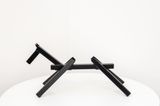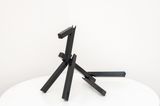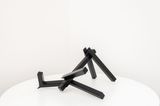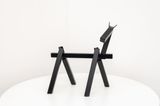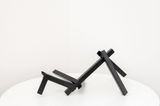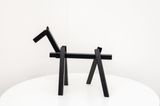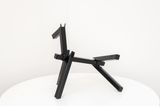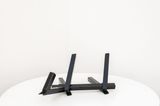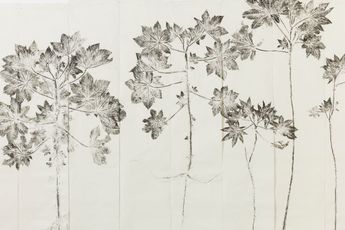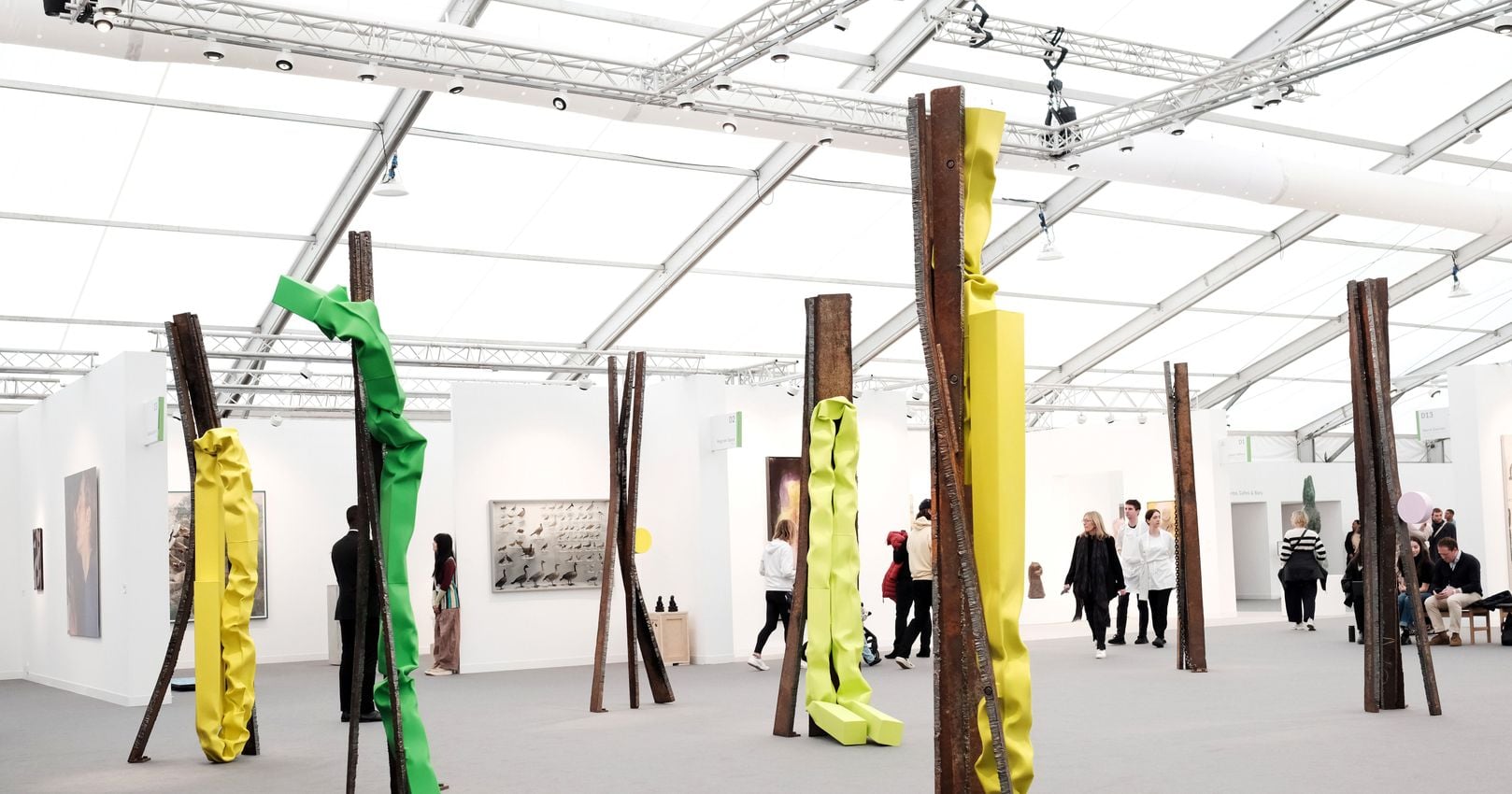
For Frieze London, Jhaveri Contemporary’s booth turns to ecology and brings together artists who focus on the species who co-inhabit our environment. Animal and plant life are intertwined in works that bridge the real, the live, the extinct, and imagined.The entry point is a herd of steel horse sculptures by Permindar Kaur. Child-like in their simplicity and installed low to the ground, akin to fledgling foals, their legs buckle beneath them. Kaur speaks of the ‘playful freedom introduced’ that upends the conventional image of horses as symbols of status and class. The twisted, modular forms, referencing the darker side of play and childhood imagination, ultimately confine the materially robust animals to their plinth.
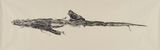
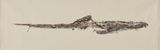
The weighty anatomies are in tension with the skeletal and epidermal prints by Simryn Gill. Part of her Naga Doodles series, each image records in ink print the body of a tropical snake that Gill found run over around her hometown of Port Dickson in Malaysia.The bodies abstract themselves and appear like eroding landscapes. The impression of individual scales, streaks of colour along with bloodstains doubles as a rugged, earthen terrain. Their presentation, isolated in empty space, on off-white paper, and unframed, makes them almost diagrammatic and as if drawn from an archive of 19th- century natural history drawings.
Fiza Khatri’s five-panel atmospheric painting installation directly addresses this historic period when Victorians were in a frenzy to name, collect, and produce knowledge about the world’s flora and fauna. Two Gharial crocodiles, a critically endangered species from South Asia, encountered by Khatri at theYale Peabody Museum, are shown superimposed on an area in Northern Karachi, Manghopir, known for its crocodile shrine. Like an altarpiece, the animal’s portraits are accompanied by paintings featuring accoutrements related to the sacred space; rose and jasmine garlands and a knot of crocodile skin showered with ruby red rose petals. The sequence for Khatri is a ‘vision of repair’ that articulates their fantasy of repatriating the specimens from America to their native habitat.
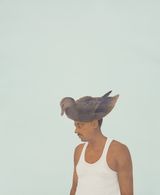
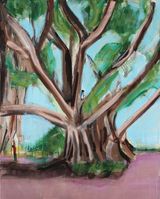
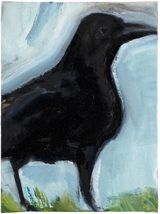
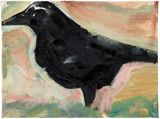
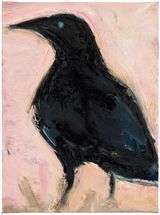
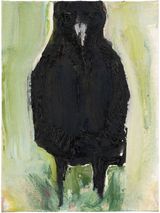
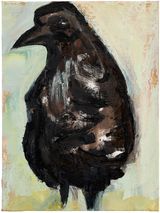
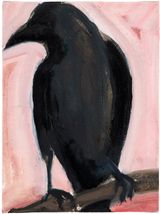
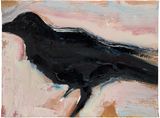
Ali Kazim’s Bird Hunters intensifies the idea of animal-human conflict. Using his distinctive watercolour method involving pencil and ink drawing and submersion of the image in a water bath, he represents a solitary male figure with a duck planted on his head. The bird, shown calm and nonplussed, references the illegal wildlife trade in species that migrate from Siberia to South Asia. The hunting of these birds is undertaken by individuals concealed by elaborate avian headwear. Hovering above are Matthew Krishanu’s characterful crow paintings that, like his magnificent Banyan tree, speak to the magnitude and dominion of the natural world. Started in 2012, each crow, painted with dark and dense textures and never in flight, is anthropomorphised to the point where it seems to exhibit familiar traits; at once coy, brazen and introspective. Similar reverence and attention is felt in Anwar Jalal Shemza’s Fish. The illusionistic work is one of his early experiments with modernism and part of a small number of paintings to include figurative representation. The shoal of fish is painted in a style that reflects both Shemza’s training as a graphic designer at the Mayo School of Arts, Lahore (now The National College of Arts) and his development of an experimental, geometric style informed by artistic references of the time, in particular the abstraction of Zubeida Agha (1922- 1997) and Shakir Ali (1916-1975).


A respected voice in contemporary art discourse.
Focusing on ambitious storytelling and insightful art-world commentary. Ocula Magazine publishes in-depth interviews, critical essays and timely analysis on the artists, exhibitions and ideas driving the global art world.
Learn more about Ocula Magazine
Showcasing the best of the art world.
Ocula partners with galleries from around the world to highlight their artists, artworks and exhibitions. Gallery membership is by application and invitation, with each member vetted by an independent panel.
Learn more about Ocula Membership

Specialises in the sale of major artworks.
Led by a team with deep ties to the world’s leading auction houses, galleries and collectors. Ocula’s advisory team offers bespoke services to high-net-worth clients from around the world who are looking to acquire the best of contemporary and modern art.
Learn more about our team and services