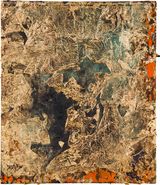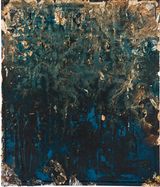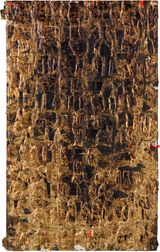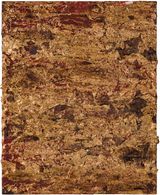
Kirtika Kain’s practice is rooted in her Dalit identity and ancestry. Based in Australia, away from the contemporary manifestation of India’s social system, she uses her body as an access point. Through her physical process of making she explores inherited memories and experiences. And while considering the depths and legacies of caste politics and dwelling on her familial experiences of oppression, she finds solidarity in Dalit literature and archives.
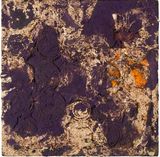
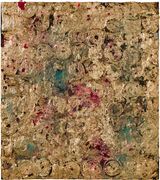
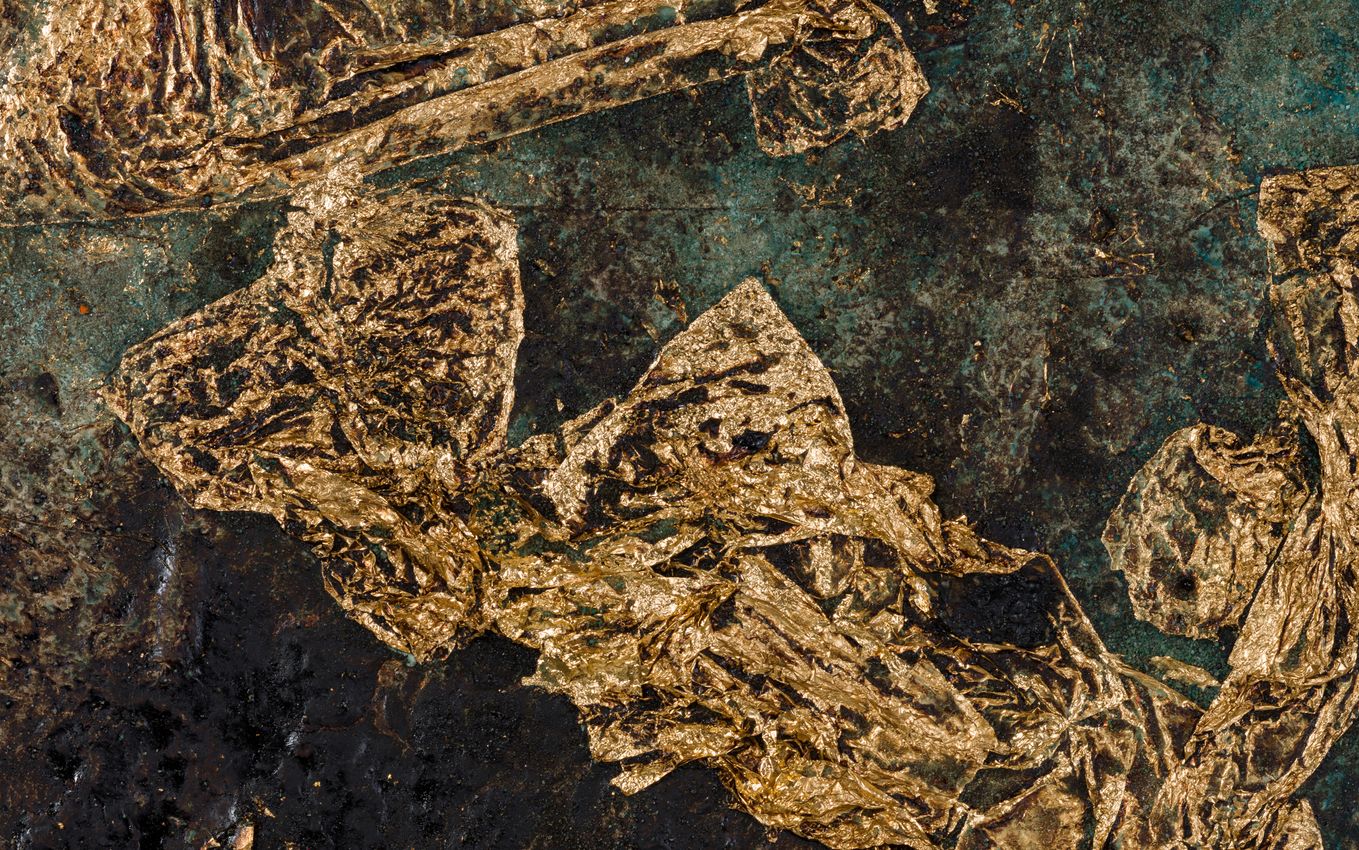
Kain’s materials are chosen for their association with temple rituals and links with Dalit labour. Tar, cotton thread and bangles clog together with ritual pigment and congeal on bases of salvaged silk screens. Gold leaf sheds from these sculptural paintings as if the work is in a process of transmutation, signalling to an eternal cycle of renewal. In part reflecting the irrevocable inheritance of caste, subtle aggression courses through the dense accumulations of matter.
Frustration stings the work’s alchemical beauty as Kain grapples with the contemporary potency of the caste system. She makes titular connections with the original Hindu male law-giver, Manu, who carved up and stratified Indian society. The Lunar Line is a sobriquet for his daughter and this pointed reference notes Kain’s interest in her own line of transmission in this social structure that prescribes worth to individuals. Kain’s works maybe heavy but they are also celebratory. Her symbolic coagulation of caste, faith and the implication of her physicality are, for Kain, a way of securing visibility and value for Dalit creativity. In broader terms, her works aim to redefine the narrative of stigmatisation.
Press release courtesy Jhaveri Contemporary. Text: Dr. Cleo Roberts-Komireddi.
Jhaveri Contemporary was formed in 2010 by sisters Amrita and Priya with an eye towards representing artists, across generations and nationalities, whose work is informed by South Asian connections and traditions. The gallery’s dedication to original scholarship, engendered through its carefully crafted shows, is one of the many ways it distinguishes itself. Entwined with this philosophy is another guiding principle: showcasing the heterogeneous practices of long-celebrated luminaries as well as emerging talents, often in generously interrogative conversations. With a focus on mining lesser-known art histories, Jhaveri Contemporary facilitates dialogue between artists, curators and historians to add to the wider field of art. Estates served by the gallery include Mrinalini Mukherjee and Anwar Jalal Shemza.

A respected voice in contemporary art discourse.
Focusing on ambitious storytelling and insightful art-world commentary. Ocula Magazine publishes in-depth interviews, critical essays and timely analysis on the artists, exhibitions and ideas driving the global art world.
Learn more about Ocula Magazine
Showcasing the best of the art world.
Ocula partners with galleries from around the world to highlight their artists, artworks and exhibitions. Gallery membership is by application and invitation, with each member vetted by an independent panel.
Learn more about Ocula Membership

Specialises in the sale of major artworks.
Led by a team with deep ties to the world’s leading auction houses, galleries and collectors. Ocula’s advisory team offers bespoke services to high-net-worth clients from around the world who are looking to acquire the best of contemporary and modern art.
Learn more about our team and services