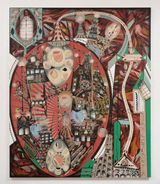




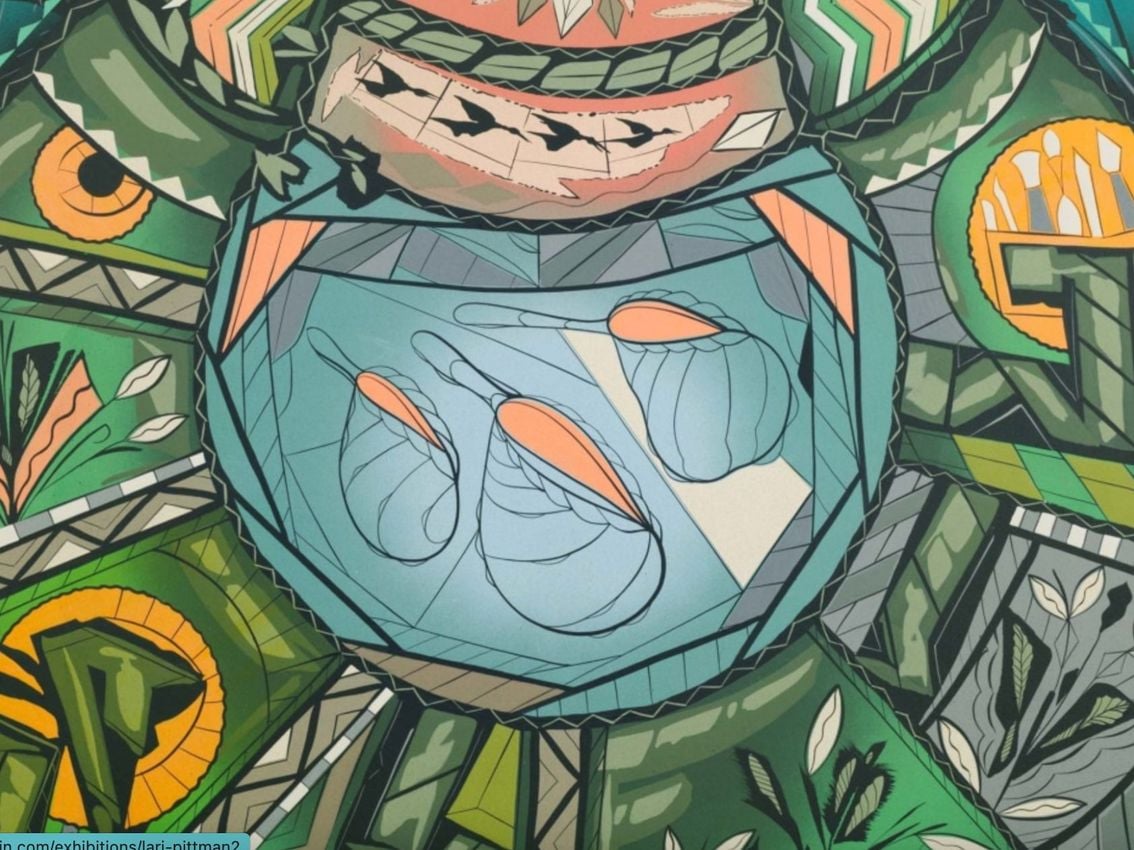
Lehmann Maupin presents Sparkling Cities With Egg Monuments, a series of eight new paintings and a monumentally scaled eponymous work by Lari Pittman. The exhibition marks his third solo presentation at the gallery. Audaciously colorful and unabashedly ornate, Pittman’s newest paintings elaborate his ongoing study of cities and the mechanisms that transform them into civil societies.
A longtime resident of Los Angeles (he spent his early childhood in Colombia), Pittman’s longstanding interest in the dynamics and decorative possibilities of the urban fabric developed in dialogue with one of America’s most surreal metropolises. Los Angeles’ astounding heterogeneity affirmed a set of ethics that has guided Pittman’s exploration of themes such as the AIDS epidemic, racial discord, LGBTQ+ civil rights struggles, and gun violence that continue to define life in America. Nowhere are such issues as intensely incubated and explosively scaled as they are in cities. During the 1990s, Pittman’s work investigated the densely patterned and productively disruptive logic of such social-political currents, using his signature painting technique to build up refracted surfaces that draw on an array of stylistic and iconographic references. Among these, Pittman has repeatedly invoked the egg as a metaphor for regeneration.
The egg’s rich history of appearances in Pittman’s oeuvre dates back to the early 1980s. Whether pictured as gestating embryos or miniature portrait cameos that might grace a locket, Pittman’s eggs have often served as vessels for both future potentiality and nostalgic remembrance. Monuments operate on a parallel, albeit typically foreclosed, register. By memorializing certain histories in public memory, they strive to inculcate a set of shared values that will steer the interpretation of future events. Conversely, the egg-as-monument is a radically open proposition. In Sparkling Cities With Egg Monuments, Pittman deploys eggs as a feminine foil to the peacocking masculinity apparent in the upward thrust of obelisks and towers. Unlike historical monuments that look towards the past, Pittman’s egg monuments—displayed dotted across vast cityscapes or presented in microscopic cross-section—are fertile, nascent, and becoming.
Each of Pittman’s paintings depict eggs in various stages of gestation, performance, exteriorization, and monumentalization. Sparkling City With Egg Monuments #5 and Sparkling City With Egg Monuments #8 enact meticulously rendered yet mysterious operations in their ovular arenas. Mollusks tumble down chutes, small eggs pearl inside larger eggs, and tendrils of vegetation bloom alongside pumping machinery. Other eggs, such as those in Sparkling City With Egg Monuments #3, Sparkling City With Egg Monuments #4, and Sparkling City With Egg Monuments #9 assume their roles as monuments. These monumental eggs become an edifice for the display of the words ‘please’ or ‘thank you.’ Written in the lost art of looping cursive, these simple words recall protocols of polite exchange. They pop up fully formed, seemingly the result of innumerable and tirelessly negotiated encounters spatialized in Pittman’s paintings—the credo of a machinery attempting to engineer a civilization, one gracious gesture at a time.
The relationship of egg to city is in constant flux. Each painting features a vertiginous urban infrastructure disrupted by the curvilinear forms of swelling eggs. Eggs and buildings interpenetrate one another both graphically and chromatically. In some cases, eggs swallow the city whole, as in #9, where a massive egg filled with turrets and bridges nestles in the raspberry walls of a suggestively uterine cavity. The egg in #4 also appears to be incubating an entire citadel, a rosy dawn breaking over the silhouette of a newly formed skyline.
Measuring 33 feet long, Sparkling City With Egg Monuments (2022) is a monumental tour de force, offering a vision of urban renewal from a different perspective. What we see at close range in the other paintings appears here at a distance. This productive remove allows ornamental patterns to become apparent: the rhythmic syncopation of egg monuments perched on delicate stands, the repeating arches of windows, the accents of orange flaring against a teal ground. Here and across the exhibition, Pittman insists that a civil society is a complex society. Its intricacy is proportional to its heterogeneity. In this way, a pattern is an ethical formation; decoration an affirmation of diversity and a statement of core values. Pittman’s egg is a monument to transformation and a reminder of our common origins regardless of gender, race, class, citizenship, or species. Sparkling Cities With Egg Monuments proposes the egg not as a symbol but as a citizen—a civil servant who cares for the new city during its chaotic gestation.
Lari Pittman, (b. 1952, Los Angeles, CA, lives and works in Los Angeles, CA). Over the course of his decades-long career, Lari Pittman has developed a unique visual aesthetic that has established him as one of the most significant painters of his generation. Pittman’s signature, densely-layered painting style includes a lexicon of signs and symbols (such as bells, eggs, animals, ropes), a compilation of varied painting techniques, and a clear homage to the handmade, craft, and the decorative. Pittman creates complex compositions that mediate the tension between colour, text and imagery; landscape and decoration; and chaos and order with remarkable dexterity and often on a large scale, and he has an innate ability to create compositions in which each element within a painting is given equal space and significance.


Rachel Lehmann and David Maupin founded Lehmann Maupin in 1996. The gallery represents a diverse range of American artists, as well as artists and estates from across Europe, Asia, Africa, South America, and the Middle East. It has been instrumental in introducing numerous artists from around the world in their first New York exhibitions.

A respected voice in contemporary art discourse.
Focusing on ambitious storytelling and insightful art-world commentary. Ocula Magazine publishes in-depth interviews, critical essays and timely analysis on the artists, exhibitions and ideas driving the global art world.
Learn more about Ocula Magazine
Showcasing the best of the art world.
Ocula partners with galleries from around the world to highlight their artists, artworks and exhibitions. Gallery membership is by application and invitation, with each member vetted by an independent panel.
Learn more about Ocula Membership

Specialises in the sale of major artworks.
Led by a team with deep ties to the world’s leading auction houses, galleries and collectors. Ocula’s advisory team offers bespoke services to high-net-worth clients from around the world who are looking to acquire the best of contemporary and modern art.
Learn more about our team and services