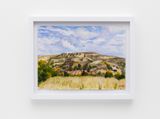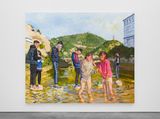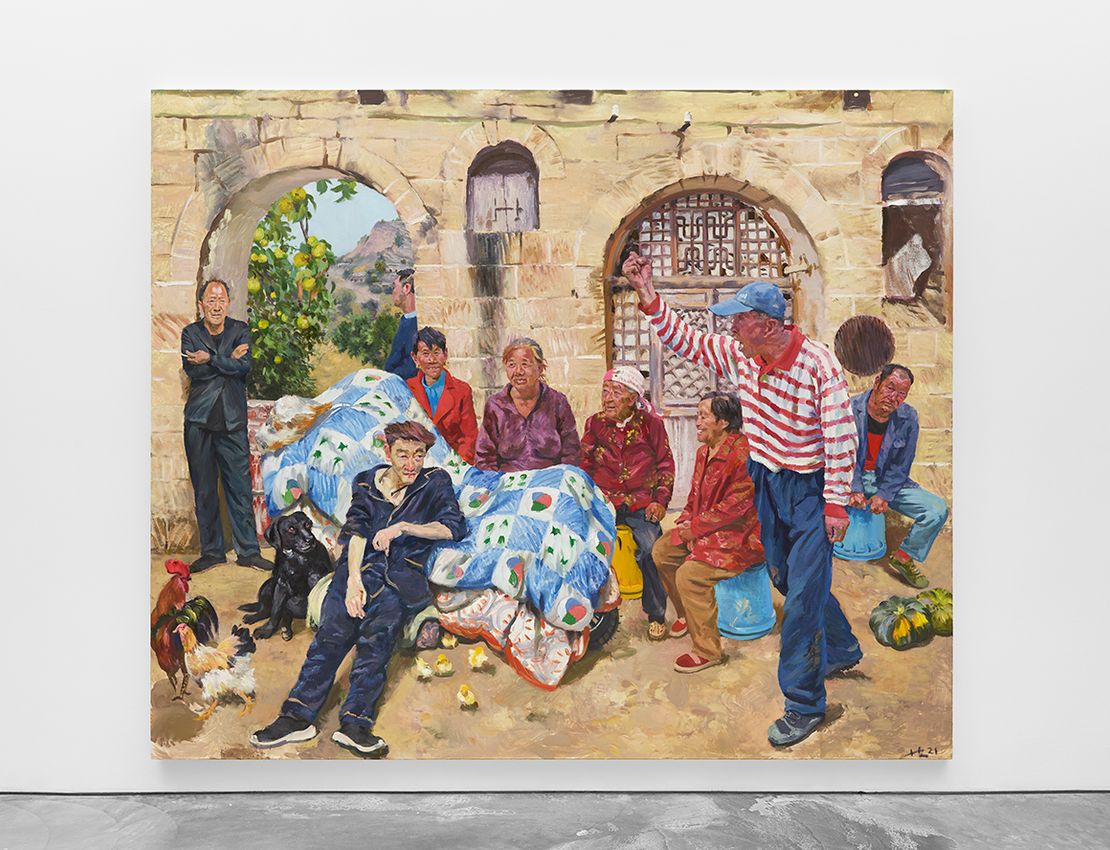
Liu Xiaodong presents an exhibition of new works from his Shaanbei series, one of the artist’s most ambitious and personally significant projects to date. As a student at the Central Academy of Fine Arts in Beijing, Liu took regular trips to the expansive Shaanbei region of China, keeping diaries and sketches of the mountainous area surrounding the city of Yan’an and the rural lands far outside the city. Liu’s return to the region 30 years later signalled a revisitation to the foundations of his practice as a painter of modern life, and allowed him to examine a changing civic landscape.
Liu Xiaodong is a painter of modern life, whose large-scale works serve as a kind of history painting for the emerging world. Liu locates the human dimension to such global issues as population displacement, environmental crisis and economic upheaval, but through carefully orchestrated compositions, he walks the line between artifice and reality. A leading figure among the Chinese Neo-Realist painters to emerge in the 1990s, his adherence to figurative painting amounts to a conceptual stance within a contemporary art context where photographic media dominate. His undertaking ‘to see people as they really are’ was galvanised in the aftermath of 1989 events and, alert to the legacy of Chinese Socialist Realism, his compositions are painted with loose, casual brushstrokes and layered with meaning. While he works from life and often en plein air, he chooses sitters to supply ancillary narratives to landscapes or situations. From recent location-specific series, such as ‘Transgender/Gay’ in Berlin, featuring portraits of the transgender woman Sasha Maria which were featured in Liu’s first comprehensive retrospective Slow Homecoming in Düsseldorf, to his London series ‘Half Street’ (2013), as well as ‘The Hotan Project’ (2012–2013) in the Xinjiang province of China, Liu has also created an automated painting machine entitled Weight of Insomnia (2016), which translates a digital video feed of traffic streams and human movement in real time into a new body of paintings tracing time, memory and behaviour. In so doing, Liu re-assesses painting in the age of internet and algorithm and implicitly invokes the present condition, in which humans and other objects reciprocally co-create the world as we know it.


Established in 1967 in London, Lisson Gallery is one of the most well-known galleries operating globally. Boasting an influential and continuing legacy, including playing a pivotal role in the careers of many pioneers of historically important art movements, the gallery works with some of the most significant contemporary artists today.

A respected voice in contemporary art discourse.
Focusing on ambitious storytelling and insightful art-world commentary. Ocula Magazine publishes in-depth interviews, critical essays and timely analysis on the artists, exhibitions and ideas driving the global art world.
Learn more about Ocula Magazine
Showcasing the best of the art world.
Ocula partners with galleries from around the world to highlight their artists, artworks and exhibitions. Gallery membership is by application and invitation, with each member vetted by an independent panel.
Learn more about Ocula Membership

Specialises in the sale of major artworks.
Led by a team with deep ties to the world’s leading auction houses, galleries and collectors. Ocula’s advisory team offers bespoke services to high-net-worth clients from around the world who are looking to acquire the best of contemporary and modern art.
Learn more about our team and services