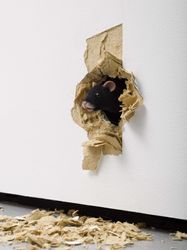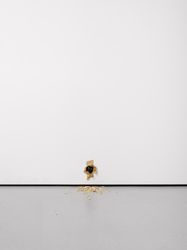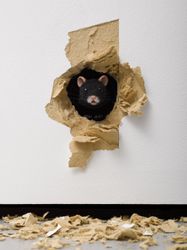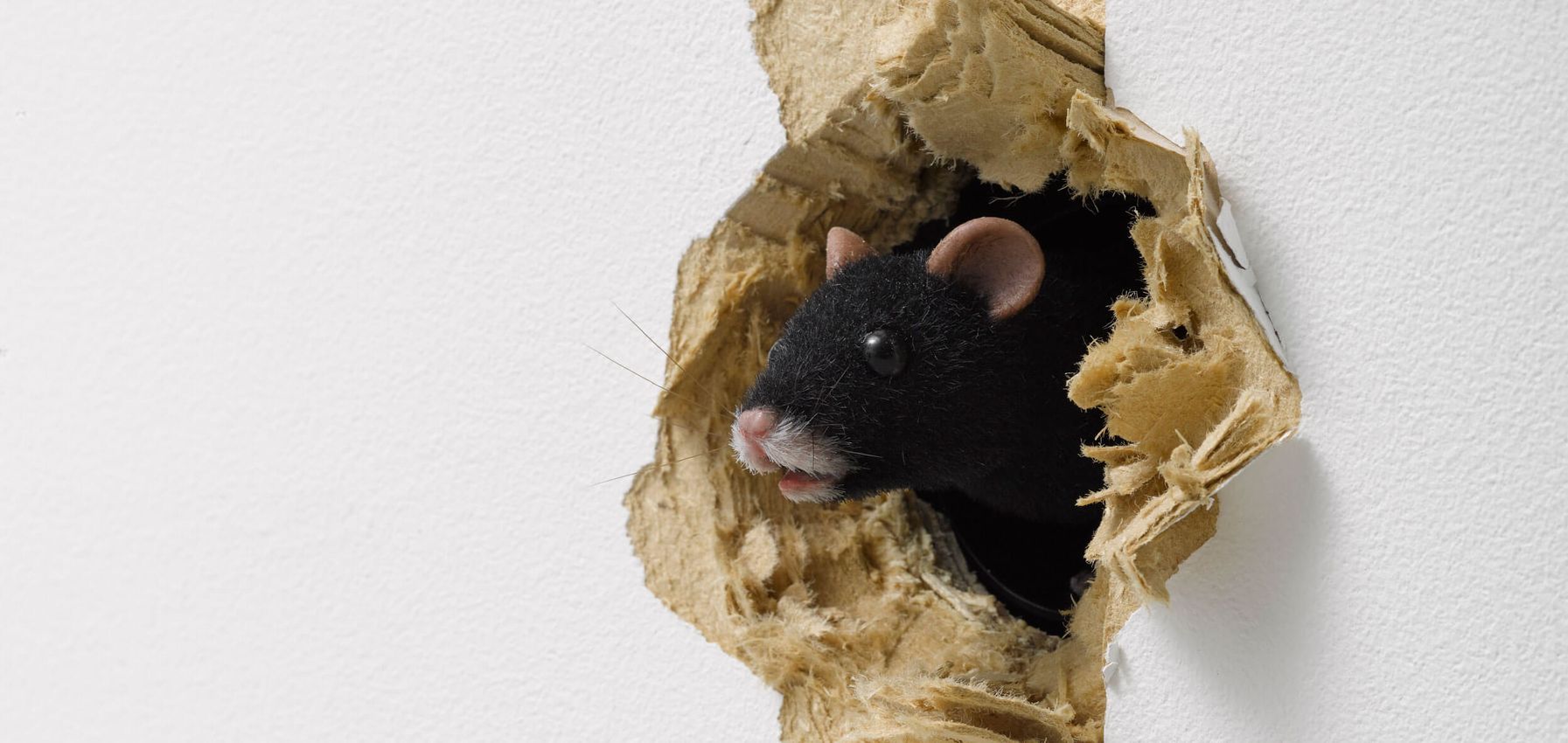
The End is the final work in a trilogy of prophetic, animated mice, voiced by the artist’s young daughters. In each, the mouse appears from the debris of a hole in a wall to philosophise, commanding the room with a tiny, innocent voice, inviting the visitor to kneel down to hear what it has to say. In the first in the series, ‘2000 year collaboration (The Prophet)’ (2018), the mouse addresses the room, recounting a speech inspired by Charlie Chaplin in the 1940 film, The Great Dictator. Using the structure of this positive moral and ethical oration, written at such a critical time in history, Gander has re-written it from a post-simulacrum, or post-digital perspective, an unimaginable future without the crutches of instant information gratification. In the second work I... I... I... (2019), similarly written by Gander and narrated by his eldest daughter, the mouse evidently has something pivotal to say but struggles to get the words out. The frustration is palpable and reminds us all of our need to be heard.
In the third, final speech of the series—The End—the mouse, now voiced by Gander’s youngest daughter, delivers a profound sermon on some of the biggest questions that face humanity from our ability to cognitively time travel to our limitations in being able to foresee our own end. The work has an apocalyptic undertone but invites an embrace of the inevitability of mortality, and how the healthy acceptance of this can give us a renewed energy and optimism—‘to make the most of the time and attention that we have’.
The End (2020), was completed just before the outbreak of coronavirus and yet seems to be written in relation to this epic transformation in all our lives. Gander comments: ‘Some people refer to them as little prophets, and they’re meant to predict the future in some way, or possible versions of what the future could hold, but when I was writing the script I had no idea of what was about to transpire. Now, the work encapsulates a moment in the history of humankind and predicts something, and talks about something, that affected and is affecting now, every soul on the planet.’
In each work in the series, the mouse demands our attention by refusing to be the one that shouts the loudest. As Gander states, ‘In this era where there’s a lot of noise and flashing and blinking and worrying and beeping and bright colours and shiny surfaces and reflections and a rainbow and loud noises and whoops and bangs—all of which are aimed at commanding our attention—that actually, you don’t need to shout anymore, that a whisper will suffice. And sometimes a whisper commands greater attention because society has realised that the things that grab our attention are often the things that aren’t valid and valuable information.’ Gander goes on to say that, ‘as predictors, as mini prophets, as protagonists that speculate about a future, the trilogy of mice all talk about time. And time really feels to me like it is the subject of our time. The art world is saturated with artworks and exhibitions about identity politics and about the internet and about things that are now. But now is not the subject of now. Time and the future is the subject of our time. Time is all that we have left and attention is our greatest asset.


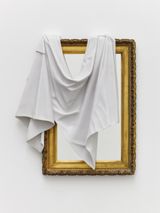
Ryan Gander’s complex and unfettered conceptual practice is stimulated by queries, investigations or what-ifs, rather than strict rules or limits. For example, what if a child’s den of sheets were remade in memorialising marble (Tell My Mother not to Worry (ii), 2012)? What if all the pieces in a chess set were remade in Zebra Wood, so that neither side was entirely black nor white (Bauhaus Revisited, 2003)? Gander is a cultural magpie in the widest sense, polymathically taking popular notions apart only to rebuild them in new ways – perhaps by refilming the same ten-second clip 50 times over, as in Man on a Bridge (A study of David Lange), 2008. Language and storytelling play an overarching role in his work, not least in his series of Loose Association lectures or in his attempt to slip a nonsensical, palindromic new word, ‘mitim’, into the English language. Occasionally his ludic concepts drift into more bodily, relational challenges, especially in This Consequence of 2006, that involved the unsettling presence of a gallery owner or invigilator dressed in an all-white Adidas tracksuit, with an additional sinister red stain embroidered into the fabric. Invitation and collaboration are also at the heart of Gander’s fugitive art – whether he’s exchanging fictionalised newspaper obituaries with an artist-friend or taking pictures of people looking at pictures at an art fair – although arguably every solipsistic action he takes merely holds up yet another mirror to his ceaselessly voracious mind.


Established in 1967 in London, Lisson Gallery is one of the most well-known galleries operating globally. Boasting an influential and continuing legacy, including playing a pivotal role in the careers of many pioneers of historically important art movements, the gallery works with some of the most significant contemporary artists today.

A respected voice in contemporary art discourse.
Focusing on ambitious storytelling and insightful art-world commentary. Ocula Magazine publishes in-depth interviews, critical essays and timely analysis on the artists, exhibitions and ideas driving the global art world.
Learn more about Ocula Magazine
Showcasing the best of the art world.
Ocula partners with galleries from around the world to highlight their artists, artworks and exhibitions. Gallery membership is by application and invitation, with each member vetted by an independent panel.
Learn more about Ocula Membership

Specialises in the sale of major artworks.
Led by a team with deep ties to the world’s leading auction houses, galleries and collectors. Ocula’s advisory team offers bespoke services to high-net-worth clients from around the world who are looking to acquire the best of contemporary and modern art.
Learn more about our team and services