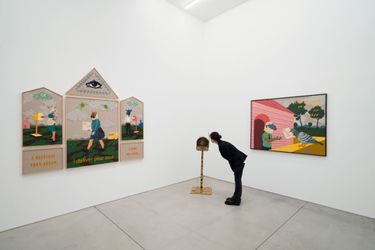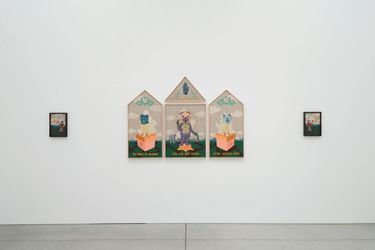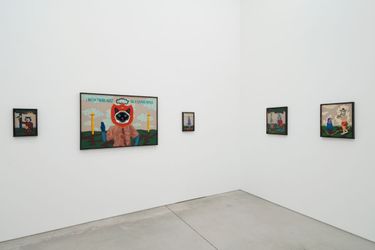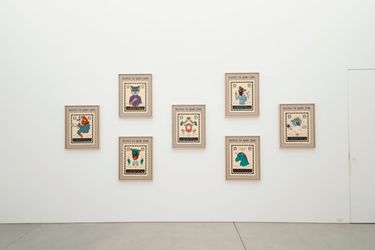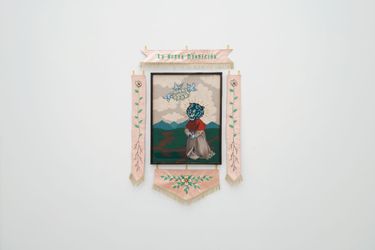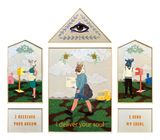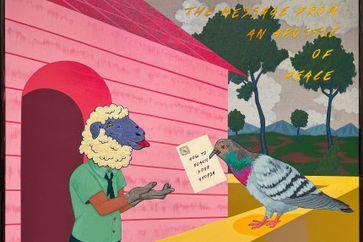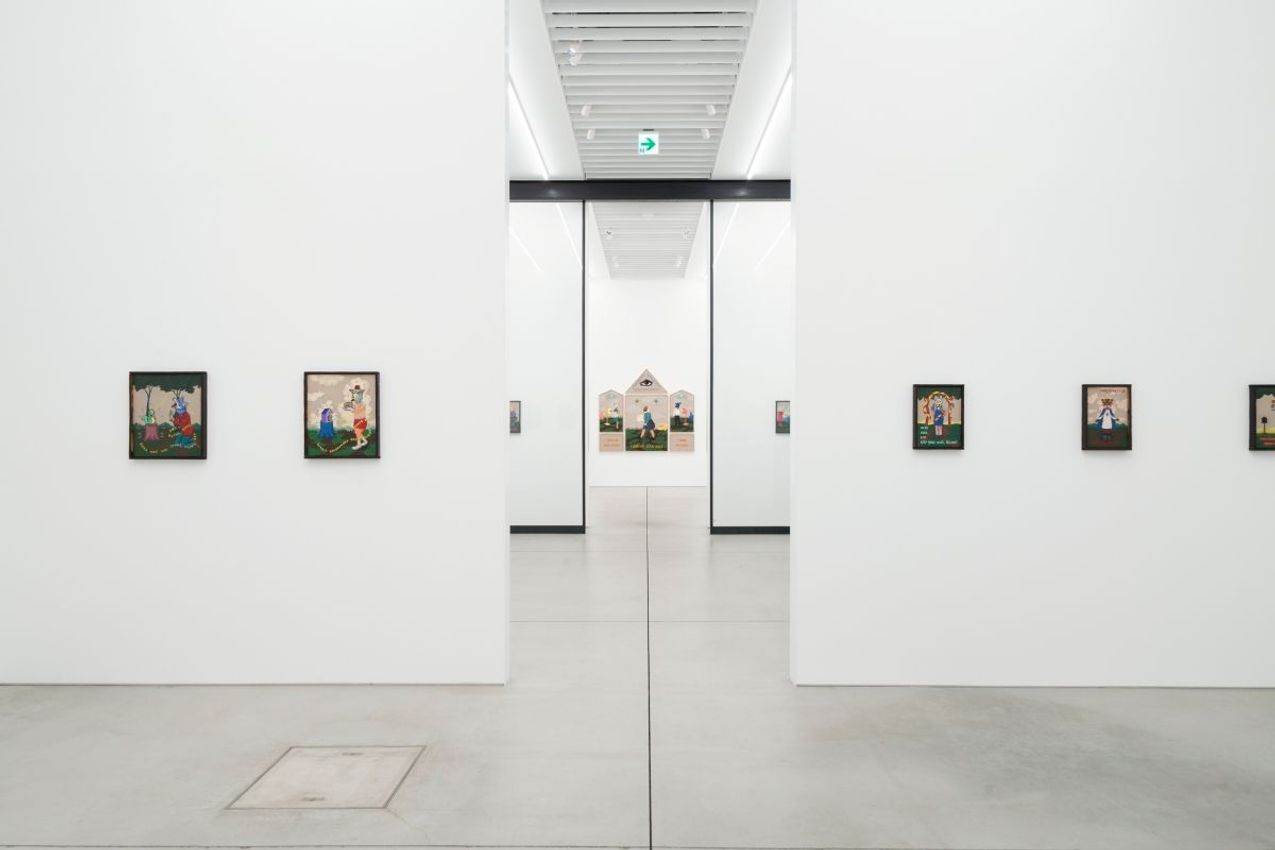
MAKI Gallery is pleased to present Deliver to Your Soul, Japanese artist Koichiro Takagi’s second exhibition with the gallery, at Tennoz I, Tokyo. Born in Tokyo in 1974, Takagi moved to San Francisco after university to study silkscreen printing, then went on to pursue a painting career while working as a studio assistant in New York. Since his return to Tokyo in 2005, he has developed a unique visual lexicon combining embroidery, printmaking, and traditional painting techniques. Deliver to Your Soul features approximately 30 examples from his most recent body of work, including those which fuse the artist’s ongoing references to religion and counterculture with motifs relating to postal correspondence.
Takagi’s striking compositions are immediately recognizable by their whimsical cast of anthropomorphic animals, often rendered in stiff postures and unnatural colors. While their stylized appearance may seem endearing at first sight, the occasional gleaming eyes and bared teeth give off an intimidating, bestial ferocity. The aggression suggests a distrust of existing social institutions and the people who maintain them, influenced in large part by Takagi’s longstanding passion for American countercultures like punk rock, graffiti, street fashion, and tattoo art. At the same time, the creatures’ theatrical poses are reminiscent of biblical paintings, exuding a mystical aura that is in stark contrast to their defiant disposition. Raised in a Catholic household, the artist was exposed to Christian art since childhood; its distinct imagery and compositional structures eventually found their way into his own creations. The visual discrepancy in Takagi’s work embodies the continuous conflict between the artist’s anti-establishment beliefs and genuine fascination for divine powers.
Text is another key element in Takagi’s practice; his canvases are embroidered with cryptic phrases that are at times inspiring and at times moralizing, such as “Good luck will find you,” or “Envy is the ulcer of the soul.” It is unclear whether these words are relayed by the animal character, the artist himself, or even some higher being. Engaging with vast themes like destiny, love, and happiness, they almost seem to mimic the didactic yet reassuring cadence of a fable or sermon. To a cynical eye, these adages may be interpreted as a biting satire of organized religion’s insistence that they hold all the answers to life. Or perhaps they are self-affirming mantras, meant to be repeated silently as a source of personal strength. The viewer is encouraged to engage in their own form of hermeneutics and discover just how nuanced and versatile language can be.
This emphasis on the importance of text to the human experience is further enhanced by the recurring use of postal motifs, such as envelopes, stamps, and mailboxes. The artist states, “Postal correspondence encapsulates our internal thoughts, and stamps serve as proof that those words have resonated with their intended target. The souls of the sender and the receiver converge and profoundly impact one other.” Letters, a timeless medium of communication, have been exchanged by human beings for thousands of years; they have played pivotal roles throughout history, politics, philosophy, and art, and simultaneously make up a significant portion of many individuals’ personal archives. Takagi uses postal imagery to represent the countless exchanges of souls woven into the tapestry of human civilization, as well as our instinctive need for meaningful connection. While the advent of the internet and social media has turned paper envelopes and stamps progressively obsolete, they remain potent signifiers in the digital realm, serving as icons representing email or direct messaging. Still, Takagi believes in the emotional value of physical postage—the ritual of writing down a message by hand, enclosing it in an envelope, meticulously addressing it, affixing a stamp, and finally, dispatching it to a mailbox or post office, shows a level of effort and care that imbues the letters with a sincerity that cannot be replicated by virtual interaction.
Deliver to Your Soul showcases Takagi’s increasingly multimedia approach, which has come to include silkscreen in addition to embroidery, paint, and ink—a combination of consistent, controlled production and labor-intensive craft. Despite working with big ideas that trace back to the origins of human society, the artist’s openly eccentric and playful imagery turns the viewing experience into a friendly, unpretentious conversation.
The sacred and the profane coexist in Takagi’s work, maintaining a delicate balance between highbrow and lowbrow, hierarchy and individualism, classical and contemporary, and faith and doubt. We invite you to step inside this eclectic world, where conflicting elements collide while echoing the yearning within us all to forge intimate bonds with others.
Press Release: Courtesy of MAKI


Born in Tokyo in 1974, Koichiro Takagi moved to the United States after graduating from university in Japan and studied silkscreen printing at the Academy of Art College (now the Academy of Art University) in San Francisco. He then relocated to New York to start his career as a painter and returned to Tokyo in 2005, where he continues to live and work today. Takagi’s multimedia creations depict a peculiar, almost eerily utopian world populated by animals and anthropomorphic creatures, where conflicting ideas like familiarity and discomfort or anonymity and ethereality converge. Influenced by punk rock and street art, the artist increasingly broadens the scope of his creative output by incorporating a wide range of materials and techniques, such as painting, embroidery, silkscreen, collage, and stencil.

MAKI Gallery was first established in Tokyo in 2003, with the aim of promoting works by seminal avant-garde Japanese artists of the 1950s-60s. The gallery has since gradually shifted its focus to working with emerging contemporary artists. After opening a location in the bustling, high-end shopping district of Omotesando in 2014, MAKI Gallery opened an expansive, museum-caliber space in the growing gallery hub of Tennoz in 2020. Across these two outposts, MAKI Gallery presents a broad range of works by internationally active artists, including Mungo Thomson, Miya Ando, Susumu Kamijo, and Marius Bercea, while also introducing younger Japanese artists, such as Anne Kagioka Rigoulet, Keisuke Tada, and Takuro Tamura, to a global audience. The gallery has also participated in various international art fairs such as Frieze New York, The Armory Show, Asia NOW, and West Bund Art & Design.

A respected voice in contemporary art discourse.
Focusing on ambitious storytelling and insightful art-world commentary. Ocula Magazine publishes in-depth interviews, critical essays and timely analysis on the artists, exhibitions and ideas driving the global art world.
Learn more about Ocula Magazine
Showcasing the best of the art world.
Ocula partners with galleries from around the world to highlight their artists, artworks and exhibitions. Gallery membership is by application and invitation, with each member vetted by an independent panel.
Learn more about Ocula Membership

Specialises in the sale of major artworks.
Led by a team with deep ties to the world’s leading auction houses, galleries and collectors. Ocula’s advisory team offers bespoke services to high-net-worth clients from around the world who are looking to acquire the best of contemporary and modern art.
Learn more about our team and services