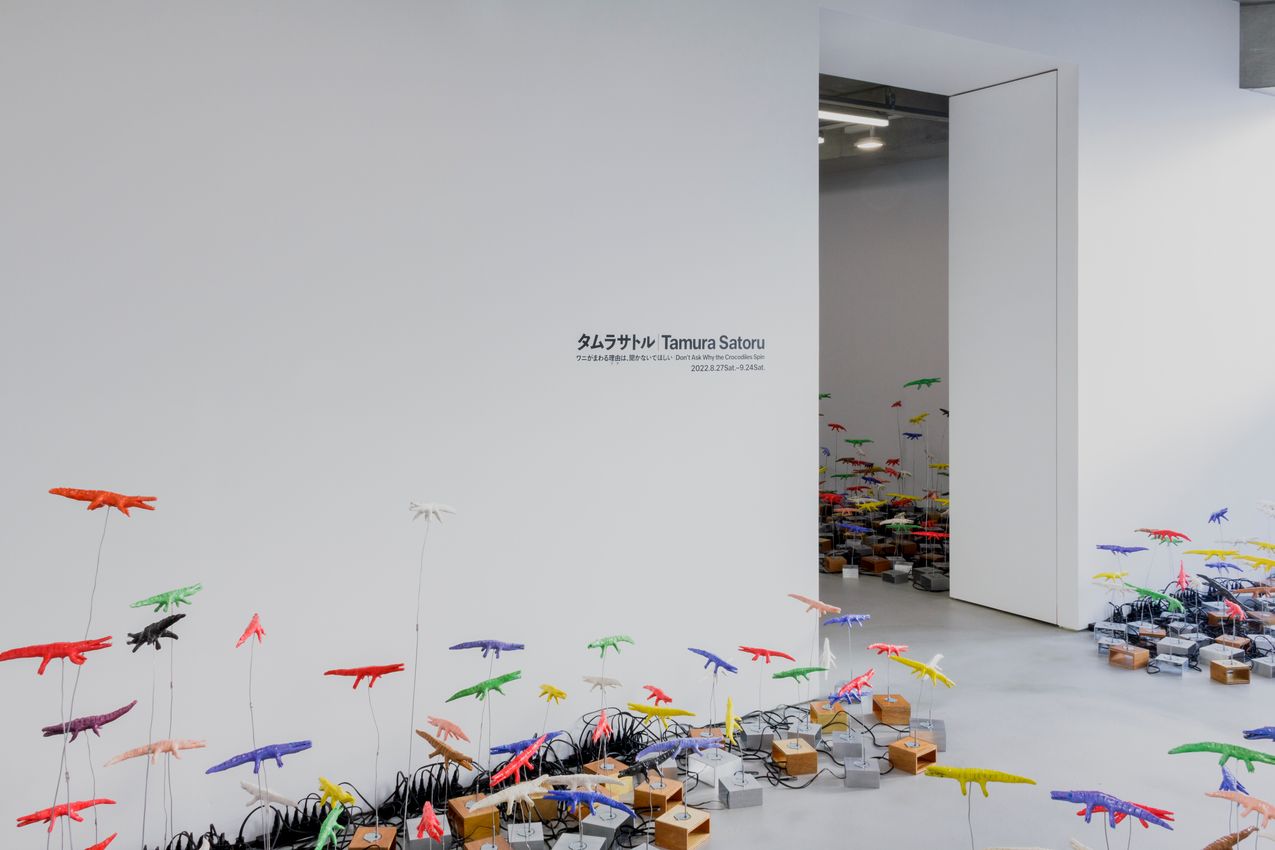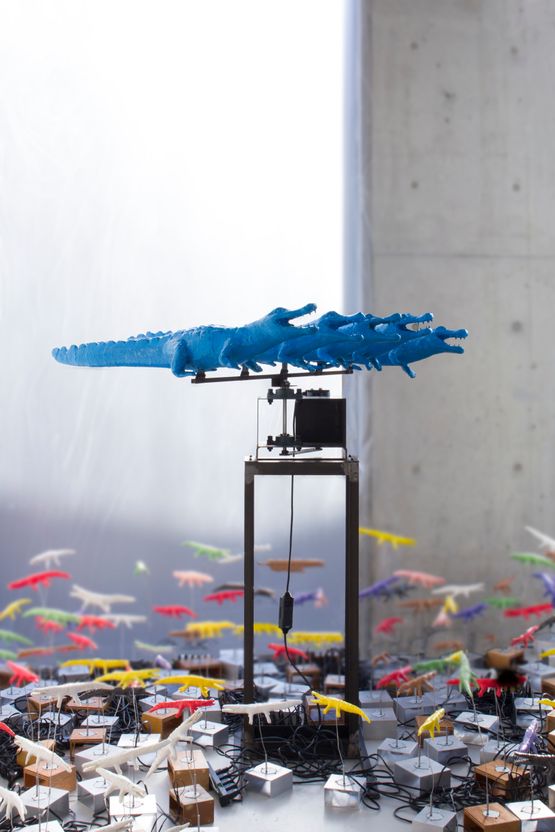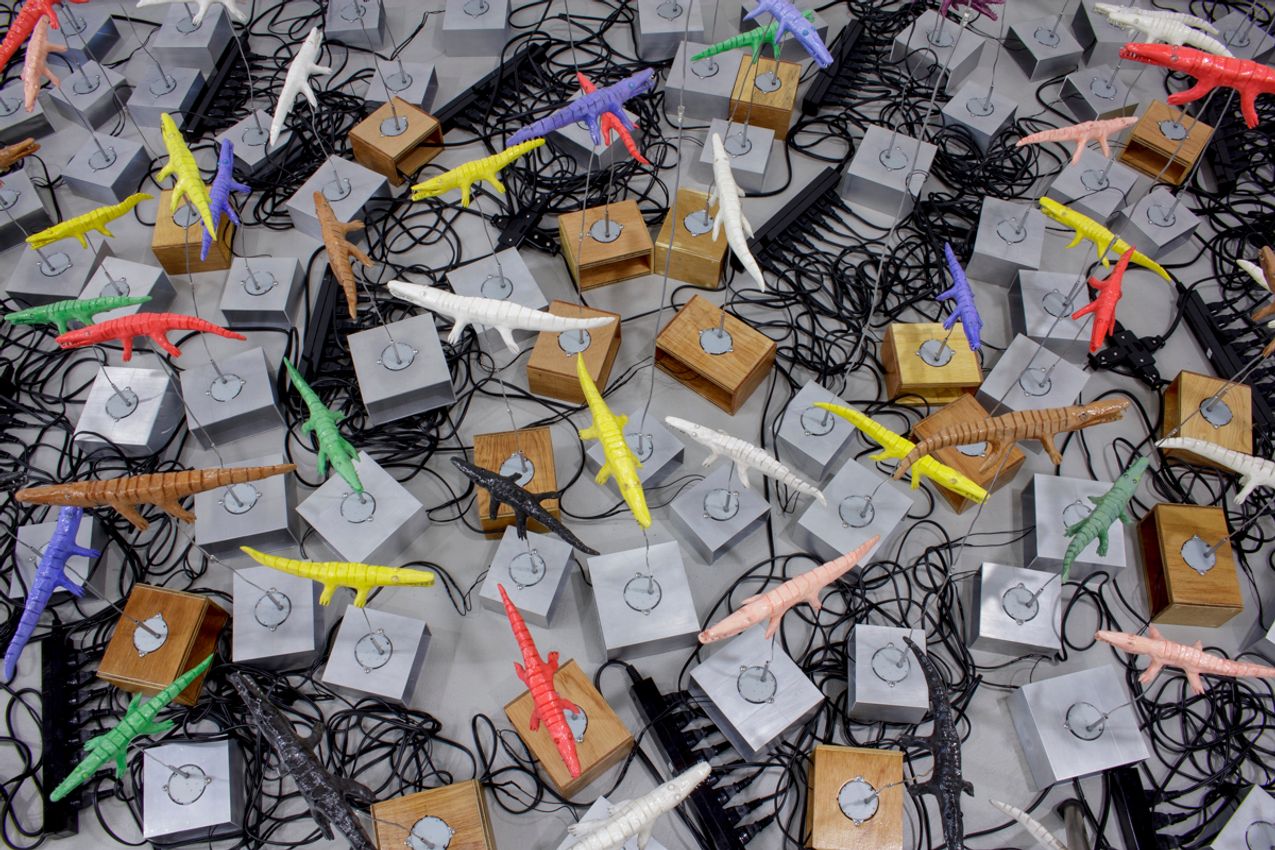
MAKI Gallery and TEZUKAYAMA GALLERY are pleased to jointly announce Don’t Ask Why the Crocodiles Spin, a solo show by Tochigi-based artist Tamura Satoru. The presentation focuses on Tamura’s spinning crocodiles—a key part of his practice for almost 30 years—and follows his well-received solo exhibition at The National Art Center, Tokyo (Roppongi) in June 2022. A total of over 1,000 rotating crocodiles will fill both spaces in Omotesando, Tokyo and Minami-Horie, Osaka, creating an explosion of color and motion that envelops the viewer with its surreal dynamism.
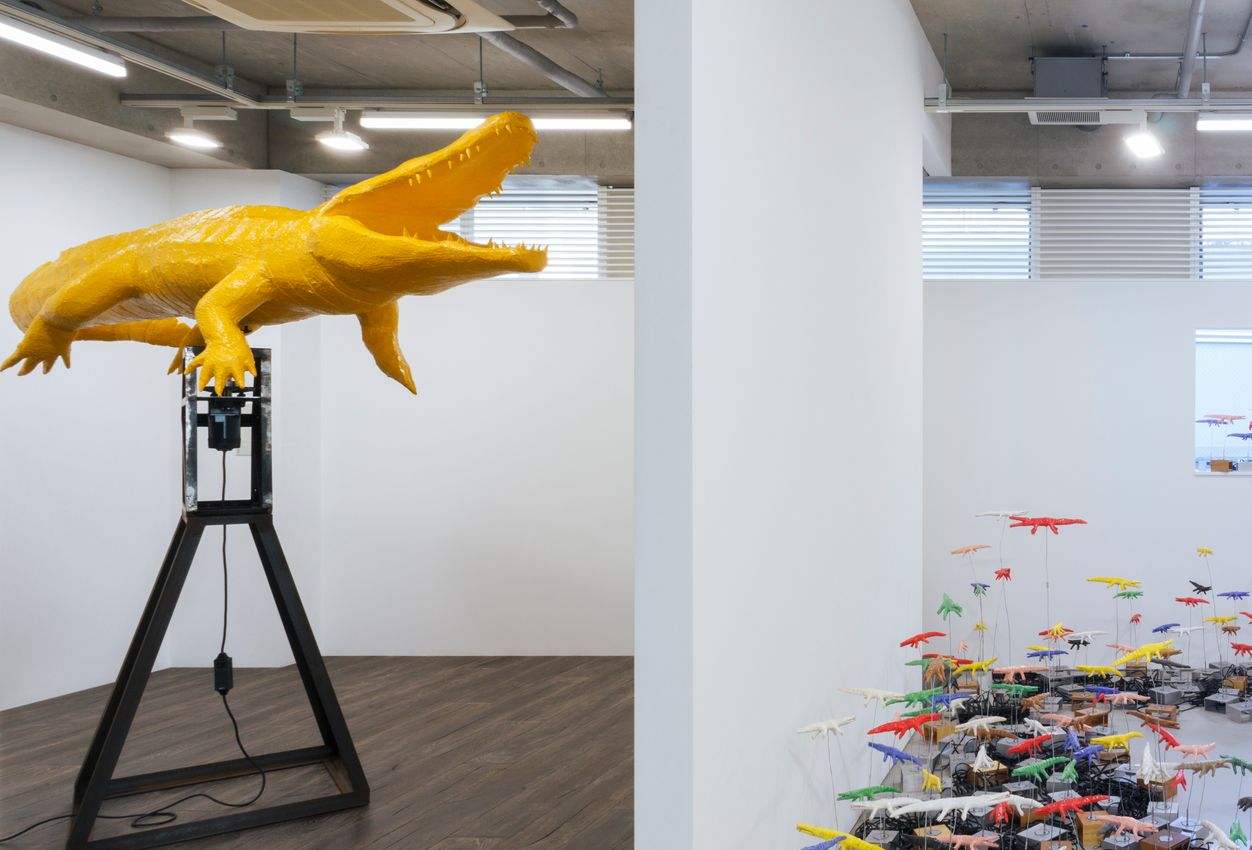
The spinning crocodile was first conceived in the fall of 1994, when Tamura was still a student at the University of Tsukuba. He was struggling with an assignment given by his professor—to create an artwork that uses electricity. At the time, Tamura had never made an electric or kinetic work before. Stumped, he decided to make whatever first popped into his head the next morning, which ended up being “spinning crocodiles.” Tamura stuck to his word and hand-sculpted a green, 4.5-meter-long crocodile mounted on a rotating pedestal. The artist was enthralled by the ridiculousness of the resulting work and went on to pursue similarly absurdist concepts after graduation. Electricity and mechanics have since become integral parts of Tamura’s practice, and the spinning crocodiles have continued to evolve alongside the artist’s career.
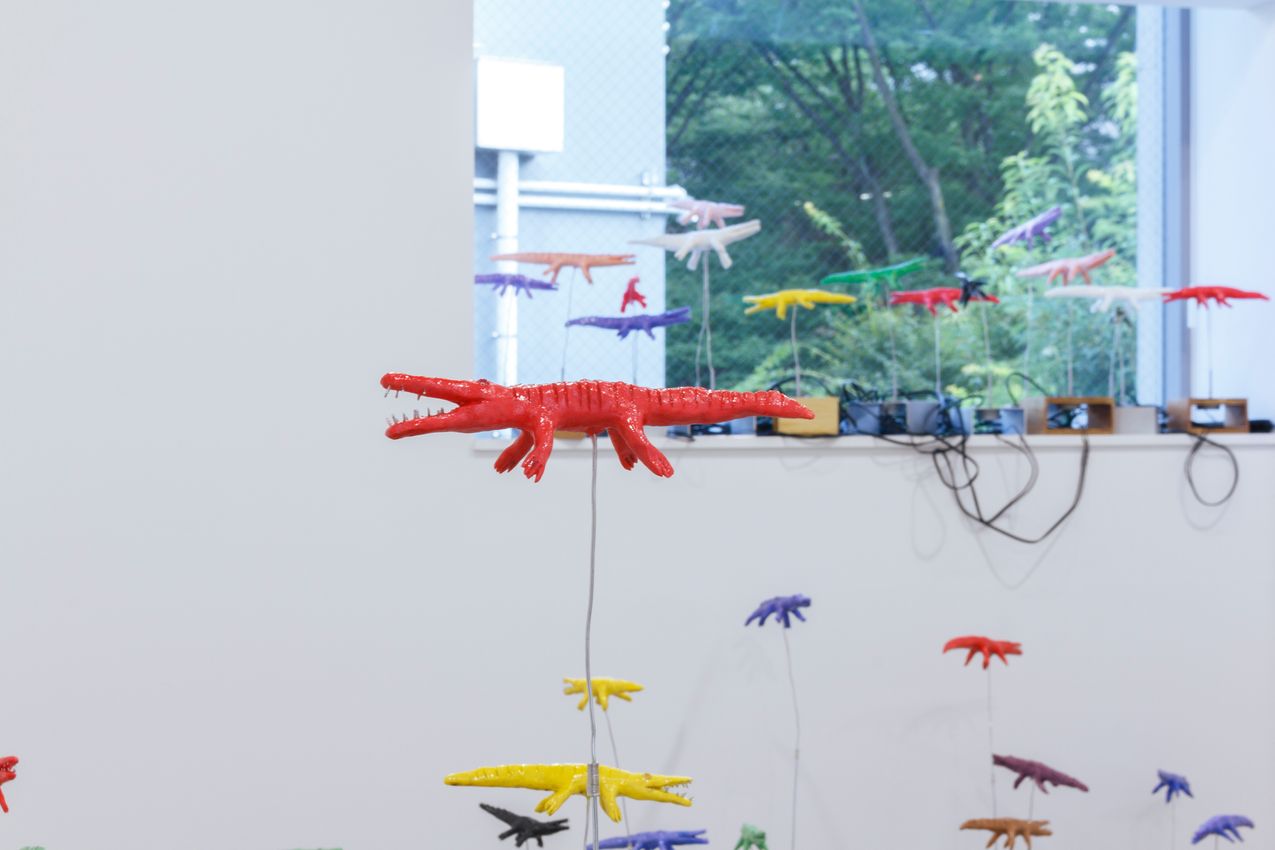
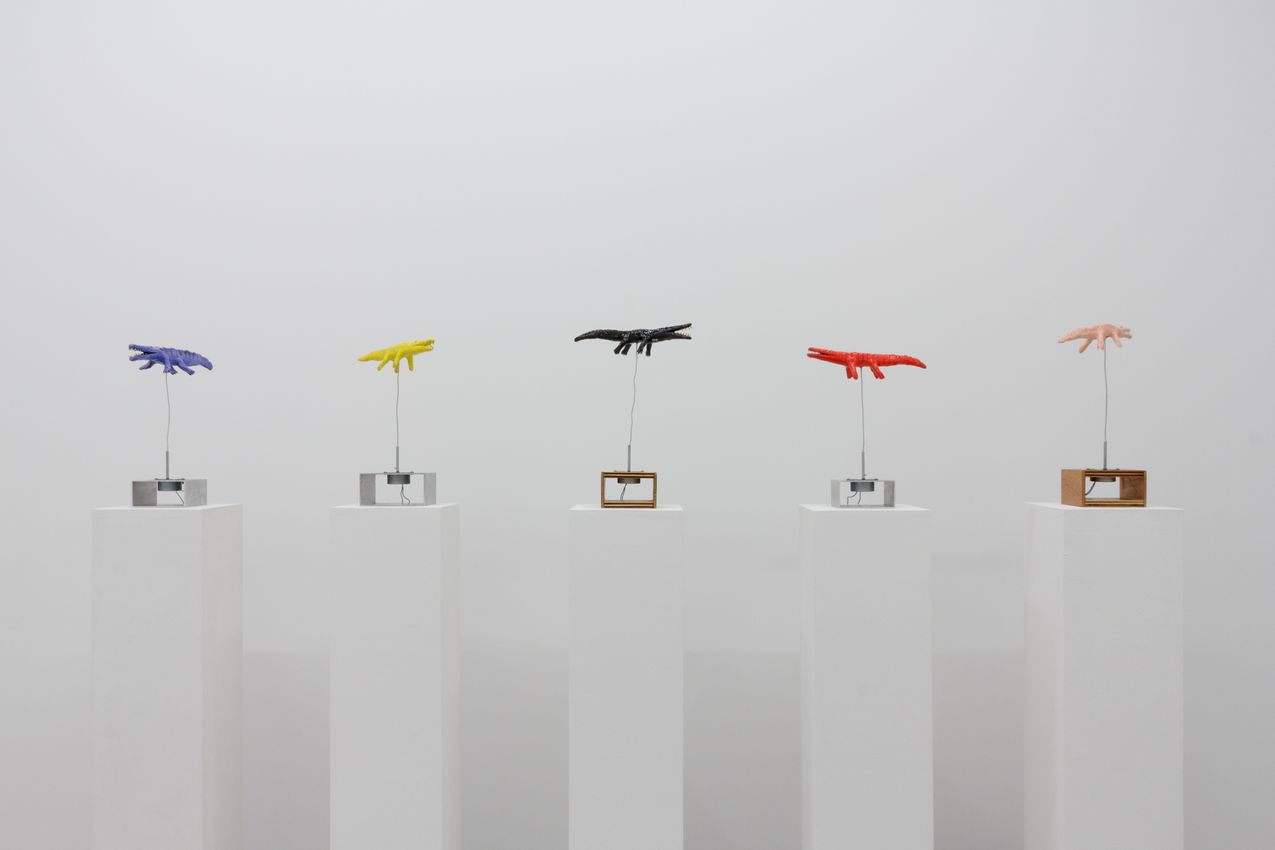
In 2022, Tamura took on the extraordinary task of building 1,000 crocodile devices to fill a massive exhibition space in The National Art Center, Tokyo. He meticulously hand-crafted every single one out of clay, streamlining the process as he went along. The artist further emphasized the crocodiles’ individuality by giving them unique names and adjusting their rotational speeds to produce slight variations. Perhaps that is why they possess a distinct warmth and personality, despite their motorized movements.
In Japan, crocodiles do not exist in the wild—common conception frames them as dangerous, exotic animals rarely seen outside captivity. Tamura exaggerates this alienness by making drastic changes in color and scale—the crocodiles can be cobalt blue, bright orange, or even stark white, and range anywhere from 20 centimeters to 12 meters long. There is a sort of childlike joy in seeing these terrifying creatures transformed into harmless, kitschy characters. Curiously, the further Tamura’s crocodiles stray from reality, the more endearing and approachable they become.
Tamura’s kinetic sculptures utilize electricity and industrial materials, yet they do not serve any productive means. There is an ironic anti-utilitarianism that underlies his practice, subtly poking fun at contemporary society’s obsession with productivity and efficiency. In fact, his works do not even present a clear artistic purpose, thus subverting the viewer’s expectations of what art should “do” or “mean.” As indicated by the exhibition’s title, Tamura refuses to define specific intentions behind his works. Instead, he encourages the viewer interact with them instinctively and pay attention to their own honest reactions. We welcome you to enter Tamura’s whimsical world, where the natural and mechanical collide to form a nonsensical yet captivating phenomenon.
Press Release : Courtesy of MAKI Gallery


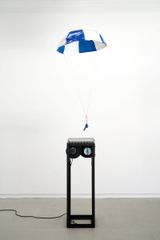
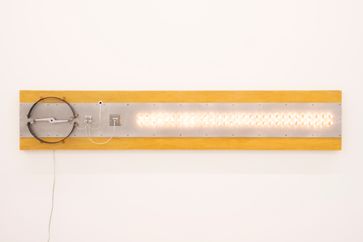
Born in 1972 in Tochigi, Japan, where he continues to live and work today, Tamura Satoru graduated from the University of Tsukuba School of Art and Design in 1995. Tamura’s practice makes frequent use of electricity, an essential element of modern civilization and a key part of its social infrastructure. At times, it endlessly rotates a sculpted crocodile; at others, it powers an instrument that quantifies beauty or illuminates a lamp with a deliberately engineered open light switch. Such ironic futility might make the viewer instinctively murmur “So what?,” but Tamura’s dynamic, large-scale devices possess a captivating energy akin to amusement park rides. The works embody what the artist describes as his “desire to break free from the meanings, frameworks, and functions that all materials and forms inherently carry.”

MAKI Gallery was first established in Tokyo in 2003, with the aim of promoting works by seminal avant-garde Japanese artists of the 1950s-60s. The gallery has since gradually shifted its focus to working with emerging contemporary artists. After opening a location in the bustling, high-end shopping district of Omotesando in 2014, MAKI Gallery opened an expansive, museum-caliber space in the growing gallery hub of Tennoz in 2020. Across these two outposts, MAKI Gallery presents a broad range of works by internationally active artists, including Mungo Thomson, Miya Ando, Susumu Kamijo, and Marius Bercea, while also introducing younger Japanese artists, such as Anne Kagioka Rigoulet, Keisuke Tada, and Takuro Tamura, to a global audience. The gallery has also participated in various international art fairs such as Frieze New York, The Armory Show, Asia NOW, and West Bund Art & Design.

A respected voice in contemporary art discourse.
Focusing on ambitious storytelling and insightful art-world commentary. Ocula Magazine publishes in-depth interviews, critical essays and timely analysis on the artists, exhibitions and ideas driving the global art world.
Learn more about Ocula Magazine
Showcasing the best of the art world.
Ocula partners with galleries from around the world to highlight their artists, artworks and exhibitions. Gallery membership is by application and invitation, with each member vetted by an independent panel.
Learn more about Ocula Membership

Specialises in the sale of major artworks.
Led by a team with deep ties to the world’s leading auction houses, galleries and collectors. Ocula’s advisory team offers bespoke services to high-net-worth clients from around the world who are looking to acquire the best of contemporary and modern art.
Learn more about our team and services