Press Release

No more can I pen down a verse.

Where no poetry dwells, there it exists.

Only fragments of consciousness turn into these lines—

Consciousness, a realm of solitude.

In solitude felt, thus I exist.

Solitude, the very root of being;

Solitude, the truest wish for beauty.

Beauty, a symbol of eternity.

Junzaburō Nishiwaki, The Wanderer Never Returns (1947)

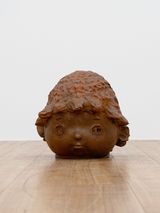
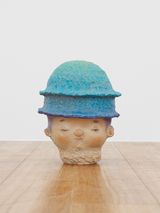
In the creative world of Otani Workshop, solitude pervades eachindividual. Subtle expressions, unwittingly revealed in solitude,encapsulate everything: smiles brought on by memories, foggyuncertainty about the future, and bewilderment in the present, all frozenin a fleeting slice of time. During his university leave, Otani embarkedon a solitary journey, echoing Junzaburō Nishiwaki’s sentiment, ‘Insolitude felt, thus I exist.’ In his wanderings, Otani was in search ofhimself. Born in Shiga Prefecture and surrounded by pottery from ayoung age, his tactile memories of playing with clay as a child drew himback to Shiga. There, he infused every piece of his work with solitaryvisions and moments, turning the vague images in his mind into tangible ‘beings’ for others to observe, imagine, and perceive, allowing thesolitary to metamorphose into a palpable beauty that can be displayed,conveyed, and even communicated.

On his travels, Otani so observed, ‘Whether it is a modern orcontemporary art museum, an ancient temple, or a historical museumcollection. When viewed from the perspective of human history, finearts, crafts, and other handicrafts are all part of an evolving spectrum.’ It is this gradual transition that Otani kneads into his work, crystallizinginto ceramic pieces, sculptures, and paintings. Therefore, ‘OtaniWorkshop’ remains his chosen name. Signifying more than just acontemporary art studio in the Chinese context, it resonates with theJapanese tradition of pottery, aligning more closely with the concept ofa workshop or factory in artisanal practice. Yet unlike traditionalworkshops, his is a solitary endeavor, devoid of any direct lineage ordisciples. Otani’s wish for his creations to inhabit an ambiguous stage,blurring the lines between art and craft in our time and age, may stemfrom his own observations of this evolving spectrum.

Starting his creative career with pottery was a blend of coincidenceand inevitability for Otani. The coincidence arose from a conversationwith a university senior, who mentioned that in Japan, few sculptors canmake a living from their art, casting doubt in Otani’s mind aboutpursuing sculpture. However, the inevitability lay in his fidelity to thetactile experience. ‘Directly touching and creating with soft clay bringsme joy, and I believe this feeling can also be imparted to the audience.’ Indeed, studies suggest that tactile memories are essentially similar tovisual representations. Although there lacks sufficient data to reliablycompare the intensity of these two stimuli, through Otani’s paintings in this exhibition, we can indeed feel the congruent perceptions of handand eye.

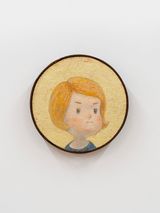
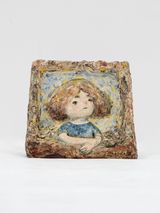
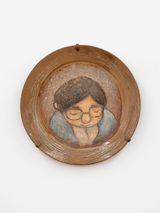
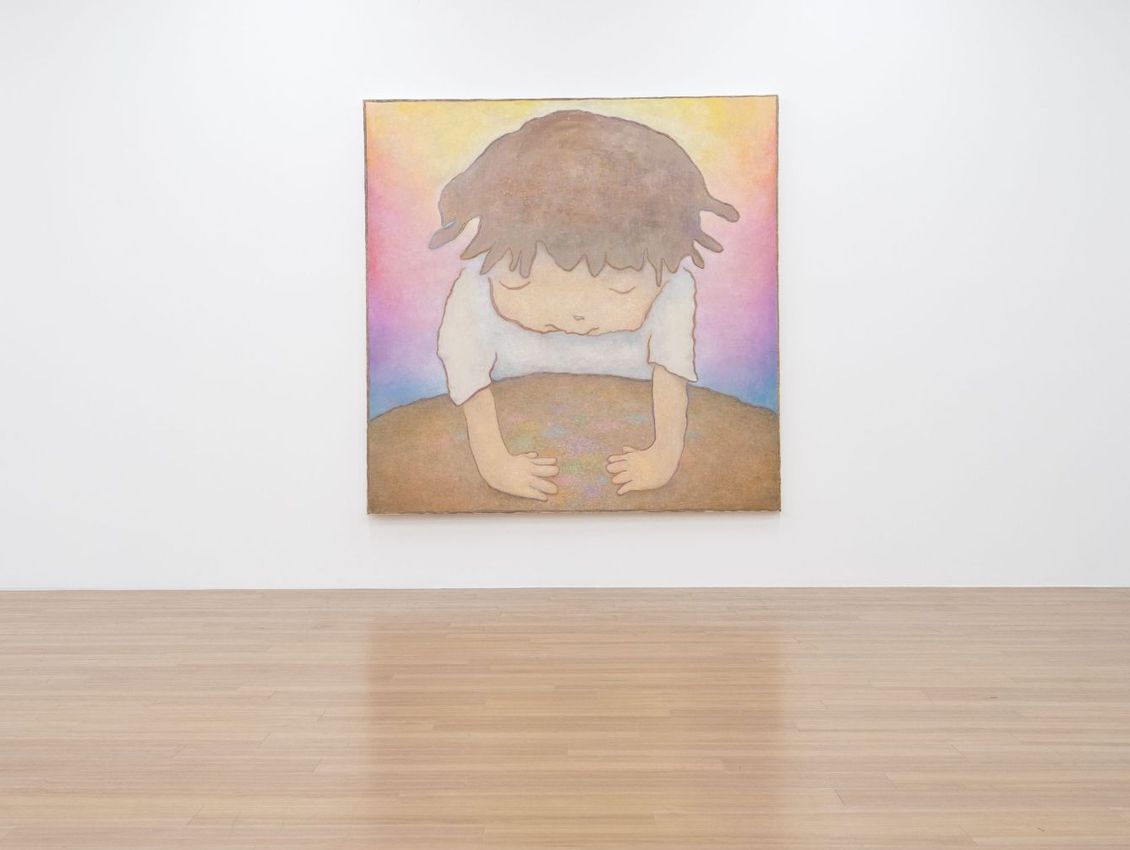
Otani transfers the unique tactile sensation experienced during theceramic-making process — the careful molding and shaping of claywith his fingers — onto two-dimensional mediums. He selects variedbases such as canvases, burlap sacks, wooden panels, and plates,and renders the tactile sensation through the dotting and layering ofpaint, creating a distinct textural effect in his paintings. At the sametime, he severs the direct connection between touch and ceramics,expanding this bodily experience across various mediums. Thus, whatwas originally a specific tactile sensation evolves into an abstractsensibility, freely flowing through the imageries he creates.

Otani’s unwavering loyalty towards his own perceptions allowed him tobreak free from the increasingly rigid cage formed by knowledge,systems, and education in reality. When he doubted the educationalapproach of art schools, he chose to take a sabbatical to experiencelife directly. As a beginner in Shigaraki, the epicenter of Japaneseceramics, Otani persisted in his trials and learning, seeking help fromlocal artisans to tackle technical challenges. Despite uncertaintiesabout becoming a sculptor, he tirelessly worked in his studio fromdawn to dusk, transforming the visions in his mind into tangible worksin his hands.

While standardized norms continually suffocate genuine bodilyperceptions, Otani has established his own standard as an individual.His world might appear hazy and elusive in his paintings, but such isthe reality of our world. And it is in chaos and uncertainty that poetryblossoms and beauty flourishes.

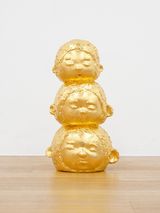
For Otani, the individual reigns supreme, each harboring a unique soul.The artist’s expression is simple and straightforward, as he often says, ‘Each work portrays an individual, and I hope viewers will observe eachone closely.’ The titles he assigns are equally straightforward, statingfacts such as ‘Boy,’ ‘Bear,’ ‘Sleeping Boy,’ ‘Golden Boy,’ and so forth.Each protagonist could be you, me, or anyone else, for we all sharecommon memories and experiences.

The recurring figure of ‘Tanilla’ — a small monster with horns andfangs, whose name is a portmanteau of Otani and Godzilla — mightwell be his self-portrait. Setting oneself as the standard, staying true topersonal experiences, and deviating from established traditions andrigid conventions can, in some ways, equate to being perceived as a ‘monster.’

In this upcoming exhibition at Perrotin Hong Kong, viewers will findthemselves amidst characters and ‘little monsters’ birthed from Otani’simagination, traversing the worlds he conjured for each soul. Here, youmight encounter echoes of your own solitude and moments of sharedperplexity. And as you wander, you are free to let your eyes and hearttake the lead. Come January 2024, Otani Workshop will unveil a soloexhibition at Kaikai Kiki Gallery. What metamorphosis will his charactersundergo then? We await the next chapter of this story with batedbreath.

Press release courtesy Perrotin. Text: Sara Yuan Jing.

Read More
About the Artist

Make no mistake: despite the name, Otani Workshop does not refer to a collective of artists, but to a singular, an eminently singular sculptor who has become the leading representative of Japanese ceramics. Silent and literally bulging heads, figures with their arms raised like praying figures, monumental middle fingers extended upwards, anthropomorphic vases, children, animals, soils, bronzes: Otani Workshop’s bestiary is a world in itself, a world in which dreams and tales converge as well as fantasies and daydreams, a world in which the queenly imagination and the kingly gesture triumph, in which forces and forms meet.

View Artist Profile

Also Exhibiting

About the Gallery
Emmanuel Perrotin founded his first gallery in 1989 at the age of 21. He has opened since then over 17 different spaces, with the aim of continuing to offer increasingly vibrant and creative environments to experience artists work. He has worked closely with his roster of artists, some since more than 25 years, to help fulfill their ambitious dreams and projects. The gallery is now based in New York, Paris, Hong Kong, Seoul, Tokyo, and participates in all the significant worldwide art fairs each year (Art Basel (Hong Kong, Miami, Basel), Frieze (London, New York), FIAC (Paris), Dallas Art Fair, Art Cologne, Art Stage Jakarta, Expo Chicago, Art021 & West Bund Art & Design, Shanghai, Zona Maco Mexico, amongst others).
View Gallery Profile
Address
807, K11 Atelier Victoria Dockside
18 Salisbury Road
Tsim Sha Tsui
Hong Kong
Hong Kong
Opening Hours
Tuesday – Saturday
11am – 7pm
(1)
Hong Kong 807, K11 Atelier Victoria Dockside, 18 Salisbury Road
Perrotin
807, K11 Atelier Victoria Dockside, 18 Salisbury Road, Tsim Sha Tsui, Hong Kong, Hong Kong
+852 375 821 80
http://www.perrotin.com

Opening hours
Tuesday – Saturday
11am – 7pm
The art world in focus