Press Release

For his new exhibition at Perrotin in Paris, New York-based artist Daniel Arsham revisits permanency while continuing to expand on his interest in Asian cultures,planetary cycles, and his own mortality—a subject inherent to his artistic practice.

Arsham, whose work has been widely exhibited internationally, questions not only the reception of a piece, but the influence a culture may have on new bodiesof work. Since the very beginning, Arsham has worked with the notion ofmemory and time, intertwining his interest with architecture, while storytellingand science fiction have always held a significant importance in his work. The artist’s personal memories of surviving a hurricane in 1992 made Arshammore sensitive to this idea of finiteness and is something we encounter in his reproduction of objects that deal with obsolescence. His recent exhibitionin Korea, which revolves around toys and animals, is a continuation of the artist’s_Fictional Archeology_ series first shown in 2013. Encasing the theme of a globalarcheology of the future and poetic ruins, these works tread a fine line betweenpast and future. The objects could be discoveries from the distant future,artifacts from our current civilization that the artist has carved out and eroded.

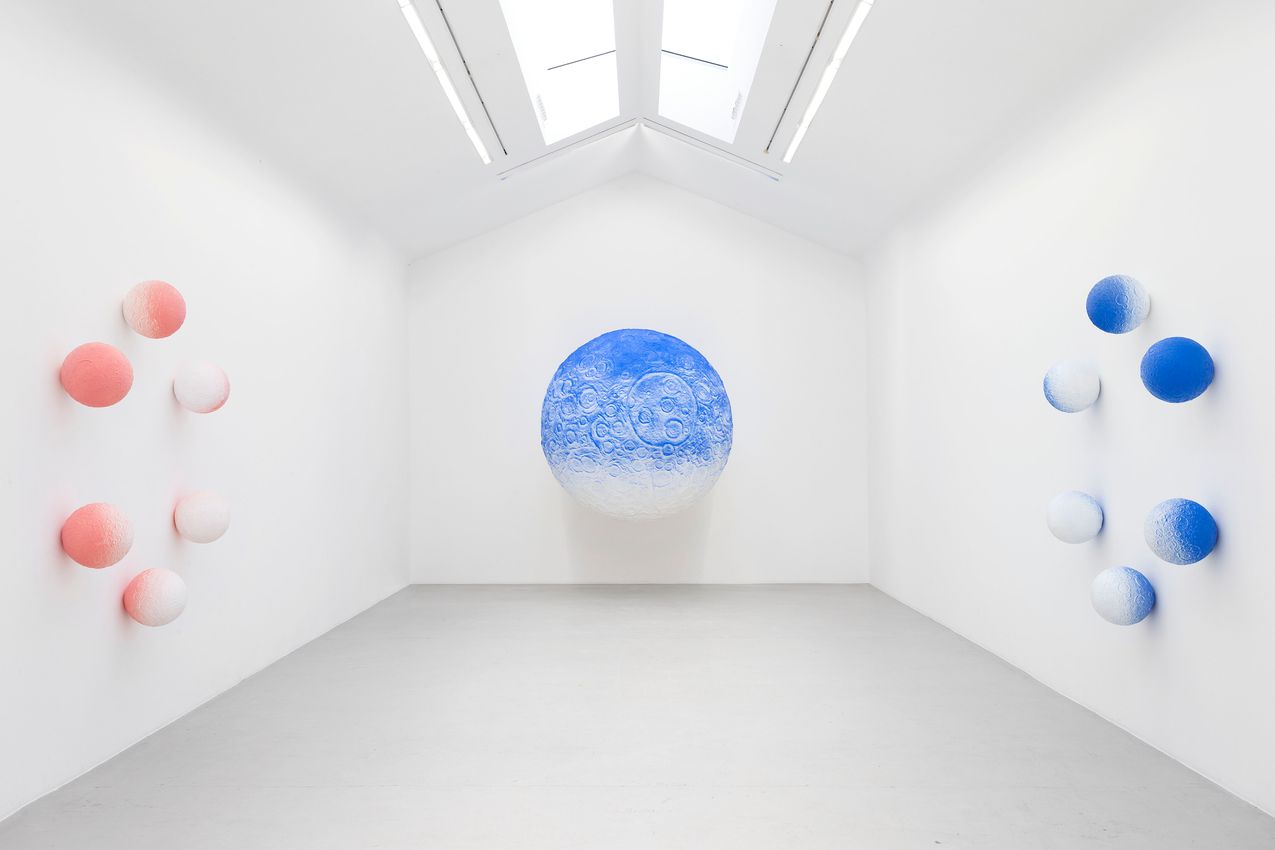
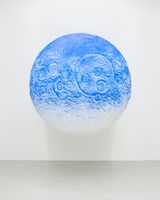
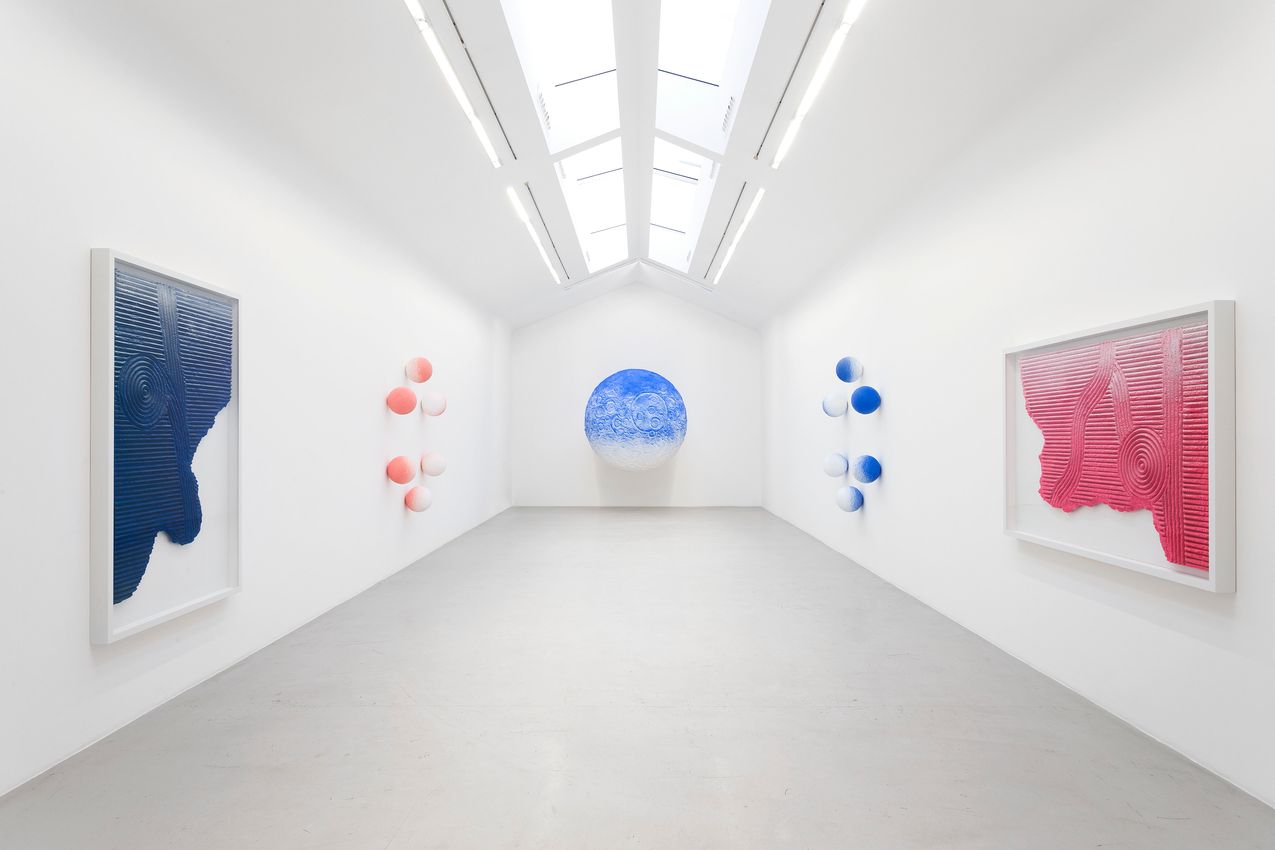
This approach is present in Arsham’s exhibition in Paris. Never forgetting the past practice of rigorously selecting objects, placing it amongst a certain conceptualprocess, and then meticulously reworking them at his studio. Gritty and terrestrialglobes with surfaces of the moon correspond to paintings made from sandwith geometric compositions. Arsham wanted to respond and match the spacein the Marais, explaining “I wanted to play with the lighting of the galleryand the way it directly or indirectly enters the space, with no connection at all with Paris’ total history.”

He says the exhibition would have been the same if it had been in the United Statesor Asia—even if childhood remains a strong topic in Asia, topic that alsoinspired the toys created for his exhibition in Korea earlier this year.In 2005, Arsham’s first Parisian representation touched on the notion of time as well and was entitled Homesick.

He displayed his interest in architecture and construction more directly backthen, blending imaginary structures with nature, while tying in modernism.

It’s as if he has taken some distance these last few years. Arsham is now exploring a passion for astrological timelessness and Eastern philosophies. The craters that trim his globes or sand paintings are one of his emblematictrademarks, always referring back to the idea of infinitude, as well as unsettlingfragility. He adds, “In this exhibition, the question of time is seen on the one hand through the moon cycle, creating a link between this star and the decadenceof objects.

They appear as if they came from the past, all while playing on the ambiguity of the residue that could have clearly only come from the future. When it comesto the sand paintings and the gardens composed of vivid colored pigments, they come from my research on Tibetan mandalas. In Japanese culture as well,for hundreds of years these same shapes and patterns have been exploredand sometimes even modernized in their composition. I’m talking about the conception of cycles that seem static and unchanged for life, when in factthey are reused on a daily basis. My sand paintings are like a fixed version that seems temporary and ephemeral, when in fact it’s the opposite and they playon the idea of representation. My primary subject is therefore this connectionbetween permanent and impermanent”.

Moreover, it is an analogy for a creative process that finds itself pushed and energized by the different locations and cultures wherever his work is exhibited.The understanding of his work can sometimes be mistakenly interpreted basedon his nationality. Upon seeing the planets, one could think an allusion is made to the quest of outerspace or to a Pop side the pieces evoke. Daniel Arsham finds himself moreand more introspective and connected to an uchronic school of thought (if the past hadn’t been the past, what would the present or future be?). He absorbsdifferent cultures, rides on temporalities, happily gazing in different directions,often on the sidelines of contemporary art. This intimate work is nowadays strictlyassociated to slow speed and contemplation, even though Arsham never fails to concurrently communicate, through the high-speed and oversaturated socialmedia platforms. But the time dedicated to an exhibition is different, intimatelyresting, as the title suggests: “The Angle of Repose” is also, by definition, the angle at which a material will naturally bend until adopting a conical shape.It is a question of balancing particles, or physics, combined with the game of chance and a certain willingness to let go...

Marie Maertens - Curator and art critic

Read More

Installation Views

About the Artist

Daniel Arsham’s uchronic aesthetics revolve around his concept of fictional archaeology. Working in sculpture, architecture, drawing and film, he creates and crystallises ambiguous in-between spaces or situations, and further stages what he refers to as future relics of the present. They are eroded casts of modern artifacts and contemporary human figures, which he expertly makes out of some geological material such as sand, selenite or volcanic ash for them to appear as if they had just been unearthed after being buried for ages. Always iconic, most of the objects that he turns into stone refer to the late 20th century or millennial era, when technological obsolescence unprecedentedly accelerated along with the digital dematerialisation of our world. While the present, the future and the past poetically collide in his haunted yet playful visions between romanticism and pop art, Daniel Arsham also experiments with the timelessness of certain symbols and gestures across cultures.

View Artist Profile

Also Exhibiting

About the Gallery

Emmanuel Perrotin founded his first gallery in 1989 at the age of 21. He has opened since then over 17 different spaces, with the aim of continuing to offer increasingly vibrant and creative environments to experience artists work. He has worked closely with his roster of artists, some since more than 25 years, to help fulfil their ambitious dreams and projects.

View Gallery Profile
Address
76 rue de Turenne
Paris
France
Opening Hours
Tuesday – Saturday
10am – 6pm
(1)
Paris 76 rue de Turenne
Perrotin
76 rue de Turenne, Paris, France
+33 1 42 16 79 79
http://www.perrotin.com

Opening hours
Tuesday – Saturday
10am – 6pm
The art world in focus