



ShugoArts is pleased to announce the opening of a solo exhibition by Shigeo Toya from Saturday, January 8, 2022.
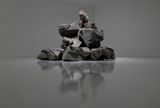
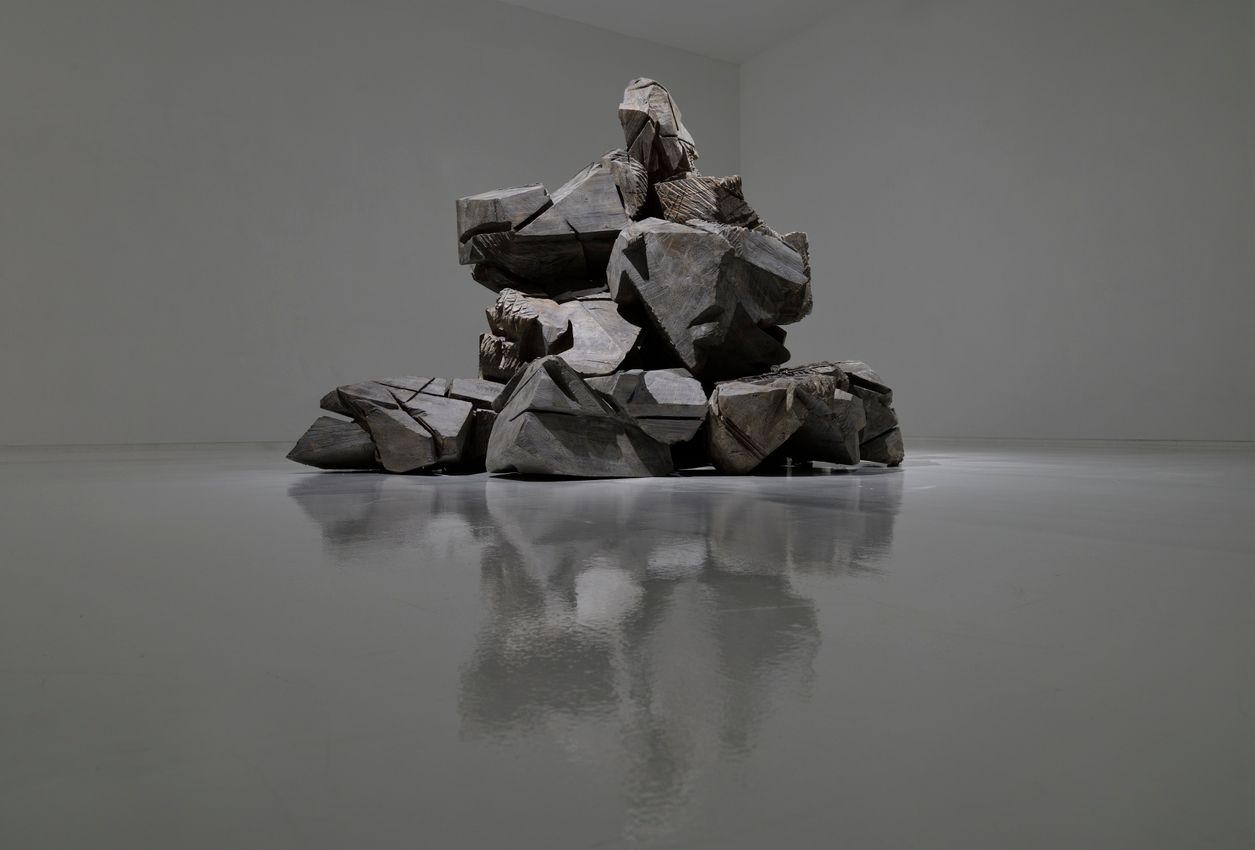
In this exhibition, Body of the Gaze−Linkage, a ‘mass’ sculpture with linked wood, will be installed in the front room, and Body of the Gaze−Accumulation, another ‘mass’ sculpture with stacked wood, will be placed in the back room.
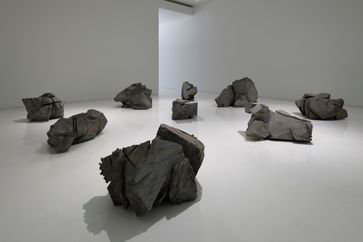
In his solo exhibition at ShugoArts in 2019, Toya installed Body of the Gaze consisting of nine masses in the front room and Body of the Gaze−Scatter consisting of scattered pieces on the four walls in the back room. This time, the artist will showcase Body of the Gaze−Linkage, which he created during spring of this year and presented in his solo exhibition at KENJI TAKI GALLERY in Nagoya, and his latest work Body of the Gaze−Accumulation.
Named as Body of the Gaze, this series contains four parts that propose continuous sculptural development: mass, scatter, linkage and accumulation.
What this exhibition entails is Toya’s blueprint for the so-called greater theory for the sculptural development movement.
Uncountable masses scatter
from scatter to linkage: from linkage to accumulation: from accumulation to mass
↓↑
forming greater scatters with masses created from the previous process
from scatter to linkage: from linkage to accumulation: from accumulation to greater mass
↓↑
with far greater masses created from the previous process
from scatter to linkage: from linkage to accumulation: from accumulation to far greater mass
The arrows are shown in both directions; however, they do not represent circulation or entropy. They imply the cosmic perspective of sculptures which maintain the mandala-like continuity to expand from individuals to groups or the continuity to shrink from groups to individuals.
What made Toya establish his unique sculptural worldview as such?
A couple of decades after the war, the 1970s was still a turbulent time. The young sculptor Toya was about to get his foot in the door to enter into the world of non-figurative sculpture, leaving figurative sculpture behind. His unique sculptural worldview sheds light on his own background, the social situation at the time, and his thought process to prove the existence of sculpture. Thus, the foundation of Toya’s art practice resides in this cosmic perspective of sculptures with the mandala-like continuity, yet this fact has not been recognised by many for years.
Intersection of individuality and others
Intersection of history and ordinariness
Intersection of illusion and existence
We are to gain a perspective to break through our own “invisibility” and reality of the present moment there.
We have to place what we draw up from the source of ordinariness between the history of expression and our own way of expression. Having placed it between them, we have to intentionally transform ordinariness qualitatively and break through its old quality.
There seems to be only one way to attain its new quality, which is to include the eyes of others, or otherness in another word, inside us.
Quoted from Shigeo Toya — For the Intersection of Illusion and Existence (1975)
Toya had already established this rather pressing sculptural worldview that embodies continuity in the 1970s. However, he had to wait until the 1980s to realize this concept in his two series: Woods and Spirit Regions, which solidified his status as a sculptor. This exhibition coherently presents the viewers with Toya’s uninterrupted sculptural view.
Both Woods and Spirit Regions have their own individuality as units and they would become scatter or linkage, and accumulation or mass when integrated, according to each exhibition. Every single one of Woods or Spirit Regions are independent as they are, and numerous strokes from Toya’s chainsaw confer identities on those works. Toya calls his sculptural concept as Body of the Gaze, which encompasses multi-layered identities engendered by every stroke of his chainsaw (gaze). His concept also contains a unit in itself that implies continuity: ‘mass – scatter – linkage – accumulation – mass,’ which simultaneously ushers the viewers into his sculptural world that is as flawless as a mandala, suggesting infinite expansion.
Takaaki Yoshimoto once said in his essay Incomprehensibility of Sculpture, “Why do humans make sculptures even though the world is already there? That is an eternal question.” Toya has been trying to give his answer to this question ever since.
Born in Ogawa, Nagano, Japan, in 1947. It has been a while since he has been accepted as one of the leading sculptors in Japan and Asia-Pacific at large thanks to his body of work, which is based on his exceptional sculptural view. Selected exhibitions: The 43rd Venice Biennale, Japanese Pavilion, Venice (1998); Yama - Mori ‒ Mura, Kuma Museum of Art, Ehime (1994); Forest of Visions, Hiroshima City Museum of Contemporary Art, Hiroshima (1995); The 3rd Kwangju Biennale, Kwangju, Korea (2000); Shigeo Toya: Folds, Gazes and Anima of the Woods, Aichi Prefectural Museum of Art, Aichi (2003); Memories in the cave, Vangi Sculpture Garden Museum, Shizuoka (2011–2012); Shigeo Toya−Sculpture to Emerge, Musashino Art University Museum & Library, Tokyo (2017). Selected publications: Shigeo Toya−Sculpture and Words (Choukoku-To-Kotoba) 1974–2013, Vangi Sculpture Garden Museum (2014); Shigeo Toya−Sculpture to Emerge, Musashino Art University Museum & Library (2017)

ShugoArts, established by Shugo Satani in 2000, values its locality, selects its artists regardless of their time and place, and sends out its activities from Tokyo.
Today, it has gotten much easier to appreciate various artworks of all times and places and their meanings, as well as spaces exhibiting artworks, need to be redefined, including contemporary art galleries. ShugoArts prioritises how to realise artists’ own growth as artists or make the most of their accomplishments. In order to nurture their abilities and possibilities, we provide our space for artists to express themselves freely and follow their artistic journeys side by side. Under any circumstances, our mission is to work and grow together with artists who ceaselessly create artworks, which shine a light on life and give it validation.
ShugoArts holds about 7 exhibitions a year and participates in national and international art fairs while simultaneously managing commissions for public spaces and organising performance and talk events. In addition, we also would like to be a part of art histories at large by creating invaluable archives and assisting art institutions.

A respected voice in contemporary art discourse.
Focusing on ambitious storytelling and insightful art-world commentary. Ocula Magazine publishes in-depth interviews, critical essays and timely analysis on the artists, exhibitions and ideas driving the global art world.
Learn more about Ocula Magazine
Showcasing the best of the art world.
Ocula partners with galleries from around the world to highlight their artists, artworks and exhibitions. Gallery membership is by application and invitation, with each member vetted by an independent panel.
Learn more about Ocula Membership

Specialises in the sale of major artworks.
Led by a team with deep ties to the world’s leading auction houses, galleries and collectors. Ocula’s advisory team offers bespoke services to high-net-worth clients from around the world who are looking to acquire the best of contemporary and modern art.
Learn more about our team and services