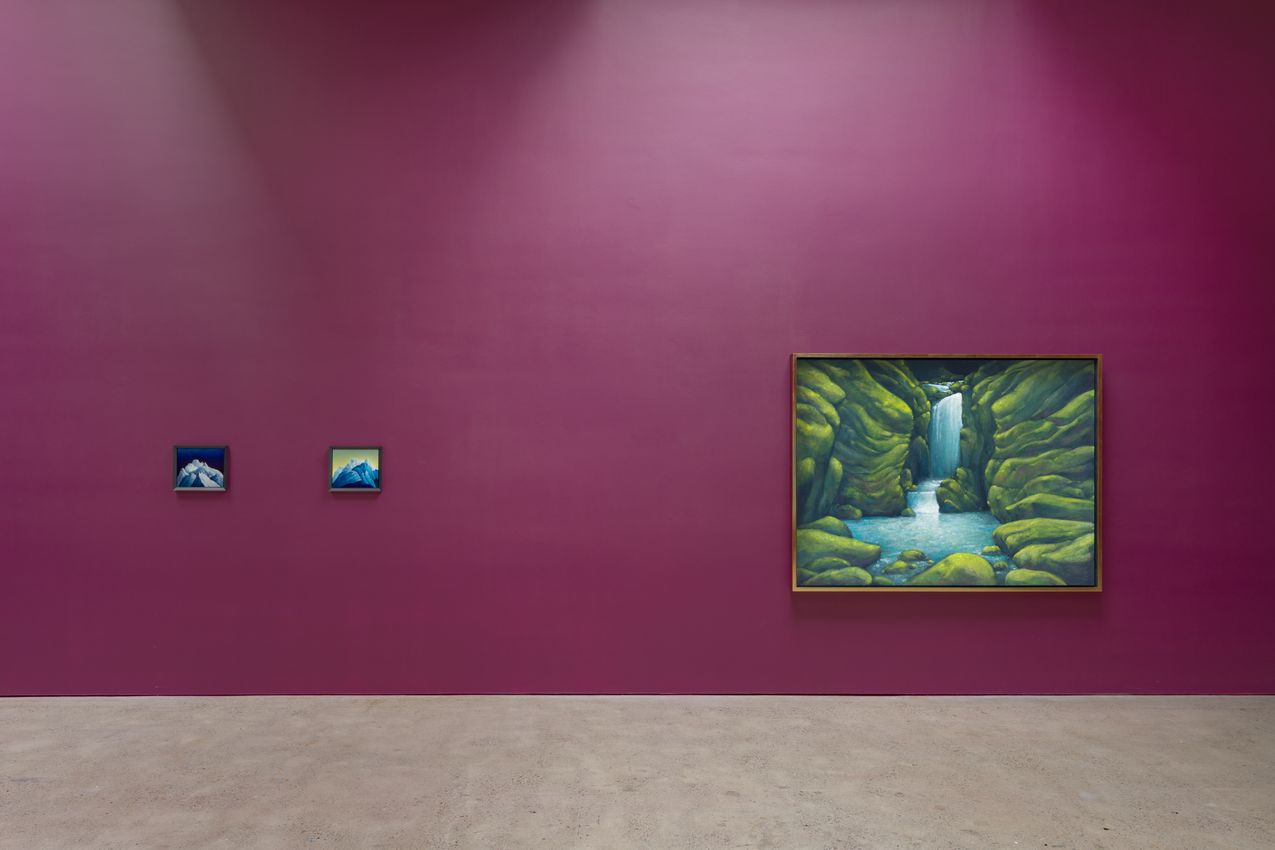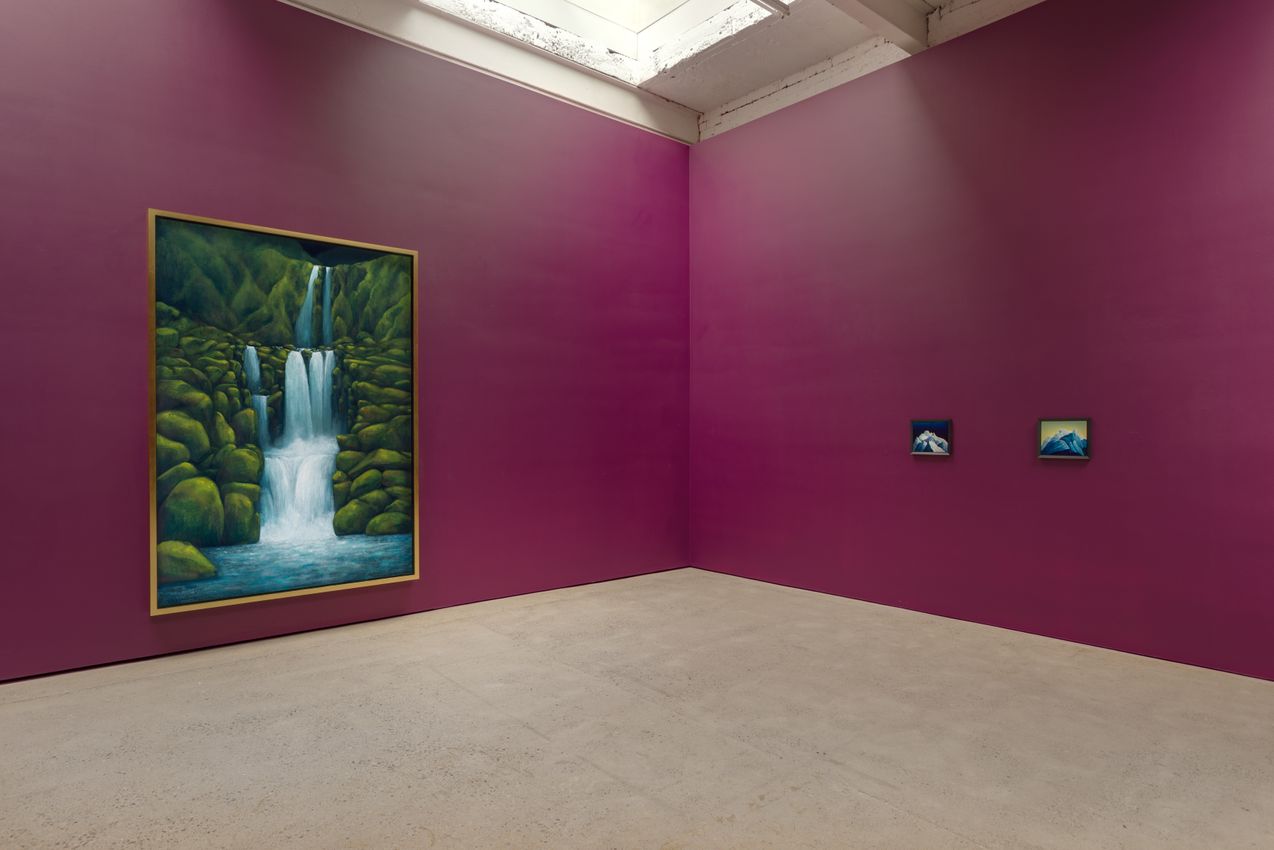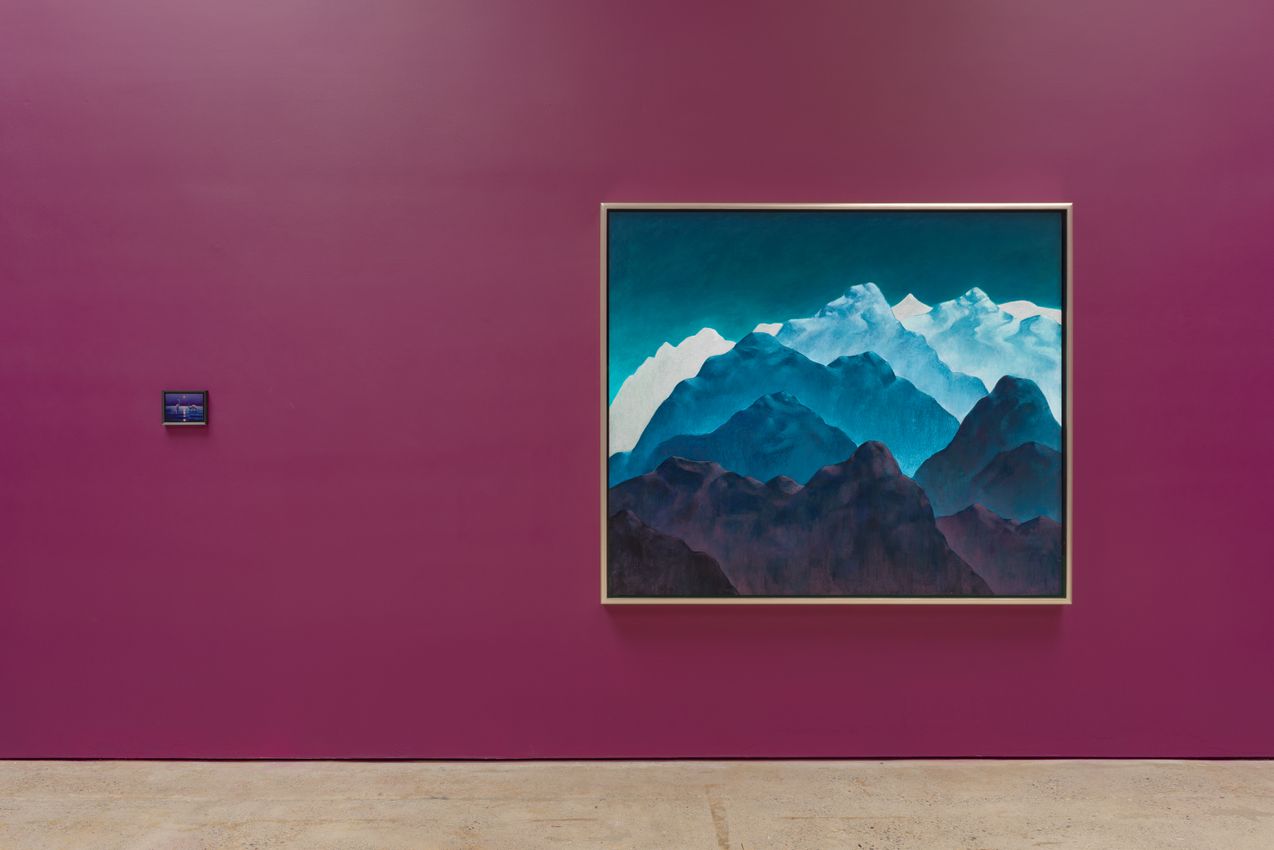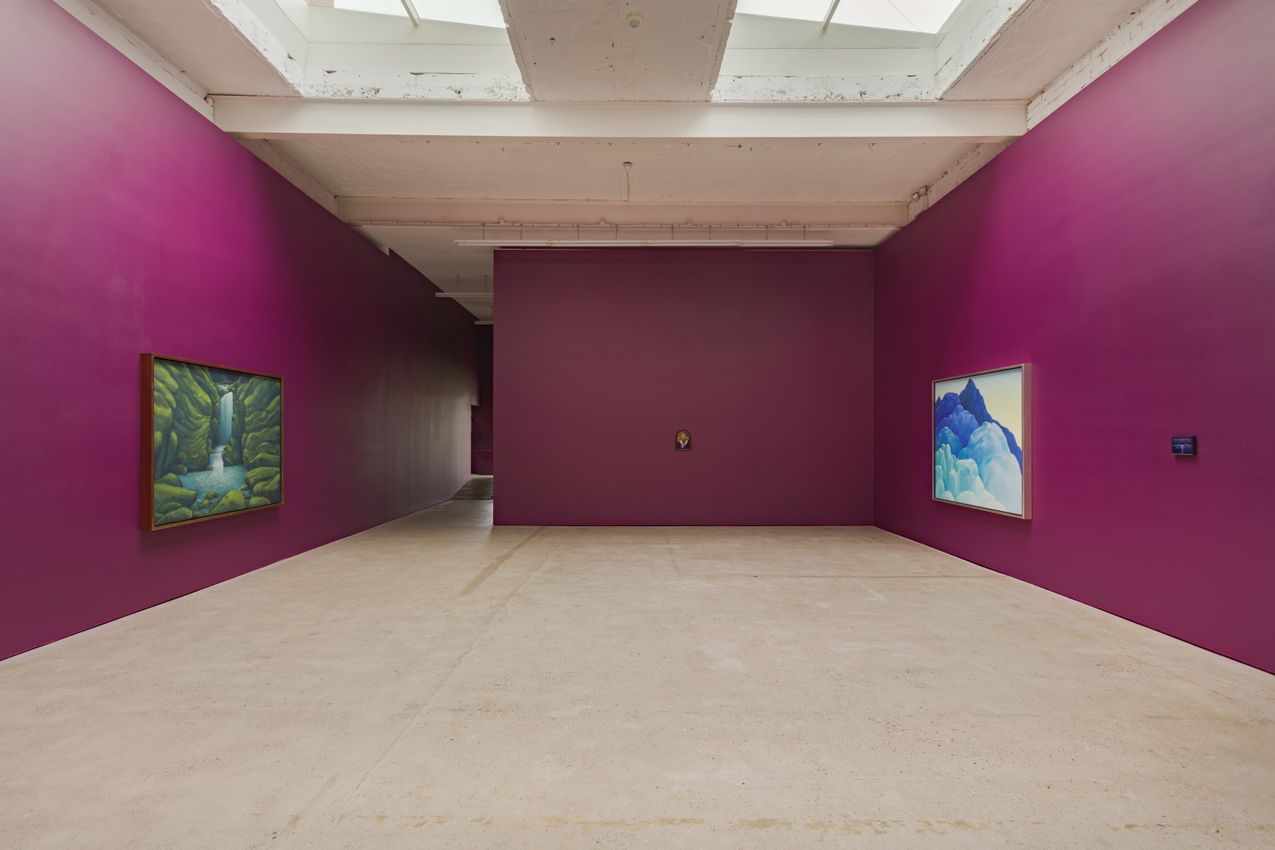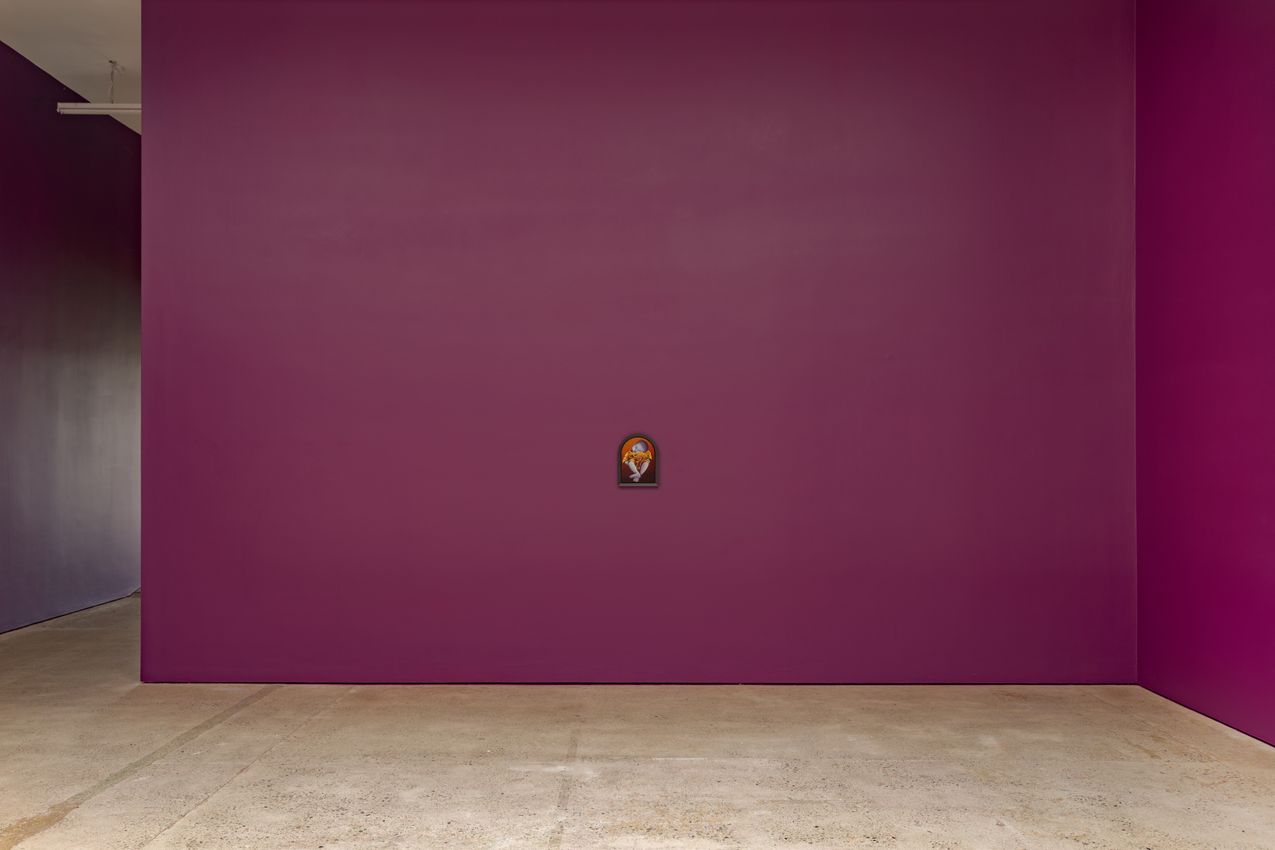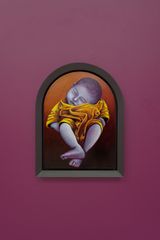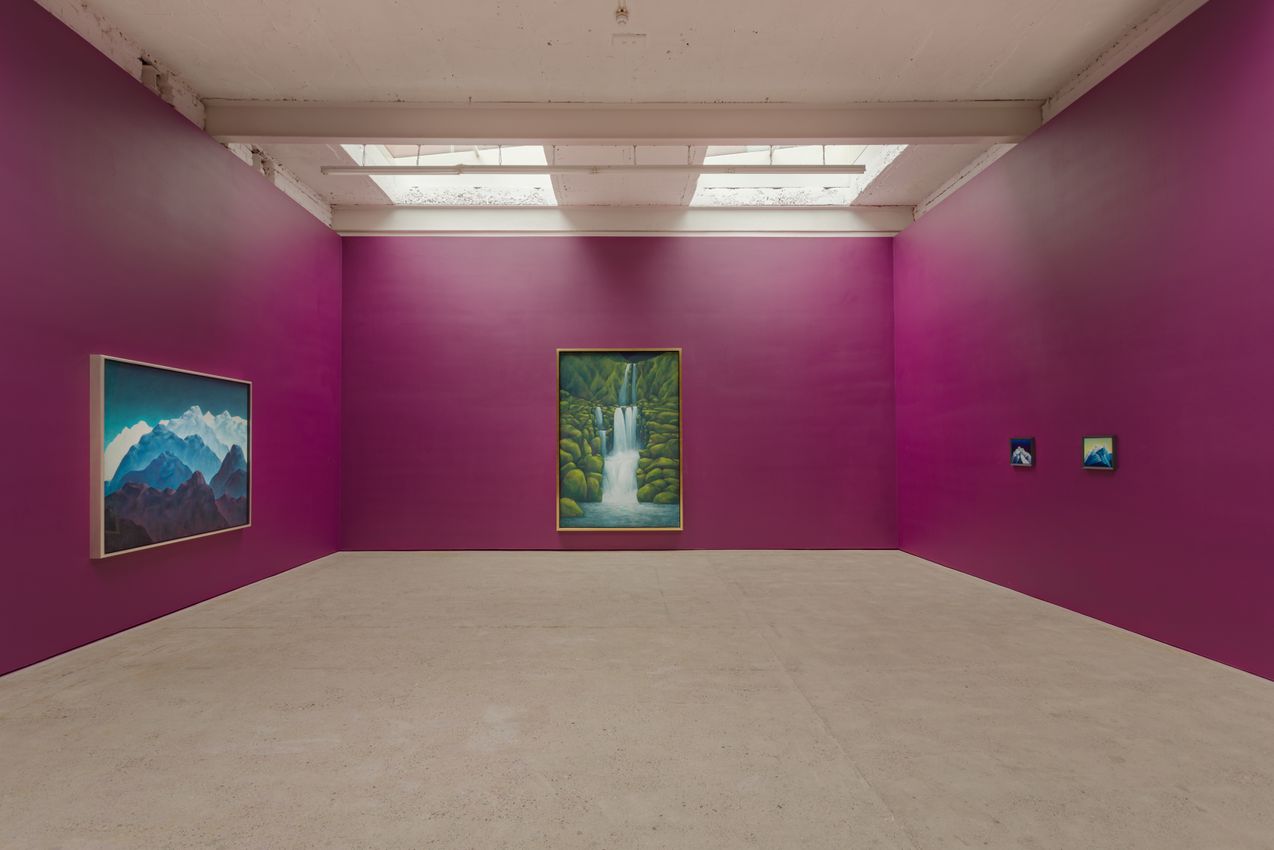
For Cretaceous, Nicolas Party’s sixth solo exhibition at The Modern Institute, the artist produced an exhibition occupying Aird’s Lane and the Bricks Space comprised of large pastels and intimately scaled oil-on-copper paintings displayed on freshly painted walls. Collectively, the pieces highlight changes in scale and focus, from sublime mountains and waterfalls to an intimate painting of a small baby. While they contain a variety of subject matters, Party imbues each work with a compelling timeless quality, speaking to the artist’s abiding concern with classical symbols and iconography.
The exhibition’s title takes its name from the geological period which ended in a mass extinction event 66 million years ago. In this sense, Party’s title can be understood as both a response to the apocalyptic moment humans find themselves in, where many of the earth’s species are being made extinct due to climate change, and a more general meditation on the creative and destructive qualities of natural forces. Throughout the exhibition, Party also utilizes his expansive knowledge of art history to work consciously within the established genres of Western art. This enables him to reduce a style to its essence, engage with its metaphorical potential and question the categorisations inherent to each format.
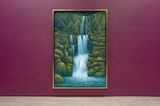
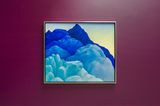
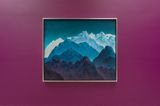
In his pastels, Party presents the viewer with various imagined subjects. The landscapes all depict singular, archetypal vistas that engage with the Romantic notion of the sublime – the internal and emotional mixes with the external forms of nature. The mountain and waterfall pieces, void of humans and animals, have a particular mystical, immutable quality and, as such, remain open and poetic statements to which the viewer can respond. The waterfalls utilise close tones of blue and green, their compositions a nod to Gustave Courbet’s celebrated waterfall canvases from the 1870s. Party’s calm mountain silhouettes are less graphic than many of his previous works and embrace more abstract and atmospheric elements, recalling Georgia O’Keeffe’s expansive paintings of clouds and sky from the mid-1960s.
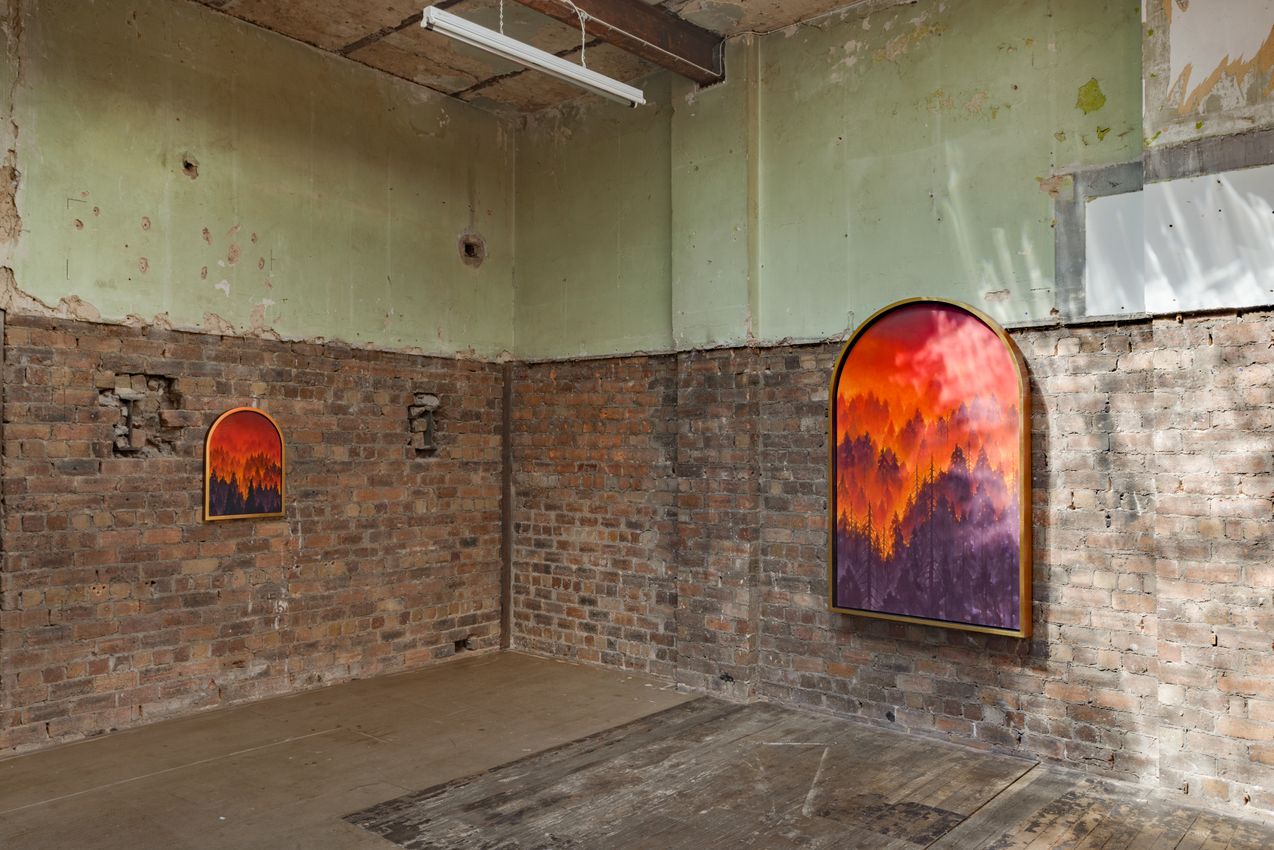
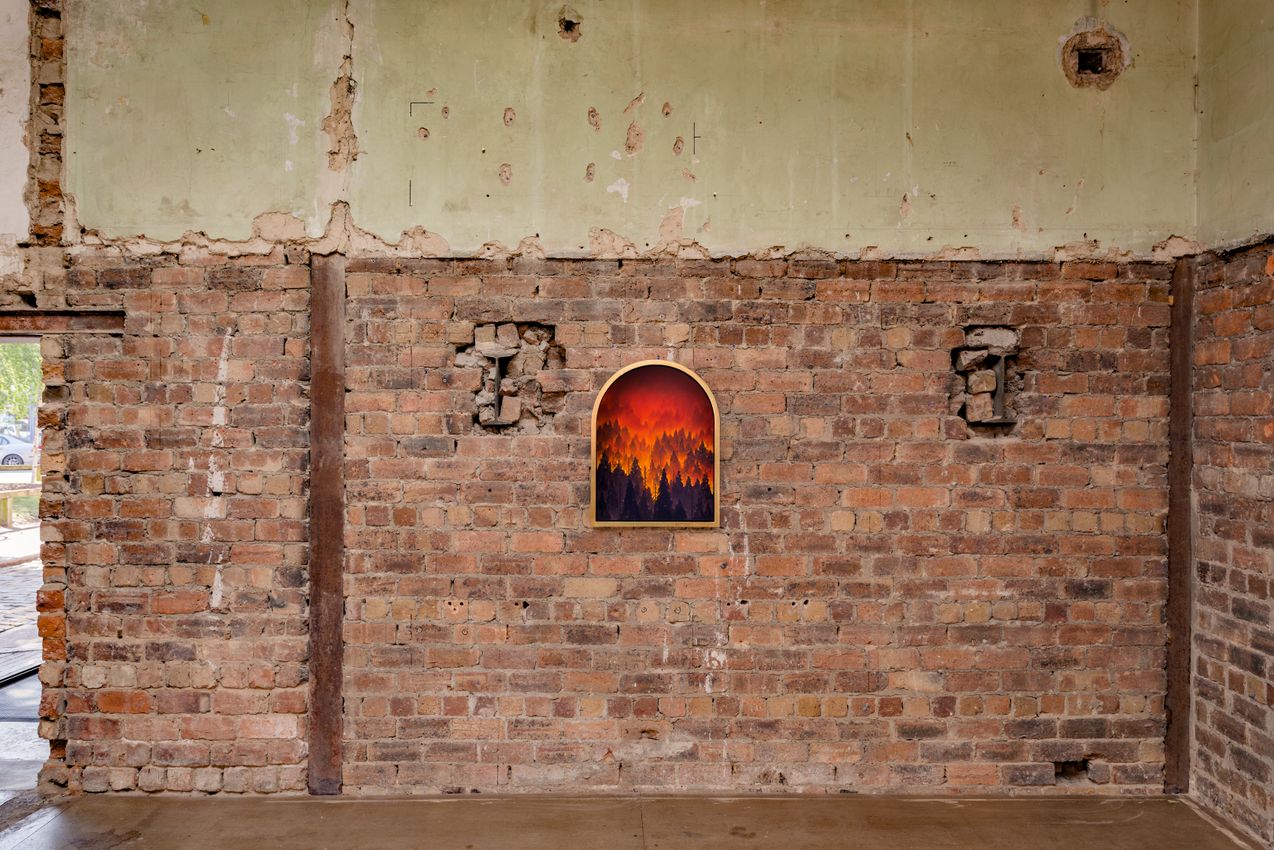
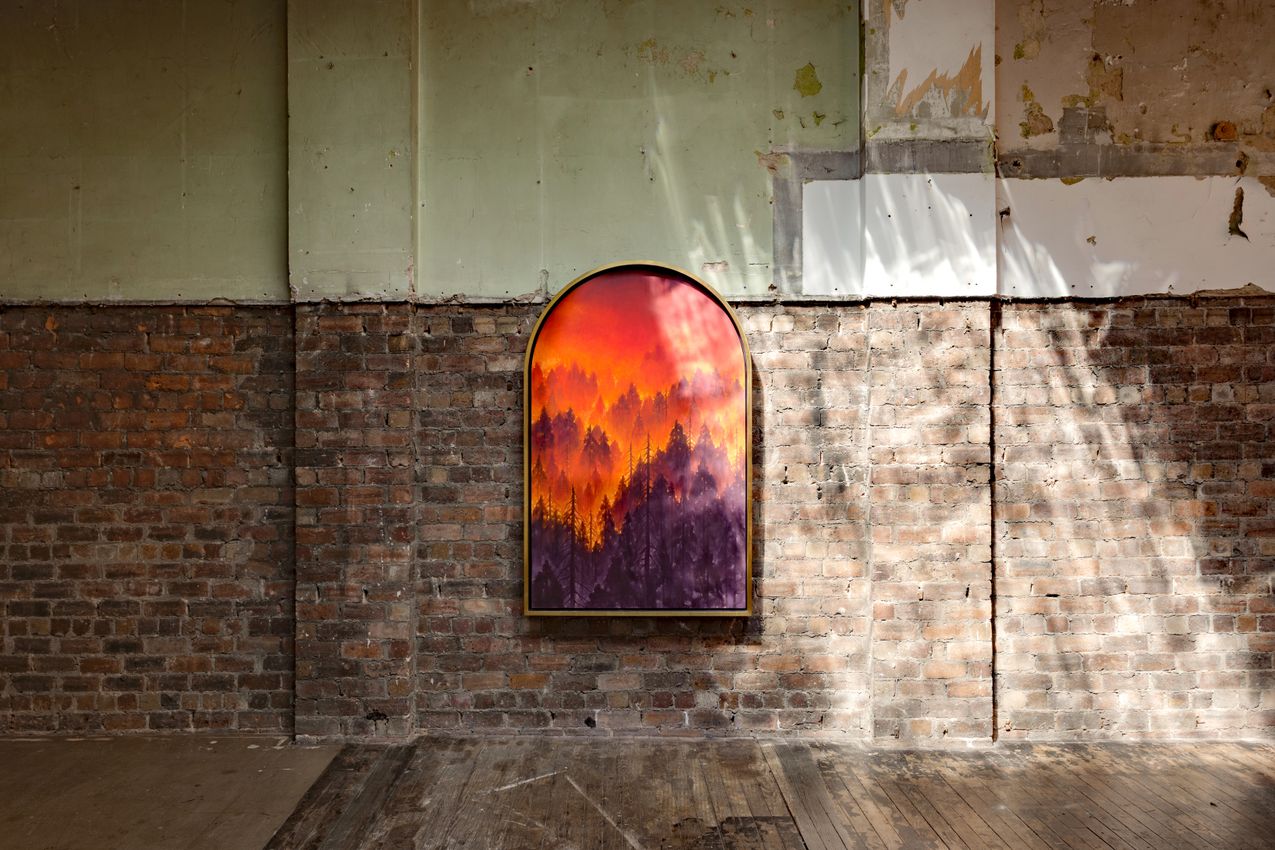
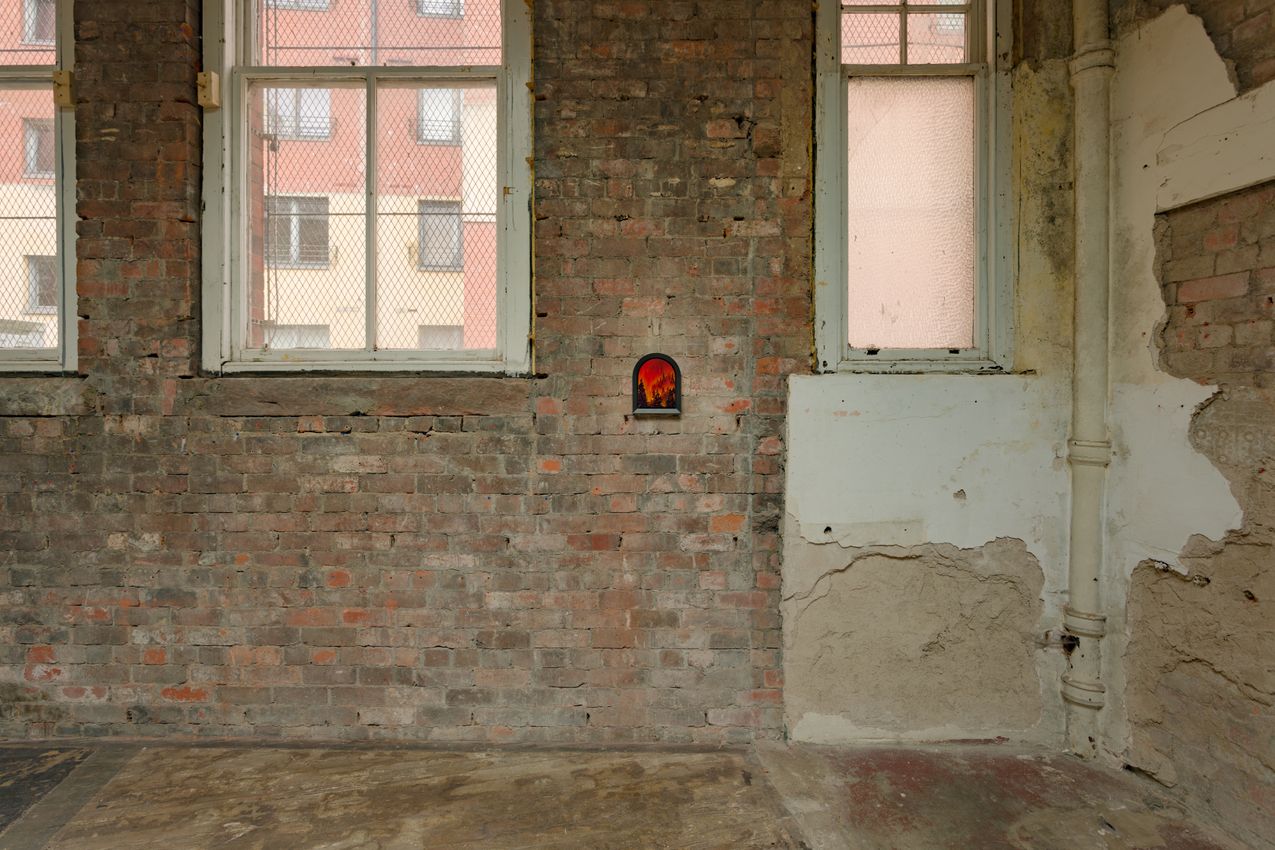
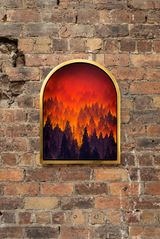
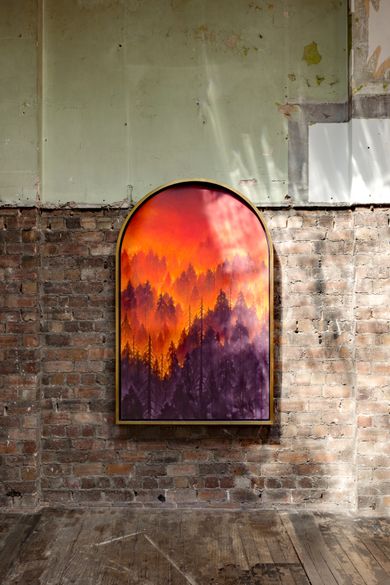
Party’s waterfalls and mountains stand as a balancing force to the fiery ‘Red Forest’ pieces. The singular motif, forest fires, is the closest to an image of climate disaster in the exhibition. The metaphorical images of destruction, speak to a perennial human anxiety about the end of the world. Recently, Party has been considering the precedents for this kind of imagery throughout art history, particularly paintings of the destruction of Sodom and Gomorrah. Art history remains a key area of research and inspiration for the artist. In the ‘Red Forest’ landscapes, it allows the artist to place apocalyptic thinking within a tradition, trace human’s relationship to the environment across time and consider the precedents of figuration in painting.
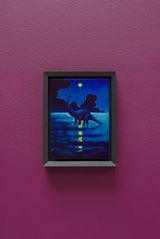
The absence of humans or animals in his landscapes is conspicuous in contrast to Party’s paintings of dinosaurs and of a baby. The gravity of the landscape tableaux sits alongside these hopeful and playful inclusions. Like the landscapes, both focus on enduring subjects which to some extent exist outside of time. The painting of the baby chimes with European paintings of the Christ child. The dinosaur works are the result of Party’s study of the history of dinosaur illustration and, in particular, how it changed over time as scientific understanding evolved. While steeped in art historical consideration and research, Party’s paintings remain stylistically cohesive, graceful and idiosyncratic. He is fascinated by the shifting meaning of these motifs and symbols across cultures. In tandem with the various elemental landscape scenes, these works construct an elegant, humorous and wide-ranging consideration of the passage of time – of transience and flux.
Selected solo exhibitions and commissions include: ‘Nicolas Party: Triptych’, Poldi Pezzoli Museum, Milan (2022), ‘L’heure mauve’, Montreal Museum of Fine Art, Montreal (2022), ‘Rovine (Ruins)’, MASI Lugano, Lugano (2021), ‘Heads and Cave (Têtes et Grotte)’ Kunsthalle Marcel Duchamp, Cully (2021), ‘Polychrome’, The Modern Institute, Glasgow (2019); ‘Arches’, M WOODS, Beijing (2018); ‘Magritte Parti’, Magritte Museum, Brussels (2018); ‘Head’, The Modern Institute, Aird’s Lane Green as part of Glasgow International (2018); Space ‘Speakers’, Modern Art Oxford (2017); ‘Dinner for 24 Sheep’, The Arnold and Marie Schwartz Gallery Met, New York (2017); ‘sunrise, sunset’, Hirshhorn Museum and Sculpture Garden, Washington DC (2017); ‘Cafe Party’ commission, Jupiter Artland, Edinburgh (2017); ‘Three Cats’, The Modern Institute (2016); Palazzo Antinori, Florence (2016); ‘Hammer Projects: Nicolas Party’, Hammer Museum, LA, 2016; Dallas Museum of Art, Dallas (2016); ‘Cimaise’, CAN: Centre d’art Neuchâtel, 2016; Neuchâtel; ‘Snails in Notting Hill’ (with Jesse Wine), RISE Projects, Lon-don, 2015, ‘Panorama’ , SALTS, Basel (2015); ‘Boys and Pastel’, Inverleith House, Edinburgh (2015); ‘Pastel et nu’, Centre culturel suisse, Paris (2015); ‘Trunks and Faces’, Westfälischer Kunstverein, Muenster (2014); ‘Landscape’, Kunsthall Stavanger, Stavanger (2014); ‘Still Life oil paintings and Landscape watercolours’, The Modern Institute, Glasgow; ‘Still Life, Stones and Elephants’, Swiss Institute, New York (2012); ‘Still Life, Gold and Peeling Paint’, ReMap 3, Athens (2011); and ‘Dinner for 24 Elephants’, The Modern Institute, Glasgow (2011).

Nicolas Party is a Swiss-born contemporary artist celebrated for his vividly coloured pastel paintings, surreal murals, sculptures, and installations that merge classical art history with playful, dreamlike imagery. Widely recognised for reinvigorating figurative painting, Party has exhibited internationally at major institutions and art galleries, captivating audiences with his distinctive, immersive worlds.


The Modern Institute was founded in Glasgow in 1997. The gallery works with 45 internationally established and emerging artists including Martin Boyce, Jim Lambie, Richard Wright, Anne Collier, Cathy Wilkes, Simon Starling, Urs Fischer, Luke Fowler and Nicolas Party.

A respected voice in contemporary art discourse.
Focusing on ambitious storytelling and insightful art-world commentary. Ocula Magazine publishes in-depth interviews, critical essays and timely analysis on the artists, exhibitions and ideas driving the global art world.
Learn more about Ocula Magazine
Showcasing the best of the art world.
Ocula partners with galleries from around the world to highlight their artists, artworks and exhibitions. Gallery membership is by application and invitation, with each member vetted by an independent panel.
Learn more about Ocula Membership

Specialises in the sale of major artworks.
Led by a team with deep ties to the world’s leading auction houses, galleries and collectors. Ocula’s advisory team offers bespoke services to high-net-worth clients from around the world who are looking to acquire the best of contemporary and modern art.
Learn more about our team and services