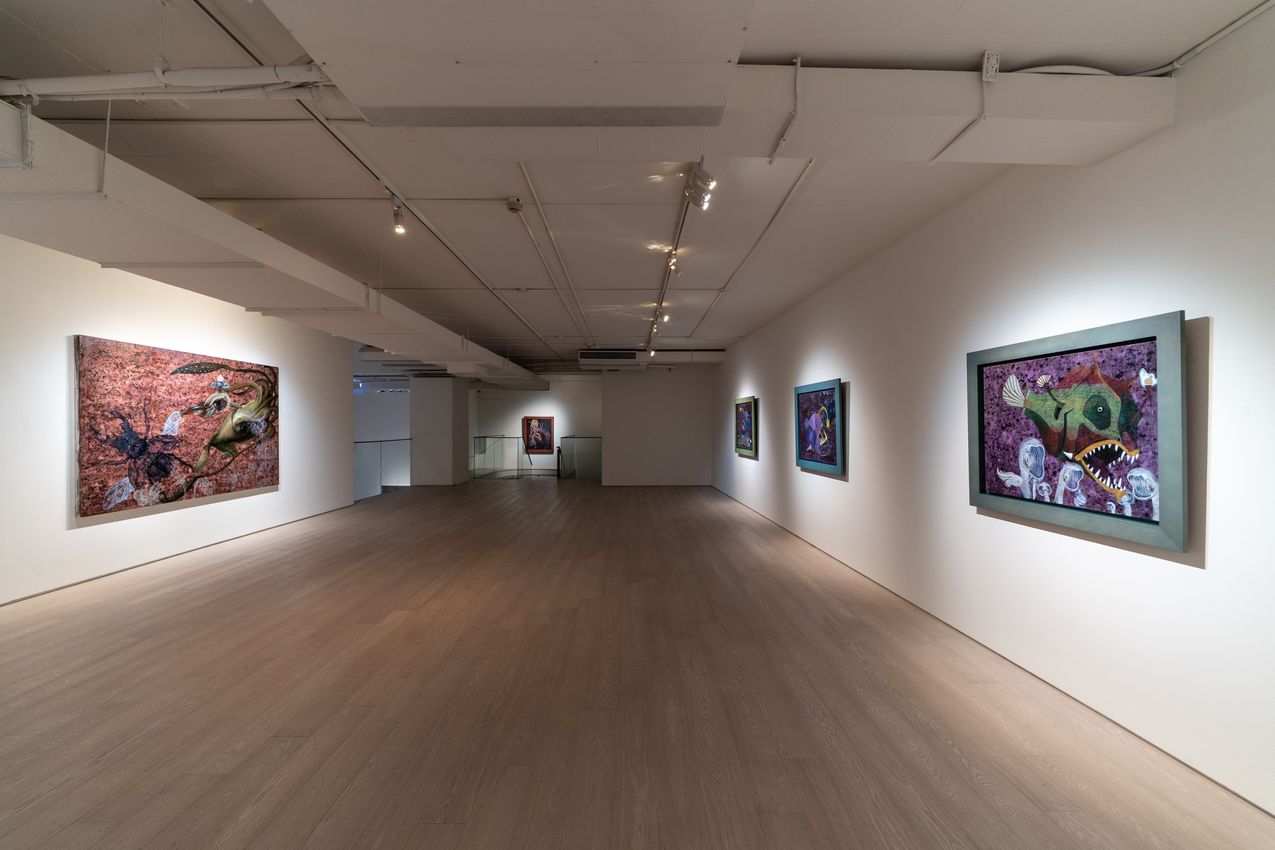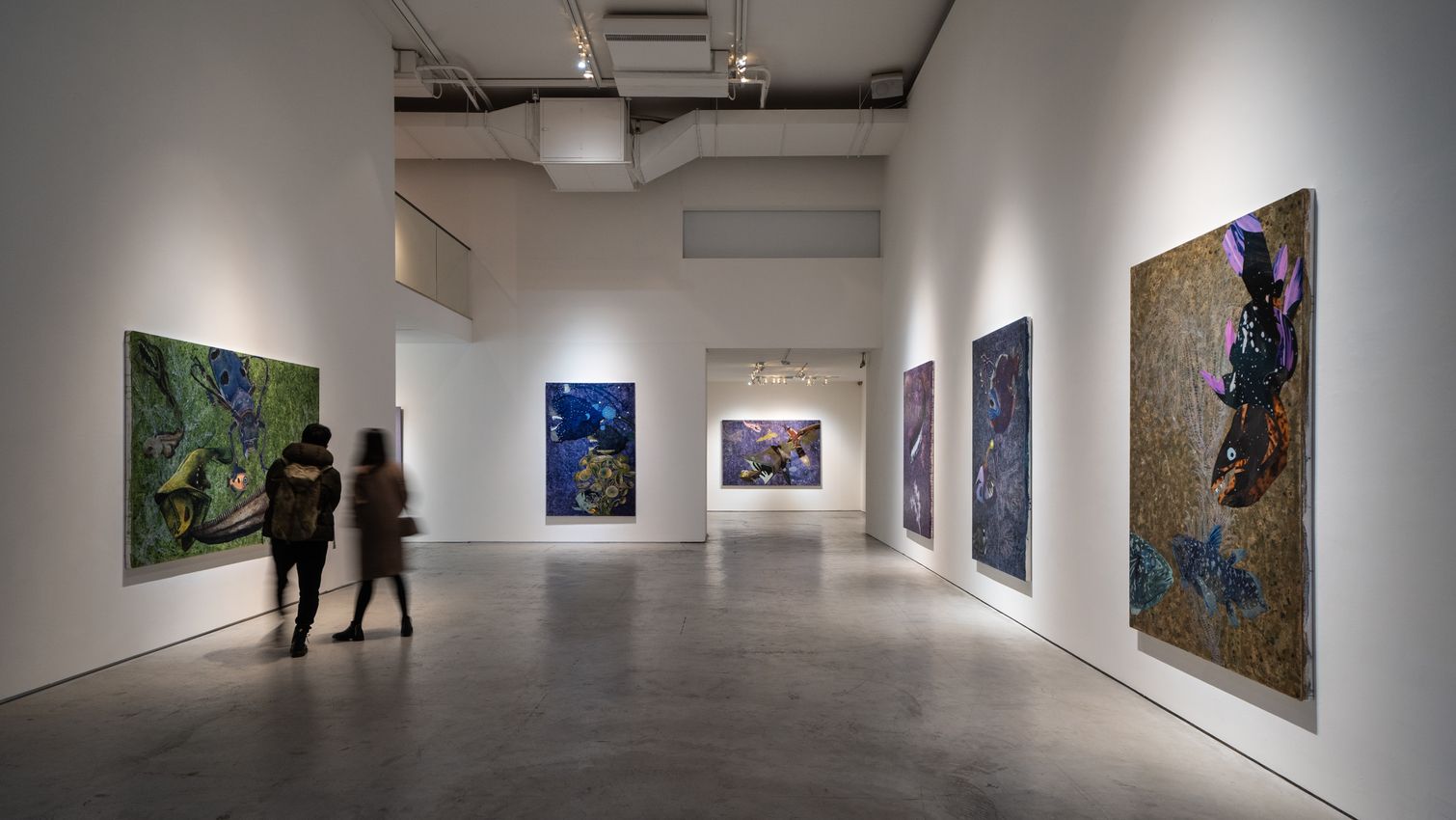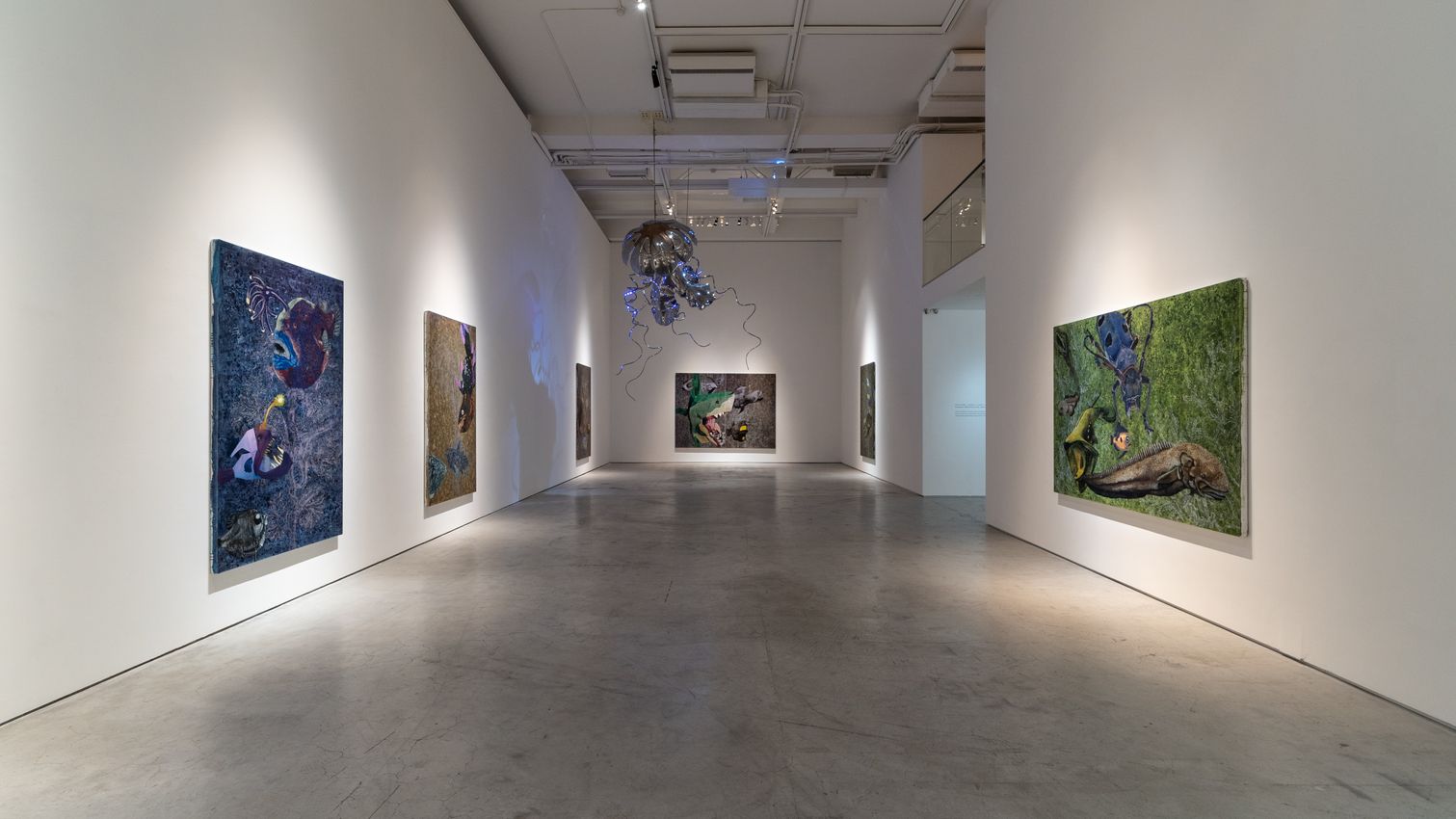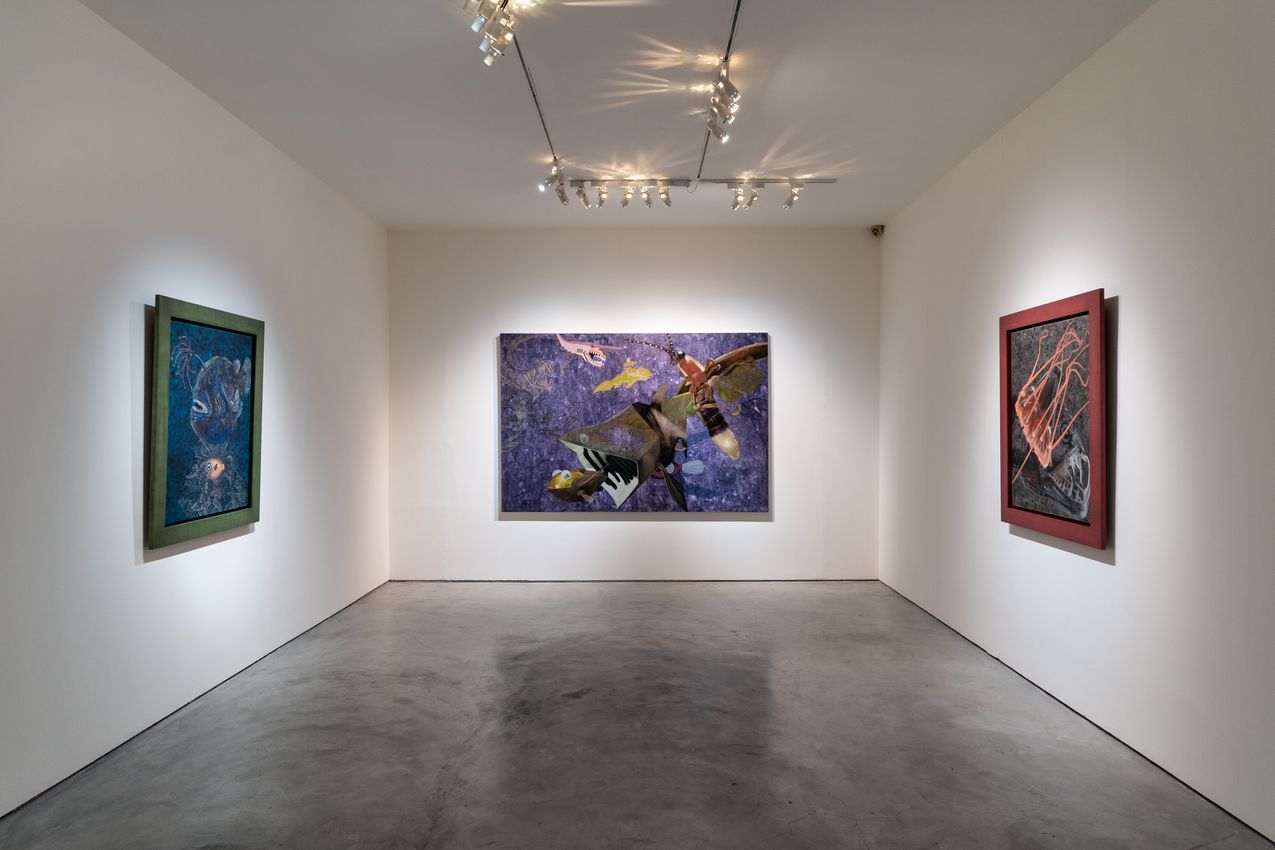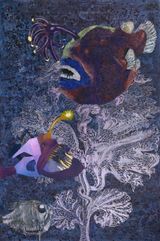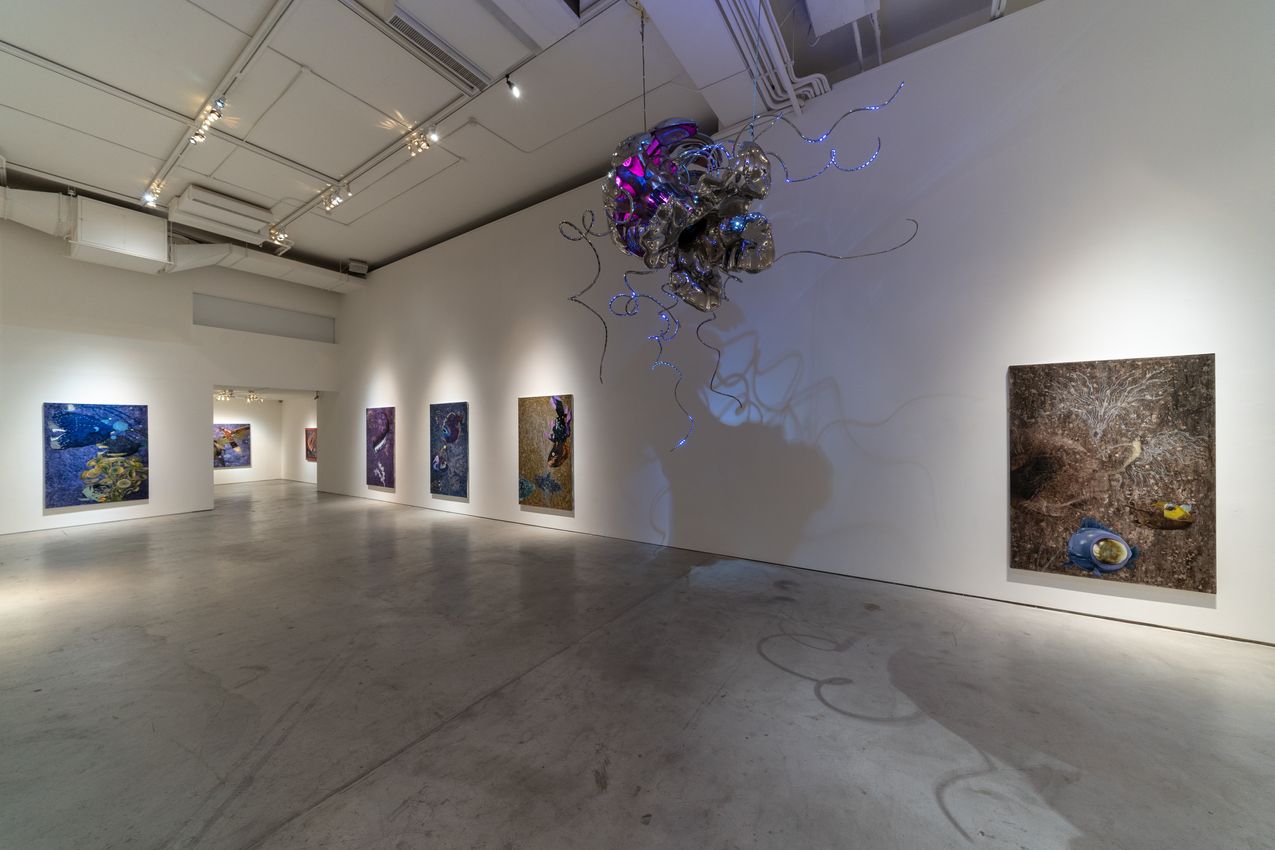
“My personality can be described as: 50% deep-sea fish, 20% gold fish, and 30% tropical fish,” Yang Mao-Lin once said of himself. A statement that casually echoes his artistic practice.
Wanderers of the Abyssal Darkness II: Somber Seas is a continuation of Yang’s 2015 exhibition The Quest for Mandala Episode I: Wanderers of the Abyssal Darkness. Leaving out “mandala” while turning it into a sub-topic in his artistic pursuit, Yang considers “somber seas” as a gradual state of composure in this series. After more than a decade dedicated to sculpture, his reflection on painting reignites his passion for the art form, a newfound connection rooted in his capricious personality. Returning to painting does not mean it’s a return to the artist’s past practice. In the Wanderers of the Abyssal Darkness series, Yang forgoes the hardcore, vigorous style that originated from Italy’s Transavanguardia movement, shifting toward a nuanced and elaborate composition. For Yang, he has now entered a new phase in his painting practice, facing yet another mountain he has to climb on his artistic journey.
The artist once said his practice always revolves around the things that spark his enthusiasm. Titling the exhibition Wanderers of the Abyssal Darkness, Yang conjures the image of the deep-sea fish, much like the way he sees himself — the 50% of him that is lonely and introspective evokes a creature living unnoticeably in the depths of the sea, yet endowed with awing, outlandish characteristics. The deep-sea fish was one of Yang’s favourites as a child. He characterises himself in three kinds of fish, and reimagines himself as different kinds of life forms, anime or manga characters. Each phase always comes with a subject that he needs to investigate, as well as a role he needs to play. Just as he embarked on his artistic journey during Taiwan’s thundering post-martial law era, he spent three decades tackling nationalism in his practice, together the politics, history, and culture series in his work a means to wrestle with the social system and social norms. However, his 2016 retrospective Made in Taiwan at the Taipei Fine Arts Museum for him symbolises an end to an era. It dawned on him — feeling outdated at midlife — that his critical attitude in his past practice is antiquated, and at this moment what he should scrutinize through his critical lens is none other than himself.
After thirty years of rivaling and confronting, now in his 60s Yang recontemplates the meaning of art after bidding adieu to a grand era, and rekindles a passion well suited for his current state of mind. As Yang deems his social responsibility completed, deeply buried childhood memories now resurface to a hunger and longing unquenched since his youth that propels him to explore the artistic road not taken.
Born in 1953, Yang Mao-Lin now lives and works in Taipei, Taiwan. Emerging from the roaring 1980s in Taiwan, he is one of the established artists on the Taiwanese art scene. He straddles mediums from painting, installation, to sculpture. A sense of humor masquerades his critical social observation, where a crossover of cultures shaped by colonisation morphs into a singular cultural phenomenon. Since his first-ever solo exhibition at the Taipei Fine Arts Museum in 1987, the artist has exhibited extensively, including Hybrid and Metamorphosis: Yang Mao-Lin’s Mythology (Changhua County Art Museum, Changhua, Taiwan, 2018); Made in Taiwan: A Retrospective of Yang Mao-Lin (Taipei Fine Arts Museum, Taipei, Taiwan, 2016); Temple of Sublime Beauty — Made in Taiwan (Venice Biennale, Collateral Event, Italy, 2009), as well as numerous group exhibitions in Japan, Korea, Hungary, France, and the U.S.
Yang Mao-Lin graduated from the Chinese Culture University’s Department of Fine Arts in 1979. He was the first director and a founding member of the Taipei Painting School in 1985. His work spans multiple genres, including painting, computer animation, installation, and sculpture. Yang explores his native Taiwan by juxtaposing historical space-times, and investigating the ways in which a cultural phenomenon has derived from the transpiring vibrant vitality and vivacious fascination of colonial hybridization. Yang reflects upon various unexpected cultural characteristics of Taiwan in an open-minded and humorous manner, though he criticizes the long-term influences of Japanese and American culture on Taiwanese society.

The Tina Keng Gallery has its roots in the Lin & Keng Gallery (1992–2009) based in Taipei, Taiwan and Beijing, China. Delving into Chinese art history, Lin & Keng was instrumental in promoting the work of Asian classical masters. The Tina Keng Gallery has continued this tradition by supporting Greater Chinese contemporary art, with a steadfast focus on nurturing Taiwanese art.

A respected voice in contemporary art discourse.
Focusing on ambitious storytelling and insightful art-world commentary. Ocula Magazine publishes in-depth interviews, critical essays and timely analysis on the artists, exhibitions and ideas driving the global art world.
Learn more about Ocula Magazine
Showcasing the best of the art world.
Ocula partners with galleries from around the world to highlight their artists, artworks and exhibitions. Gallery membership is by application and invitation, with each member vetted by an independent panel.
Learn more about Ocula Membership

Specialises in the sale of major artworks.
Led by a team with deep ties to the world’s leading auction houses, galleries and collectors. Ocula’s advisory team offers bespoke services to high-net-worth clients from around the world who are looking to acquire the best of contemporary and modern art.
Learn more about our team and services