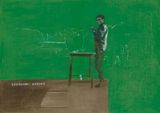
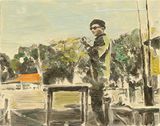
Counter-historiography and the discourse against Burmese-centric narratives from a localised, non-Burman perspective have always been the core of Sawangwongse Yawnghwe’s artistic practice. Yawnghwe’s work interweaves reality and fabrications from historic scenes, family photos, and his father’s notes left behind. With his meticulous research, he interacts with scholars of Burma, human-right activists, journalists, and writers. He employs research methodology to draw on philosophical discourses, reflecting upon the validity of history when ethnic minorities’ narratives are dissolved and eradicated. Meanwhile, he criticises the merging of modernism with capitalism. His work depicts the paradoxical contradictions as well as political fluidity and its aftermaths.
Many Shans and other people from Burma have been in exile for decades. Compared with the literal definition of ‘exile,’ the Shan story is further cast in a diasporic light, not only because of their forced expulsion by the military, but also because of poignant nostalgia for a homeland that no longer exists. Haunted by the shattered dream of returning home, Yawnghwe has long experienced loss for the homeland he never had. As Slavoj Žižek wrote in Absolute Recoil: Towards A New Foundation of Dialectical Materialism, Malcolm X adopted ‘X’ as his family name, signaling the deprivation of familial ancestry, ethnic roots, and culture when his ancestors were sold and taken away from their homeland as slaves. Rather than summoning Africans to fight to return to their homeland, the idea was to encourage people to seize the opportunity provided by X — to acknowledge their new lack of identity caused by their enslavement that has forever stripped them of their roots.
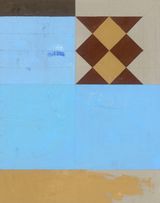
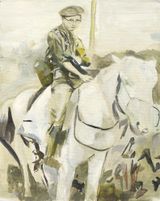
To dismantle the idea of X, Yawnghwe takes X as the subject, and returns to the outset of the catastrophic exile of his family to start anew from ground zero, for his latest solo exhibition at TKG+, Burmese History X. It is another ontological new start in contrast to his former solo exhibition in 2019, Yawnghwe Office in Exile / State Museum / Absoluter Gegenstoss / Absolute Recoil, and will continue to develop. Yawnghwe’s painting can be defined as post-structuralism, which claims the impossibility for a neutral, omniscient point of view to exist outside a text. Based on the collection of family photographs and the archives he has compiled, he allows Burmese iconography and contemporary art to coalesce. By juxtaposing imagery of pictures with colour blocks, the artist reimagines the figurative and the abstract as one single image. The sectioning and shifting of the re-presented images and colour blocks render a space of liberation that is almost indescribable. The disruption of colour blocks in the composition symbolises the disintegration of traditional forms.
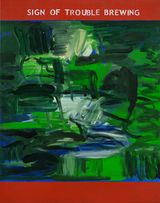
For Yawnghwe, the colour blocks in the composition can be purely abstract, while sometimes the colours are selected deliberately, even the same colour can stand for different meanings. For instance, the white, green, yellow, and red commonly seen in his work are also the Shan flag’s colour. However, the green colour sometimes symbolises the Burma’s army, the yellow for Burma’s colonial rule, and the red for the courageous spirit and blood of the Shan people. Whereas the black could denote mystery, it could also be a salute to the monochromatic painting artist, Ad Reinhardt. The purple and the blue, on the other hand, bear a connection to royalty. These colours in the composition allow viewers’ imagination to expand poetically and bring abstraction closer to reality.
The phrases in Yawnghwe’s works are quotes from his father’s notes, written on pieces of paper clipped together and carefully kept with him for years. Yawnghwe considers the phrases as signifiers, bridging the concepts in his work just like family pictures. In his latest work on view in this exhibition, he combines these phrases with a new form of composition. For instance, in X18 (Faded into oblivion), X 29 (Saw Ba U Gyi) and X 37 (Sao Kya Seng), the images and phrases blend in with the hazy background, becoming a poetic manifestation of radical immaterialism and pure philosophy.
Sawangwongse Yawnghwe’s painting and installation practice engages politics with reference to his family history as well as current and historical events in his country. Family photographs also provide the basis for a pictorial language through which he explores events in the country, suggesting that existing and available archives cannot reveal a nation’s entire truth. In addition, Yawnghwe’s work of maps charts the conflicts between drugs such as heroin and amphetamines, revolutionary armies, minority ethnicities, mining and gas pipelines, the armament of generals, as well as state genocide against its minorities. He intends to bring discernible order to a complex political situation.
A forerunner of Taiwanese modern art, the Tina Keng Gallery hinges upon the philosophy that art is a reflection of the times. The Tina Keng Gallery has its roots in the Lin & Keng Gallery (1992–2009) based in Taipei, Taiwan and Beijing, China. Delving into Western painting and Chinese art history, Lin & Keng tirelessly promoted the work of Asian classical masters, cultivating a critical thought on Greater Chinese modern art. The Tina Keng Gallery has continued this tradition by centering its focus on Asia, further excavating art history and rediscovering modern aesthetics. Upon this foundation, the Tina Keng Gallery is steadfast in nurturing Taiwanese modern and contemporary art, with hopes to capture the changing states of art through writings of history, in so doing highlighting the cultural underpinnings of its worldview. Art arises from culture, and culture mirrors the times. The Tina Keng Gallery endeavors not only to support Greater Chinese modern and contemporary art, but to shape a perspective that is elementally Asian.

A respected voice in contemporary art discourse.
Focusing on ambitious storytelling and insightful art-world commentary. Ocula Magazine publishes in-depth interviews, critical essays and timely analysis on the artists, exhibitions and ideas driving the global art world.
Learn more about Ocula Magazine
Showcasing the best of the art world.
Ocula partners with galleries from around the world to highlight their artists, artworks and exhibitions. Gallery membership is by application and invitation, with each member vetted by an independent panel.
Learn more about Ocula Membership

Specialises in the sale of major artworks.
Led by a team with deep ties to the world’s leading auction houses, galleries and collectors. Ocula’s advisory team offers bespoke services to high-net-worth clients from around the world who are looking to acquire the best of contemporary and modern art.
Learn more about our team and services