Press Release

Xavier Hufkens is pleased to announce a new exhibition by David Altmejd (b. 1974, Montreal, Canada), his fourth with the gallery.

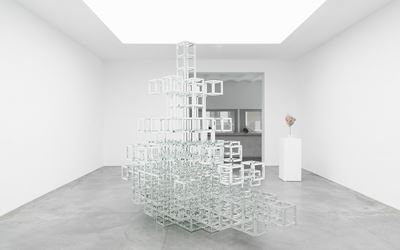
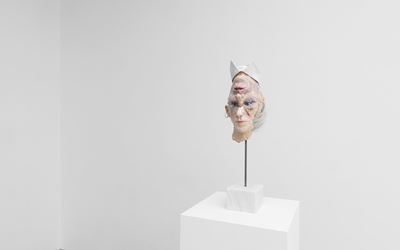
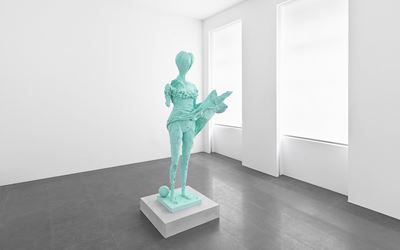
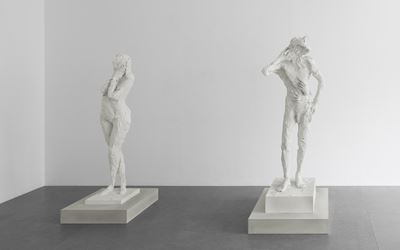
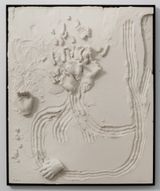
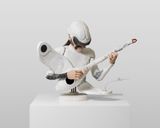
Driven by his fascination with the beauty and mystery of the natural world, David Altmejd’s oeuvre is as diverse as it is arcane. It is a universe unto itself, one that encompasses breathtaking labyrinthine constructions in Perspex, strange hybrid beings, colossal human figures and complex mirrored structures. In this exhibition, the artist presents a new series of bronze figures, together with a group of sculptural matrices in mirrored glass, and an ensemble of sculpted heads. The antithetical nature of the works on display highlights the dynamic tension that is always present in Altmejd’s work, as well as a number of key themes that can be traced throughout the oeuvre: the human figure, reflection and structure.

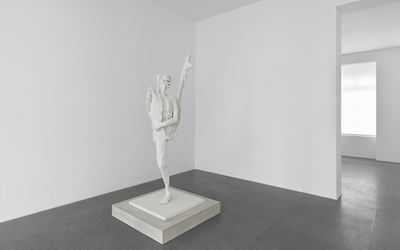
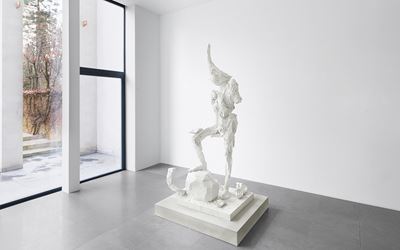
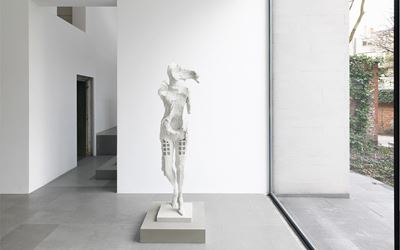
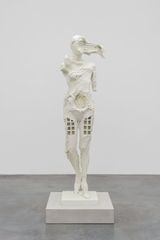
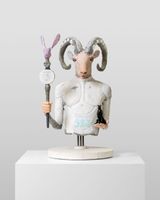
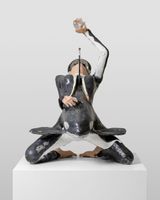
Several of the bronze figures in the exhibition can be seen as evolutions of Altmejd’s ongoing series known as Bodybuilders. Originally modelled in plaster, the figures combine pristine, polished casts of hands and feet with raw, lumpy torsos and limbs. Scarred by the fissures torn through the plaster by the artist’s fingers, but also subject to the manipulation of the truncated hands, the bodies appear to be constructing and deconstructing themselves. Other works, however, are disrupted by incongruous organic and architectural elements. Here, the opulent surface textures and details that defined earlier sculptures have given way to a greater simplicity and an emphasis on the assemblage of individual physical elements (hair, feet or hands), gesture (walking, leaning), or the integration of a single, often surreal, focal point. At the same time, the works lean more towards the feminine, as evidenced by anatomical detail or attributes such as high-heeled shoes. Casting the plasters in bronze brings a new sense of potential to Altmejd’s work by allowing it to be sited beyond the gallery space, while the white paint maintains an essential visual link with the more fragile, original materials. The full-length figures are also seen alongside several works from the Rabbit Hole series: composite, mottled heads that are suggestive death, and whose features are obliterated by crystal-encrusted, seemingly endless chasms.

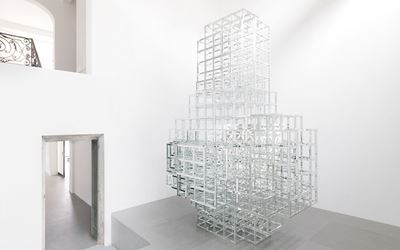
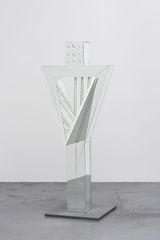
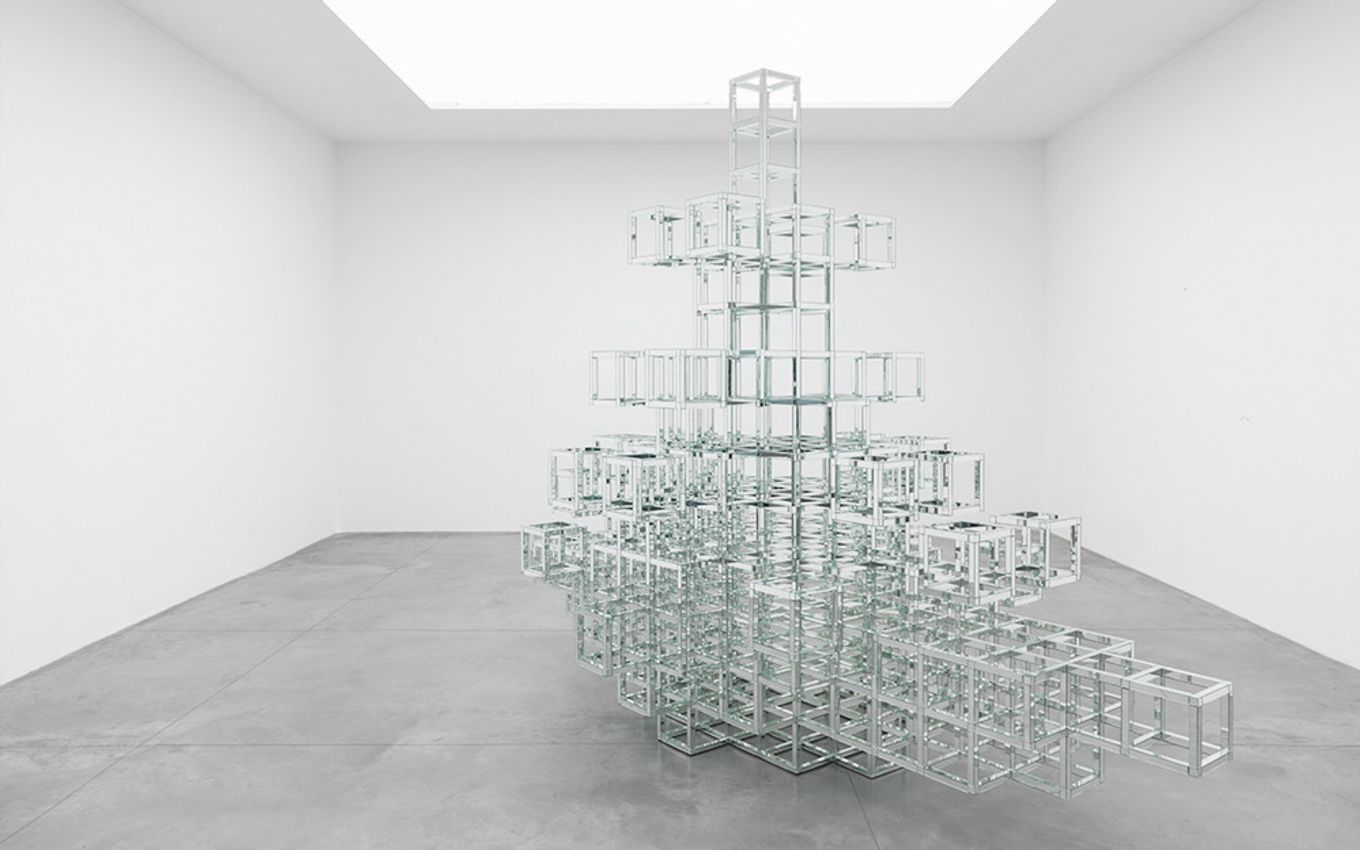
The idea of combining multiple elements to create a unified whole is given different expression in the mirrored matrix sculptures. Here, the artist focuses on the transmission of power, energy and uncertainty through a complex grid of extensions, duplications and refractions. While the structures resemble early Minimalist sculptures, the mirrored glass lends the work a degree of physical ambiguity: what appears to be light, airy and fragile is, in reality, dense, heavy and anchored. At first glance, the matrix works are impossible to fully comprehend: the viewer never sees his whole reflection, only multiple fragments of himself, in the same way that the surrounding gallery space is also absorbed, splintered and endlessly refracted. Altmejd has said of these pieces that he is interested in the perfection of the structure, and the notion of being able to create a seemingly infinite interior space within a finite exterior form. And herein lies not just the mainspring of David Altmejd’s art, but also the unifying force within the exhibition: the tension that exists between the infinite and finite, the lifelike and the surreal, the rough and the smooth, the beautiful and the grotesque, and the visible and the invisible. In L’ air Altmejd presents us with a paradox: solid, tangible forms that, through the absence of colour (white figures, black voids), or reflection and refraction (mirrors), seem to vanish from their surroundings. The only ‘escape’ from this hermetic, endlessly shifting, nebulous world being through the gaping, inky, endless ‘rabbit holes’ that, like vents, puncture the livid, featureless faces on the gallery walls.

David Altmejd’s exhibition Géants can also be seen in the Forum of the Royal Museums of Fine Arts of Belgium, Brussels as of March 18th and until August 21st. Six colossal sculptures will take over this central meeting point of the museum in a spectacular way.

Recent solo exhibitions include: The Flux and the Puddle, Louisiana Museum of Modern Art, Humlebaek, Denmark (2015-16); Flux, Musée d’Art Contemporain de Montréal, Montréal, Québec, Canada (2015); Flux, Mudam Luxembourg, Musée d’Art Moderne Grand- Duc Jean, Luxembourg, Luxembourg (2014-15); Flux, Musée d’Art Moderne de la Ville de Paris, Paris, France (2014) and David Altmejd: The Orbit, MOCA Cleveland, Cleveland, USA (2012). David Altmejd represented Canada at the Venice Biennale in 2007.

Read More

Installation Views

About the Artist

David Altmejd creates highly detailed sculptures that often blur the distinction between interior and exterior, surface and structure, representation and abstraction. For Altmejd, the process of making is paramount – he is interested in how the act of constructing an object generates meaning. Altmejd often defies traditional material conventions. In his recent series of large-scale semi-figurative sculptures he used seemingly random objects (such as hessian, polystyrene, chains, fur, crystals and resin casts of his hands and of exotic fruits) to create resonant connections and juxtapositions between diverse material elements. In his complex installations involving Perspex structures and vitrines, Altmejd often pairs symbolic objects, such as crystals and taxidermy birds and animals, with virtuosic applications of materials such as plaster, glitter, minerals and mirrors. Motivated by the invisible worlds that often exist just beneath the surface of things, the artist reveals the hidden structures in his own works through negative spaces: gaps, holes, fissures and crystal filled orifices are a recurring motif. In contrast, the reflective surfaces of his mirrored sculptures are impenetrable and both define and destabilise, as well as multiply, the spaces around them.

View Artist Profile

Also Exhibiting at Xavier Hufkens

About the Gallery
Xavier Hufkens is one of Europe’s leading galleries for contemporary art. Located in Brussels, the gallery maintains a diverse exhibition programme with solo exhibitions of the gallery artists as well as group exhibitions and special projects. The gallery deals in a distinctive combination of painting, drawing, sculpture, photography, video and installation-based work.

The origins of the gallery date back to 1987, when Xavier Hufkens opened a gallery space in an un-refurbished warehouse in the neighbourhood of the South Station (Midi) in Brussels. During the early years, the focus of the gallery was upon mid-career and emerging artists and the gallery is known for having introduced some of the most influential contemporary artists to Brussels at a time when they were still relatively unknown. British sculptor Antony Gormley, who is still affiliated with the gallery, Felix Gonzalez-Torres and Rosemarie Trockel all showed in Belgium for the first time with Xavier Hufkens (Gormley in 1987; Gonzalez-Torres in 1991 and Trockel in 1993).

In 1992, the gallery moved to a 19th-century townhouse at 6 rue Saint-Georges, close to the Avenue Louise. Completely renovated by Belgian architects Paul Robbrecht, Hilde Daem and Marie-José Van Hee, the house quickly gained a reputation for being not just one of the most beautiful contemporary art spaces in the Belgian capital, but also one of the most interesting. The expanded exhibition programme coincided with the additional representation of a number of established artists from Belgium and abroad, including Richard Artschwager, Thierry De Cordier and Jan Vercruysse. In 1997, Hufkens expanded the gallery further by annexing the adjacent building and a number of new artists joined the gallery, including Louise Bourgeois, Roni Horn and Thomas Houseago.

A second space in the same street, at 107 rue Saint-Georges, opened in spring 2013. Located in the Galerie Rivoli, a mixed-use commercial development from the 1970s, the new gallery space was designed by Swiss architect Harry Gugger, who was previously in partnership with Herzog and De Meuron. Slegten & Toegemann, Brussels, managed the project. A third space opened in spring 2020, located at 44 Rue Van Eyck, designed by architect Bernard Dubois.

An eclectic but very clear vision underpins all of the gallery’s activities: ‘The definition of the gallery was established from the start. The common thread, then and now, is quality over and above everything else, which I find more intellectually challenging than a forced definition. From the early days I juxtaposed established artists such as Michelangelo Pistoletto with someone like Felix Gonzalez-Torres when he was totally unknown. Today I still mix my work: I have no problem showing Malcolm Morley … alongside Robert Ryman, or Willem de Kooning.’ [Xavier Hufkens in The Art Newspaper, Issue 220, January 2011, published online: 20 January 2011]

Xavier Hufkens represents some thirty artists from different generations. He was part of the six-member selection committee for Art Basel during seven years and also participates in up to five international Arts Fairs annually. The gallery has partnerships with the estates of Louise Bourgeois, Willem de Kooning, Robert Mapplethorpe and Alice Neel.
View Gallery Profile
Address
6 rue St-Georges
St-Jorisstraat
Brussels
Belgium
Opening Hours
Tuesday – Saturday
11am – 6pm
(1)
Brussels 6 rue St-Georges
Xavier Hufkens
6 rue St-Georges, St-Jorisstraat, Brussels, Belgium

Opening hours
Tuesday – Saturday
11am – 6pm
The art world in focus