‘This show is about games and mortality—hunters, scavengers, and reproduction.’ – Sherrie Levine
Xavier Hufkens is pleased to present an exhibition of recent and historical work by Sherrie Levine (b. 1947). By means of a meticulous scenography and a well-considered selection of artworks in various media, the artist investigates her abiding interest in repetition, replication and art historical appropriation.
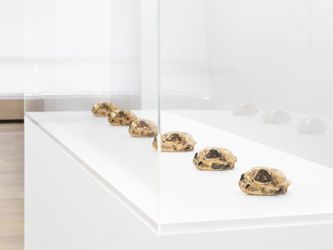
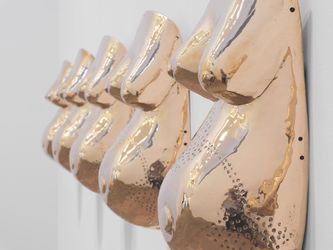
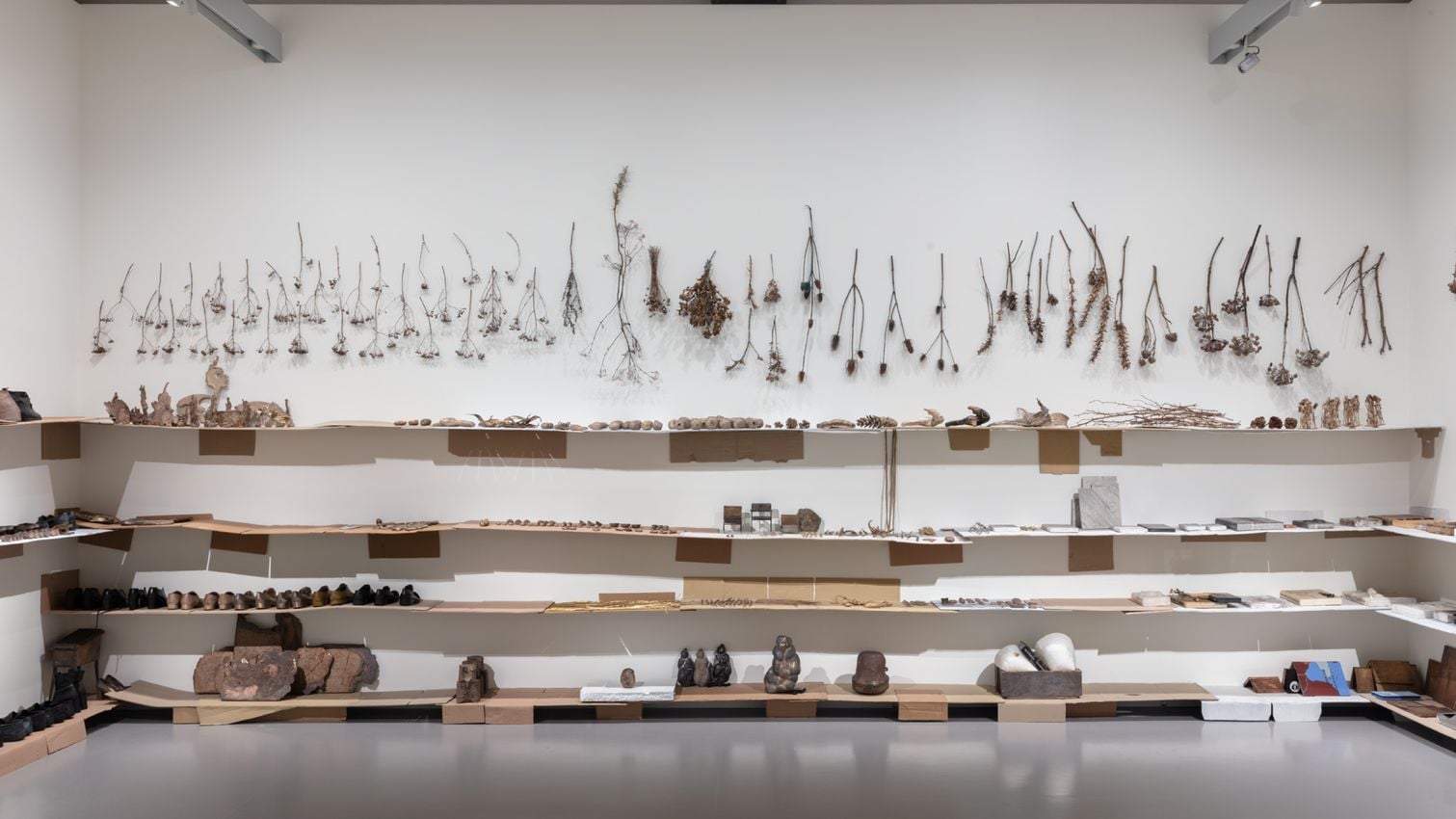
Rows of identical, repeating pregnant Tattooed Body Masks (2020) and feline Bobcat Skulls (2010), both cast from unique found objects – a wooden makondo mask from South-Eastern Tanzania and an animal carcass respectively, testify to Levine’s scrutiny of art historical principles and interpretations. By attributing equal significance to form and concept, the replication and duplication of these objects is not an arbitrary choice but indicates Levine’s profound engagement with the art historical canon. In this light, the Tattooed Body Masks can be read as an allusion to the influence of ethnographic art on early modernism, while the Bobcat works are evocative of Georgia O’Keeffe’s paintings of animal skulls. The glistening golden surface of these works serves a dual purpose. On the one hand, it speaks to the language of modernism, most notably Brancusi’s polished bronzes, but on the other, it transforms these charged artefacts – one man-made, one natural – into seductive and opulent-looking works of art. In so doing, Levine decontextualises and recontextualises the significance of the masks and skeletons, and examines the different cultural meanings that their reproduction acquires within each new context.
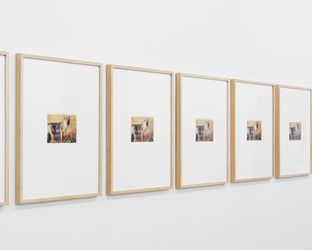
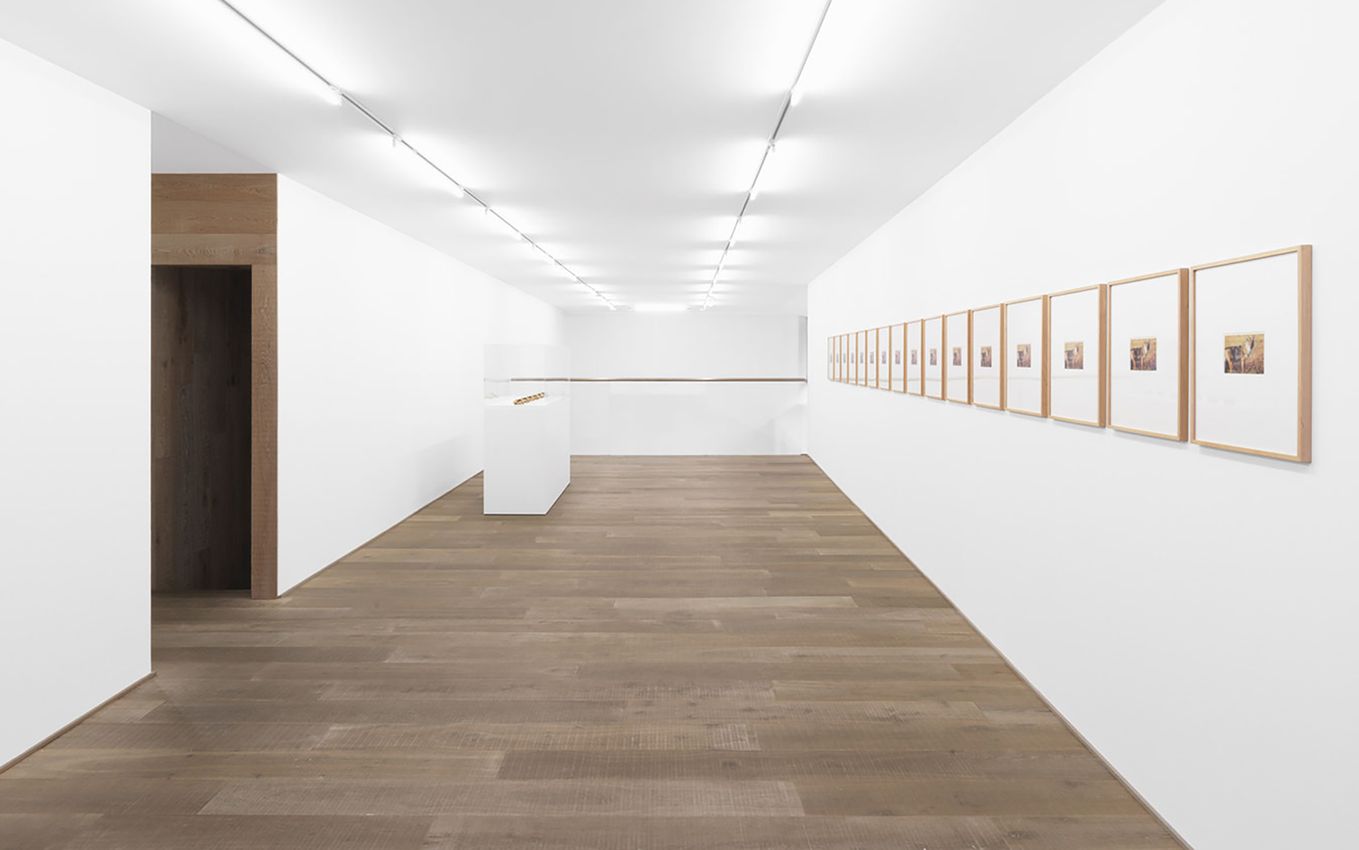
The overarching themes of reproduction and repetition in this exhibition are explored in different ways in Cathedral: 1-9 (1996) and Coyote Postcard Collage: 1-16 (1999). While the former work is based on Monet’s paintings of the Rouen Cathedral, which is itself a serial work, Coyote Postcard Collage: 1-16 comprises sixteen identical postcards of a lone wolf, which can be taken as a reference to Joseph Beuys. In these works, Levine doubles down on the defining format of minimalism to create grids-within-grids. But instead of divesting her work of all external references, as per the conventions of the genre, she completes them with art historical and representational imagery. In Cathedral: 1-9, Levine breaks down Monet’s church facades into pixels, each one of which corresponds to an average colour value in the nineteenth-century paintings. By doing so, she arrives at a work in which the original source retains an imperceptible presence within the abstract composition.
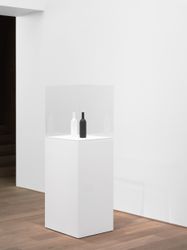
Both art historical motifs, Black and White Bottles (1992) and the Medium Check Paintings (2021) play with the effects of mirroring and replication. Of the bottles, Levine has said: ‘I thought a wine bottle was the perfect generic Modernist icon, having been so frequently used as a subject by the Cubists and Surrealists.’ The origins of the check paintings can be found in the chessboard motifs that fascinated this latter group of artists, most notably Man Ray and Duchamp. Executed on wood – so that the paintings literally become boards – the checked motif is repeated within each panel, while each object mirrors the other.
By perpetually questioning notions of originality and duplication, Levine’s art is not static, nor is it absolute. Not only does she inventively denounce the systems that construe and categorise art, she also challenges the conventions that define what we call history and meaning. She nudges the viewer towards certain interpretations, yet her aim is to suspend meaning, never revealing it entirely. She provokes answers, urging us to read the works without providing directions. Or to paraphrase Roland Barthes, it is up to the viewer – not the artist – to generate and determine meaning.


Active since the late 1970s, American artist Sherrie Levine is recognised for her radical and uncompromising analysis of the critical issues surrounding art-historical interpretation. Initially establishing her reputation in the field of photography and appropriation, most notably of works from the modernist canon, her practice has broadened over the years into a wide-ranging discourse on the historical and contemporary meaning of originality and authorship. Central to her approach is the decontextualisation and recontextualisation of material culture with an emphasis on form and aesthetics. The relationship of Levine’s work to its ‘source’ - be it an existing artwork, found object or theoretical concept - typically creates a paradigm shift that prompts a re-evaluation of the trajectories that objects and ideas travel across time and media. In this, Levine not only challenges the institutional structures, hierarchies and systems that define and categorise art, but also the mechanisms responsible for the creation of history and significance. In works that are as formally rigorous as they are intellectually prescient, Levine explores the seductive nature of objects and images and reveals how their power and authority can be mediated, eroded, subverted or augmented.


A respected voice in contemporary art discourse.
Focusing on ambitious storytelling and insightful art-world commentary. Ocula Magazine publishes in-depth interviews, critical essays and timely analysis on the artists, exhibitions and ideas driving the global art world.
Learn more about Ocula Magazine
Showcasing the best of the art world.
Ocula partners with galleries from around the world to highlight their artists, artworks and exhibitions. Gallery membership is by application and invitation, with each member vetted by an independent panel.
Learn more about Ocula Membership

Specialises in the sale of major artworks.
Led by a team with deep ties to the world’s leading auction houses, galleries and collectors. Ocula’s advisory team offers bespoke services to high-net-worth clients from around the world who are looking to acquire the best of contemporary and modern art.
Learn more about our team and services