Yun-Fei Ji (b. 1963, Beijing) presents Together, his fourth solo exhibition at Zeno X Gallery.
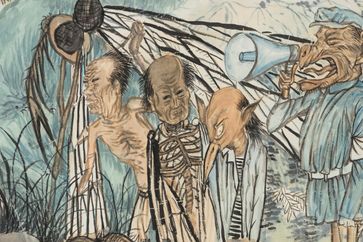
Yun-Fei Ji is a storyteller who takes contemporary events and the lives of ordinary people as subjects ofhis work. He addresses socio-political themes such as migration, labour and climate change and subtlydenounces the impact of power structures. In the past, Ji mainly drew and painted using watercolour andink on handmade rice paper in a visual language closely related to classical Chinese painting. To broadenthe scope of his work, he recently started to experiment with oil paint and acrylic on canvas. After all,rather than being restricted to a Chinese reality, the subject matter of his work has global relevance. Bothin these new paintings, as in his work on paper, Ji challenges and questions our expectations of whatcontemporary painting can be.
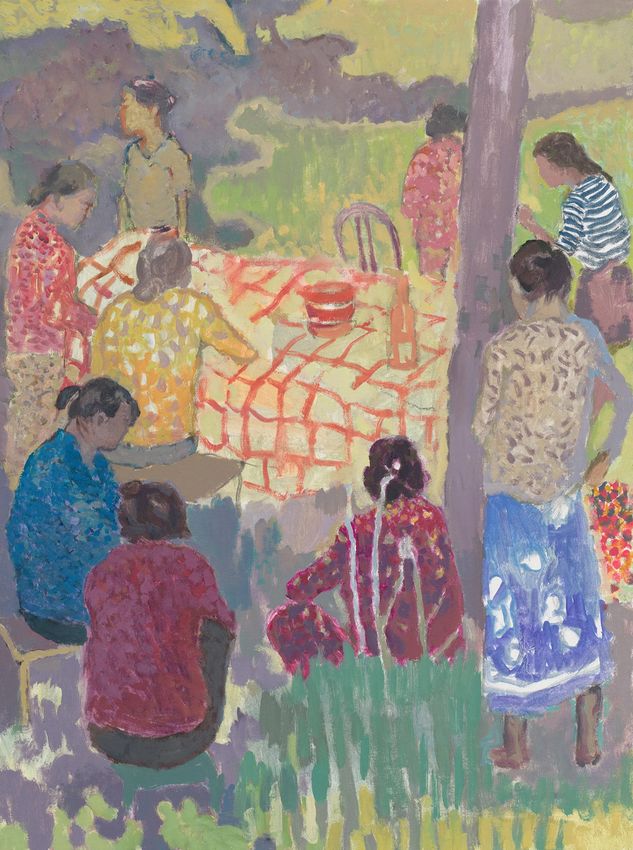
In the exhibition Together, Ji tells the story of a close-knit group of women he got to know when he spentsome time in Beijing a few years ago. He observed how the women travelled to the city to take on workexclusively as a group. Their unique togetherness and solidarity, despite their difficult living conditions,fascinated him. The paintings in the exhibition show both the women at work and during everydayactivities. He depicts how they behave and live as a group in often temporary spaces: at work in a jeansfactory, during their lunch break or on their way to work. Even when they are not depicted, their presenceis palpable.
Ji’s work belongs to a long tradition of social criticism within art history. He refers to the influence ofartists such as Hieronymus Bosch, Francisco Goya or James Ensor, as well as that of Chinese landscapepainting, where certain motifs can be read both literally and figuratively. For example, high mountainssymbolise rulers, wind can be interpreted as the influence of power on the people, bamboo stands forresilience. The bamboo branches in Gather under the Bamboo are characterised by their hard, rigid outerlayer, an allusion to the strong nature of the group of women, who are at the center of this exhibition.
The most notable difference from Ji’s work on paper is the ubiquity of colour. The soft, saturated colourscreate an intimate and vibrant atmosphere, evoking a sense of harmony and unity. However, the apparenttranquility is subverted by the multitude of patterns as well as the disorder of all kinds of objects scatteredover the surface. The intensity of the image is further heightened by the flat composition and the stackedperspective which puts the viewer, as it were, in the middle of the image. While the colours emphasisethe connection between man and his surroundings, the slumbering chaos reminds us that this balance isprecarious and constantly under threat.
Yun Fei Ji was born in Beijing. He lives and works in New York. He has had solo exhibitions at KalamazooInstitute of Arts, The Hilliard Art Museum in Lafayette, Honolulu Art Museum, Cleveland Museum of Art,Wellin Museum of Art, Hamilton College in Clinton, UMCA in Amherst, Krannert Art Museum in Champaign,Ullens Center for Contemporary Art in Beijing, Worcester Art Museum, Rose Art Museum of BrandeisUniversity in Waltham, ICA Philadelphia, Contemporary Art Museum St. Louis and the Pratt Institute inNew York.
Yun-Fei Ji has participated in several international exhibitions such as the Whitney Biennial in New York(2002), Lyon Biennale (2011), Biennale of Sydney (2012) and Shanghai Biennale (2014). His work is in thepublic collections of MoMA in New York, the Metropolitan Museum of Art in New York, Hammer Museumin Los Angeles, New Museum in New York, Rose Art Museum in Waltham, Whitney Museum of AmericanArt in New York, and many others.
Yun-Fei Ji utilises the structures and symbols of folkloric tradition to speak truth to power. Full of phantoms, demons, and other spectral characters, Ji’s paintings have frequently functioned as metaphorical critiques of oppressive power structures—and strategies of defiance. In his ink and watercolour compositions, these ghostly figures are stand-ins for the complex political undercurrents and cultural tug-of-war shaping rural communities in a rapidly developing world.

In 1981, Frank and Eliane Demaegd founded Zeno X Gallery in an early 20th century townhouse in the Antwerp South district. In the early years the program of the gallery was mainly focused on architecture and installations with artists such as John Körmeling, Rem Koolhaas, Anne-Mie Van Kerckhoven and Patrick Van Caeckenbergh. Nowadays the gallery represents around thirty artists which operate in many different mediums such as painting, sculpture, film, photography and performance.

A respected voice in contemporary art discourse.
Focusing on ambitious storytelling and insightful art-world commentary. Ocula Magazine publishes in-depth interviews, critical essays and timely analysis on the artists, exhibitions and ideas driving the global art world.
Learn more about Ocula Magazine
Showcasing the best of the art world.
Ocula partners with galleries from around the world to highlight their artists, artworks and exhibitions. Gallery membership is by application and invitation, with each member vetted by an independent panel.
Learn more about Ocula Membership

Specialises in the sale of major artworks.
Led by a team with deep ties to the world’s leading auction houses, galleries and collectors. Ocula’s advisory team offers bespoke services to high-net-worth clients from around the world who are looking to acquire the best of contemporary and modern art.
Learn more about our team and services