

NATHANAËLLE HERBELIN
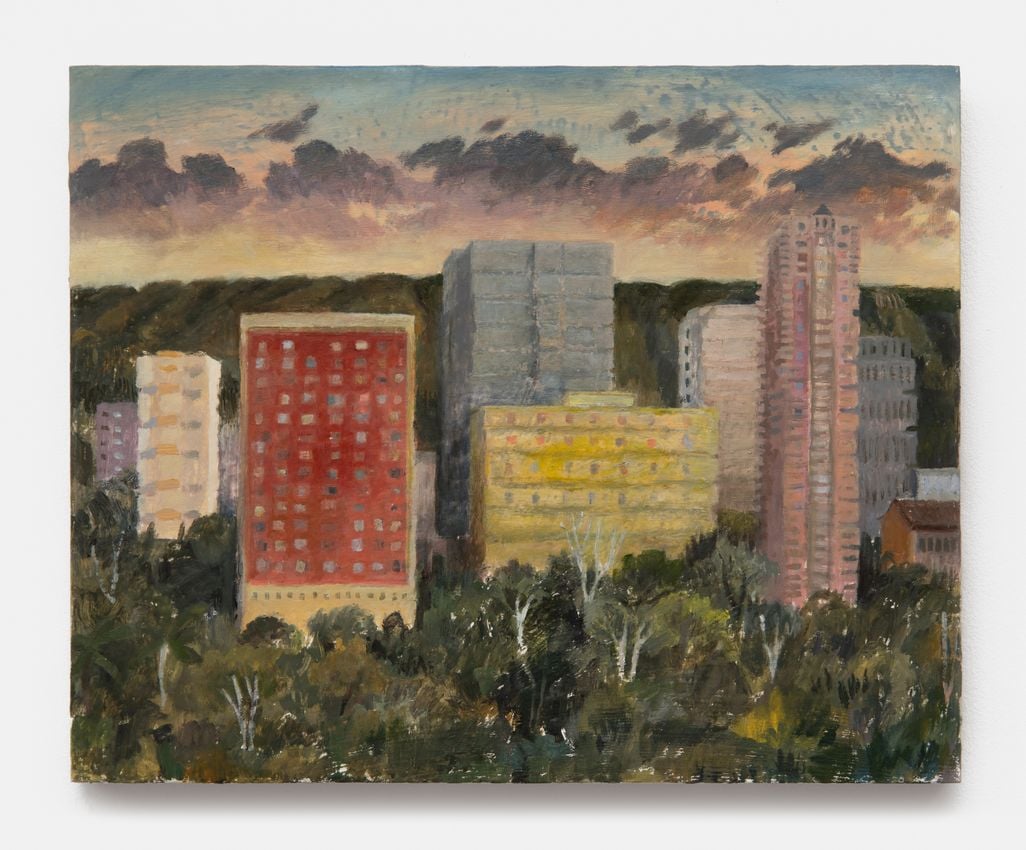
b. 1989, Israel“When you make a painting,” Nathanaëlle Herbelin has said, “it’s like feeling the world very intensely.” The artist has developed a distinctive pictorial language to create her figurative paintings: while observation is a key element of her art, her pieces also harness the power of the memory of lived experience, allowing viewers to perceive different, individual relevance and meanings from her artworks.
Early Years
Nathanaëlle Herbelin was born in Tel Aviv in 1989—her mother was Israeli and her father French. Herbelin has always been exposed to, and has taken inspiration from, two different cultures: she grew up in the Israeli village of Zoran but frequently visited her grandmother in Paris. She moved to the French capital when she was 23 and gained her MFA from the École des Beaux-Arts in 2016. During her studies, Herbelin often visited the Musée d’Orsay, where she was inspired by the works of the Nabis, a group of 19th-century French painters including Pierre Bonnard and Édouard Vuillard, who created images of everyday scenes in flat, bold colours.
Nathanaëlle Herbelin: Artworks
“Everything that provokes an emotion for me is paintable and more than that—everything can become a painting if I give it an emotion,” Nathanaëlle Herbelin has said. Her nuanced paintings demonstrate how individual and collective experiences co-exist, blending moments of intimacy with familiar social situations. Subtle brushstrokes and often muted tones recall post-Impressionist styles, yet the visual language she has created offers an imaginative, sensitive take on everyday life and ritual. Her portraits and interiors hinge on moments of connection, whether that’s between the figures depicted on the canvas or between subject and viewer.
- Max (2015—2022) is a strong example of Herbelin’s blend of portraiture, interiors, still life and detail that sparks memory or familiarity for the viewer, gently asking us to consider how we view everyday scenes. The subject sits on a sofa—coming towards us at the front of the canvas is a table holding pieces of his life, notably his phone and his breakfast. The painting sold at Phillips in London in 2025 for £57,150 against an estimate of £25,000—£35,000.
- In a departure from her works in which subjects or objects are framed in everyday situations, 2024’s Containers (displayed at Art Basel Hong Kong 2026) is instead a collection of 21 different vessels, from vases to teapots, painted in oil on a white background.
- In the self-portrait Manifestation pour une deuxième grossesse (2025—2026), Herbelin uses the canvas to discuss ideas and expectations around the experience of a second pregnancy: while she is at work painting, her child is at her feet. The mirror reflects the complexity of her daily life as she juggles (most obviously in the number of brushes she is holding) her artistic practice and her experience of motherhood.
Nathanaëlle Herbelin: Select Exhibitions
Select Solo Exhibitions
- And there is a place you will not be able to return to, Xavier Hufkens, Brussels (2025)
- Feel the pulse, He Art Museum, Shunde (2025)
- Et il est un jour où tu ne pourras retourner, part 2, Jousse Entreprise, Paris (2025)
- Être ici est une splendeur, Musée d’Orsay, Paris (2024)
- Undivided Attention, Xavier Hufkens, Brussels (2023)
- À la surface, le fond de l’oeil, French institute of Tel Aviv (2022)
- L’eau douce pénètre en profondeur, Nosbaum Reding, Luxembourg (2021)
- In Situ, Hôtel de Guise, Paris (2021)
- Sur le fil, Galerie Dilecta, Paris (2021)
- Et peut-être que ces choses n’ont jamais eu lieu, Jousse Entreprise, Paris (2021)
- Devenir peinture, Tante Martine, Yishu 8, Paris (2021)
- Perhaps it was never so, Umm El Fahem Art Gallery (2021)
- Ritual for long distances, Emmanuel Barbault Gallery, New York City (2019)
- Mise en scene, Villa Saint-Cyr, Bourg-la-Reine (2019)
- Onze mètres carré, In-Box, Brussels (2018)
- Versions, Jousse Entreprise, Paris (2016)
Select Group Exhibitions
- The Self Assessed, Galerie Max Hetzler, Berlin (2026)
- Love is Louder, Bozar, Brussels (2024)
- Cache-Cache, Perrotin, Paris (2023)
- Shelf Life, Marlborough Gallery, London (2022)
- Veillée d’Armes, (with Anne-Charlotte Fine), Paris + par Art Basel (2022)
- Ils ont dit oui, Marguerite Milin, Paris (2021)
- On view, Vitrine 65, Paris (2019)
- Seuls ensemble, H Gallery, Paris (2017)
- Full House, Le Cabinet Dentaire, Paris (2015)
- Exhibition during the university exchange at The Cooper Union Gallery, New York City (2015)
- Carte blanche to Hector Obalk, Farideh Cadot, Paris (2014)
- Artishowk fair #3, Florentine, The Comfort, Tel Aviv (2009)
Further Reading
- Nathanaëlle Herbelin’s website
- Nathanaëlle Herbelin’s Instagram
- Artist profile page at Xavier Hufkens
- Artist profile page at Hauser & Wirth
Nathanaëlle Herbelin FAQs
Does Nathanaëlle Herbelin make preliminary sketches?
Not always. Talking about her self-portraiture practice in 2026, she explained that sometimes she creates a very quick felt-tip sketch, but at other times she works straight on the canvas. “In fact,” she said in 2026, “what’s more important than preparing is being ready to let yourself experience the feelings that come with painting.”
What is Nathanaëlle Herbelin’s relationship with her studio?
Herbelin has said that she feels privileged to have her own studio, a place where she is able to “let go” in her studio, and “let the mess, the accidents and the chaos take over”. However, she also sometimes feels that the studio is where she allows the conflict and complexity of the outside world to enter her space.
Did Nathanaëlle Herbelin paint her late grandfather?
Yes, in her 2025 exhibition And there is a place you will not be able to return to at Xavier Hufkens in Brussels, Herbelin used photographic source material to paint her late grandfather from Israel. She also created two works for the show that centred on Jewish mourning rituals: Shiva (2025) recreates her grandfather’s home during the seven-day period of mourning following his funeral and Dîner aux œufs durs (2025) (inspired by Egon Schiele’s 1918 work Die Freunde (Tafelrunde) groß) explores the post-burial meal of condolence.
Ocula






Explore and Follow Artists Shaping Contemporary Art
A respected voice in contemporary art discourse.
Focusing on ambitious storytelling and insightful art-world commentary. Ocula Magazine publishes in-depth interviews, critical essays and timely analysis on the artists, exhibitions and ideas driving the global art world.
Learn more about Ocula Magazine
Showcasing the best of the art world.
Ocula partners with galleries from around the world to highlight their artists, artworks and exhibitions. Gallery membership is by application and invitation, with each member vetted by an independent panel.
Learn more about Ocula Membership
Specialises in the sale of major artworks.
Led by a team with deep ties to the world’s leading auction houses, galleries and collectors. Ocula’s advisory team offers bespoke services to high-net-worth clients from around the world who are looking to acquire the best of contemporary and modern art.
Learn more about our team and services