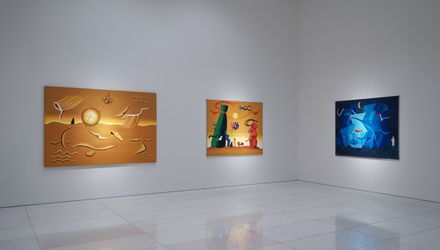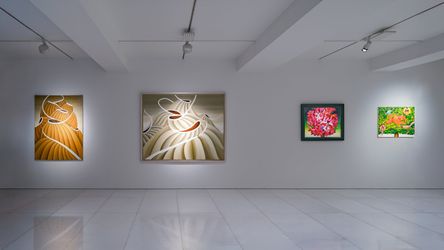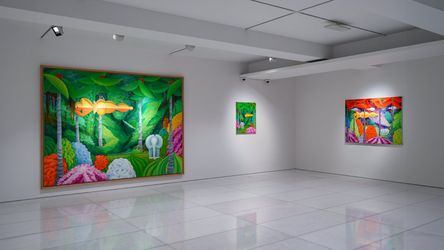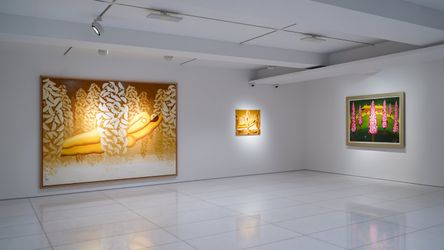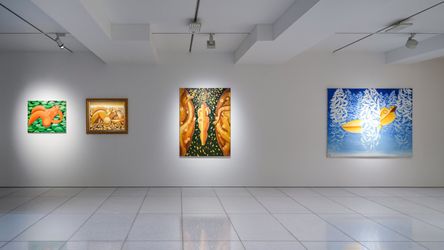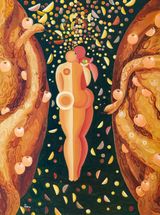
ARARIO GALLERY SEOUL presents a solo exhibition by JUNG Kangja (1942–2017), entitled I_t Has Always Been The Beginning_, from 15 November to 30 December 2023. JUNG is a prominent female avant-garde artist who made a significant mark in the history of contemporary Korean art. As the first generation female performance artist in Korea, her radical actions played a critical role in shaping the experimental art movement in Korea of the 1960s and 1970s. JUNG’s artistic path encountered resistance early on, with the forced closure of her debut solo show Incorporeality (1970). This event led her to spend many years abroad, and upon her return to Korea in the 1980s, she continued to create works prolifically for over four decades. Despite the lack of recognition in the domestic art scene for a long time, JUNG continued her artistic activities until her passing, embodying her thoughts in art as the essence and purpose of life. Since the 2000s, the need for research and reevaluation of JUNG’s work has been raised and recently attempts to reassess her oeuvre have been carried out in various ways within Korea and abroad. This solo exhibition, being held after 5 years since her previous retrospective at ARARIO GALLERY SEOUL and CHEONAN in 2018, focuses on JUNG’s works from 1995 to 2010, showcasing a variety of paintings that highlight her intense and rich colour palette and unique spirit of challenge.
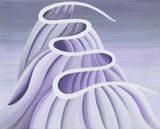
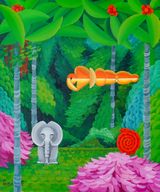
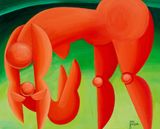
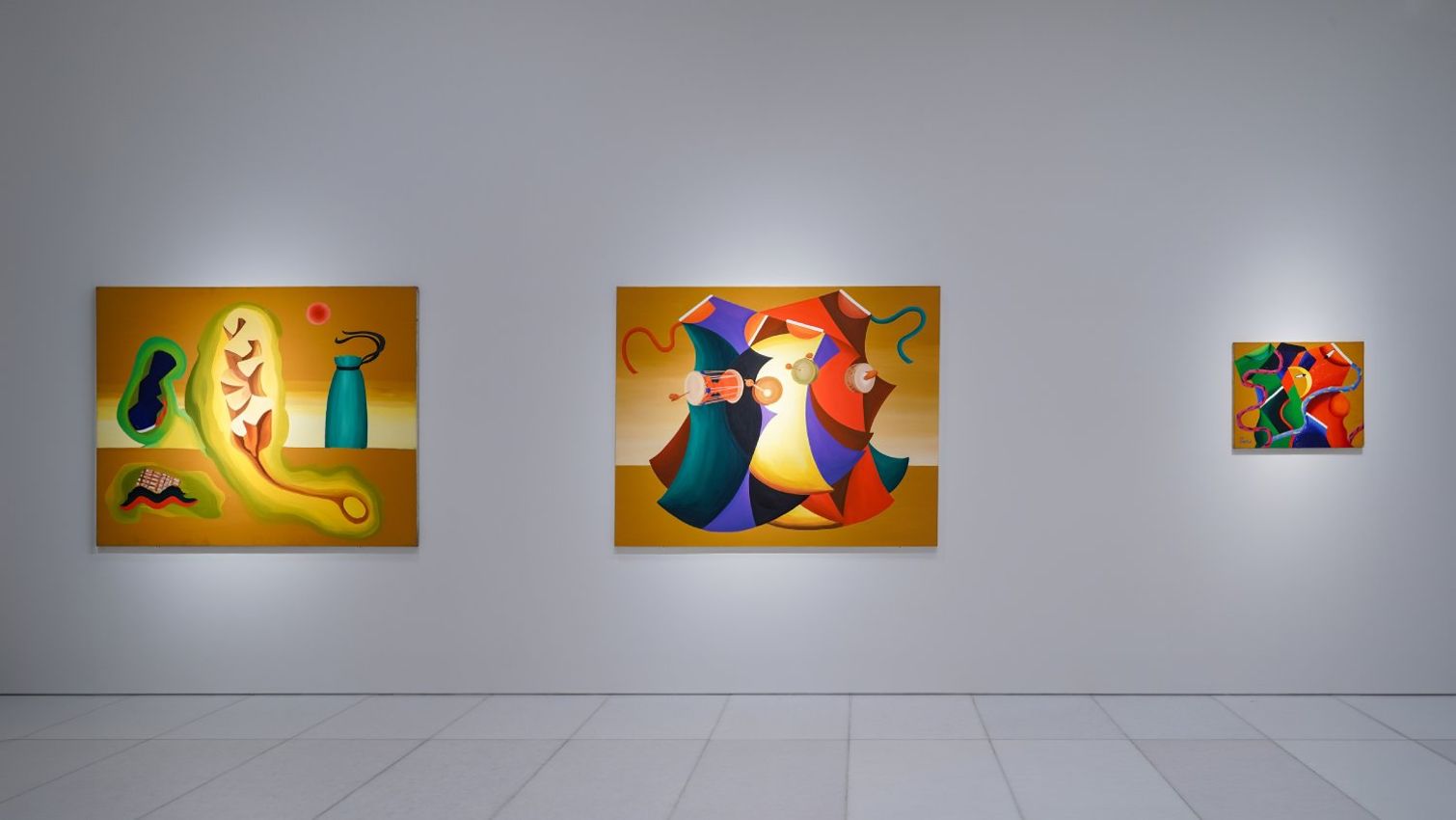
Levels B1 and 1 of the gallery shed light on JUNG’s works from the 1990s. From the 1980s to the early 1990s, JUNG traveled to various parts of the world including Central and South America, Africa, South and Southeast Asia, and the South Pacific, a journey to capture the essence of untamed nature and indigenous cultures. JUNG’s pursuit was both a literal journey and a metaphorical exploration of her personal dreams and visions. The works from this period reveal diverse visual experiences gained from her extensive travels, and also delve deeper into her inner contemplations. JUNG created unique vibrant and colourful surrealistic works applied with her own imaginative compositions. Transitioning into the late 1990s, JUNG’s work took a turn towards abstract and transcendent forms. JUNG’s interest became apparent in motifs that symbolised the traditions of her homeland, such as reinterpreting the hanbok (traditional Korean dress) as a sculptural element. The various symbols within her canvases implicitly reveal JUNG’s life and philosophy, and her identity and intense sensibility as a female artist. JUNG once said that the hanbok skirt is ‘a flag of Korean women who have been suppressed and infringed upon male chauvinism for thousands of years’ and ‘something that comes to mind when I think of my mother.’ In JUNG’s paintings, the hanbok associated with traditional constraints of pressing down the chests of women, sometimes freely unfurls into the sky or is piled up to become a grand monument.
Levels 3 and 4 of the gallery are dedicated to the exploration of JUNG’s works from the 2000s. During this period, JUNG’s works become deep personal reflections, characterised by the integration of primal landscapes and the significant motif of Janus. Janus, considered by JUNG as both a self-representation and an icon, is a recurrent theme in her work. In JUNG’s later works the semicircle is a prominent element, which derives from the circle, the smallest unit of all things in the universe. Together with artificial lines the semicircles fill up JUNG’s paintings, a glimpse into her experiments in reducing all forms to geometric shapes. Through the language of painting, JUNG desired to alleviate the oppressive realities of her time and her own suppressed desires. JUNG aimed to liberate herself through the boundless imaginations unfolded in the infinite free space of the canvas and devoted herself to her work until her passing. The multitude of paintings she has left behind vividly display the life and passion of a female artist who navigated the turbulent times of modern Korean society.
JUNG Kangja was born in Daegu, Korea and graduated from the Department of Western Painting at Hongik University, Seoul, Korea. JUNG’s artistic activities as a female artist have been introduced in several exhibitions including Reenacting History: Collective Actions and Everyday Gestures (National Museum of Modern and Contemporary Art, Gwacheon, Korea, 2017), Asia Women Artists (Jeonbuk Museum of Art, Wanju, Korea, 2017), JUNG Kangja: I Want My Last Trip to the Moon (ARARIO GALLERY Seoul and Cheonan, Korea, 2018), JUNG Kangja: Dear Dream, Fantasy, and Challenge (ARARIO MUSEUM in SPACE, Seoul, Korea, 2023) and Only the Young: Experimental Art in Korea 1960s-1970s (National Museum of Modern and Contemporary Art, Seoul, Korea, 2023). The exhibition that recently took place at the National Museum of Modern and Contemporary Art, Seoul, Korea, is currently on display at the Solomon R. Guggenheim Museum, New York, US and is scheduled to tour to the Hammer Museum, Los Angeles, US early next year. JUNG’s works are in public collections in Korea including The National Museum of Modern and Contemporary Art, Seoul Museum of Art, Suwon Museum of Art and ARARIO MUSEUM.


As one of representative female artists who addressed a turbulent historical ear in Korea, JUNG Kangja had emerged in Korean art circles through the Korean Young Artists Association Exhibition in 1967.
ARARIO GALLERY SEOUL opened its doors in Sogyeok-dong in 2006. Since then, it has established its foothold as a leading contemporary art gallery in Korea and across Asia, continuing to be at the forefront of the international art scene through its efficient representation system and bold exhibitions. In March 2014, ARARIO GALLERY SEOUL relocated near the National Museum of Modern and Contemporary Art. In April 2018, ARARIO GALLERY SEOUL RYSE HOTEL, a second exhibition space in Seoul, opened in the Hongdae area. Running concurrently with its primary location until November 2019, the project space aimed to mirror the experimental spirit of the neighbourhood through its innovative programming. In 2022, ARARIO GALLERY SEOUL ended its Sogyeok-dong era. However, the various experimentation and ventures carried out in the gallery’s previous spaces continue to shape its future at its current location in Wonseo-dong, which reopened in February 2023. Through the preemptive discovery of young artists, steady support of represented artists, and the realisation of meaningful and original exhibitions, ARARIO GALLERY SEOUL aims to continually grow and contribute to the growth of the contemporary art scene in Korea.

A respected voice in contemporary art discourse.
Focusing on ambitious storytelling and insightful art-world commentary. Ocula Magazine publishes in-depth interviews, critical essays and timely analysis on the artists, exhibitions and ideas driving the global art world.
Learn more about Ocula Magazine
Showcasing the best of the art world.
Ocula partners with galleries from around the world to highlight their artists, artworks and exhibitions. Gallery membership is by application and invitation, with each member vetted by an independent panel.
Learn more about Ocula Membership

Specialises in the sale of major artworks.
Led by a team with deep ties to the world’s leading auction houses, galleries and collectors. Ocula’s advisory team offers bespoke services to high-net-worth clients from around the world who are looking to acquire the best of contemporary and modern art.
Learn more about our team and services