Press Release

‘The moment a number of figures become involved, you immediately come on to the storytelling aspect of the relationships between figures. And that immediately sets up a kind of narrative. I always hope to be able to make a great number of figures without a narrative.’–Francis Bacon

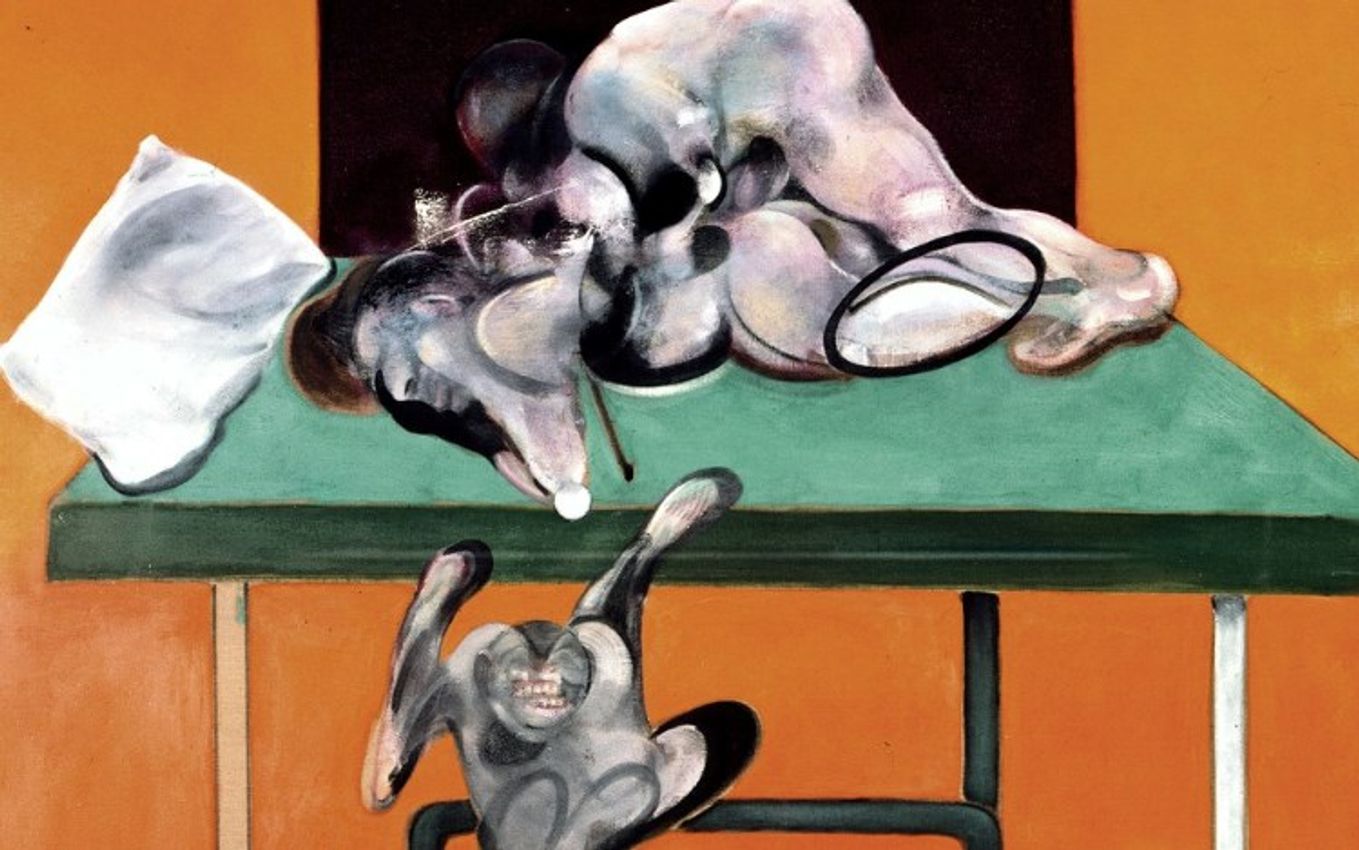
Gagosian is pleased to present Couplings, an exhibition of Francis Bacon’s double-figure paintings.

Bacon’s disturbing images–his portrayals of friends and fellow artists, and the deformations and stylistic distortions of classical subjects–radically altered the genre of figurative painting in the twentieth century. In Bacon’s paintings, the human presence is evoked sometimes viscerally, at other times more fleetingly, in the form of a shadow or a blurred, watchful figure. In certain instances, the portrayal takes the form of a composite in which male and female bodily traits are transposed or fused. This selective exhibition explores a theme that preoccupied Bacon throughout his career: the relationship between two people, both physical and psychological.

At the heart of the exhibition are two of the most uninhibited images that Bacon ever painted: Two Figures (1953) and Two Figures in the Grass (1954). These interrelated works have not been seen publicly together since the major retrospective of Bacon’s work at the Grand Palais, Paris, in 1971. After completing Two Figures in the Grass, Bacon did not return to the subject until 1967, the year that homosexual acts in private were decriminalised in England and Wales. That same year he painted Two Figures on a Couch (1967), which was last exhibited in London in 1968 and is also included in Couplings.

Finding that the physical presence of his subjects could prove inhibiting, Bacon painted his figures and portraits both from memory and from photographs–his own, as well as Eadweard Muybridge’s dynamic studies of people in motion, including male wrestlers. Although Bacon was sometimes reluctant to specifically identify the subjects of his paintings, a number of the works in Couplings (a term the artist himself used) were inspired by his fraught, often violent and passionate relationships. His affair with Peter Lacy, a former fighter pilot whom he met in 1952, cooled off after Lacy moved to Tangier, Morocco, in 1956, where Bacon visited him every summer until 1961. But even after Lacy died in 1962, Bacon continued to paint portraits of him, recalling intensely intimate moments in their relationship. In 1963 Bacon met George Dyer, a petty criminal from London’s East End. Dyer succeeded Lacy as Bacon’s lover and model and was the inspiration for many of Bacon’s grandest and most emotive paintings of the male nude. Three works in Couplings suggest a startlingly erotic and sometimes violent relationship between two men, such as the one Bacon and Dyer had: Two Figures on a Couch, the triptych Three Studies of Figures on Beds (1972), and Two Figures with a Monkey (1973)—the last two painted after Dyer’s suicide in 1971.

This is Gagosian’s third exhibition dedicated to Bacon’s work, following Francis Bacon: Late Paintings (2015) and Francis Bacon: Triptychs (2006).

The gallery is deeply grateful to the private lenders to this exhibition, as well as to Leeds Art Gallery, England, and Museo Tamayo, Mexico City.

The exhibition will be accompanied by a fully illustrated catalogue with a previously unpublished interview with Bacon by Richard Francis; an essay by Martin Harrison, author of the acclaimed Bacon catalogue raisonné; and an introduction by Richard Calvocoressi, senior curator at Gagosian. The catalogue will be released in October 2019, to coincide with Frieze London.

Read More
About the Artist

Francis Bacon was born in 1909 in Dublin and died in 1992 in Madrid. Bacon, one of the greatest painters of the twentieth century, remained devoted to figuration and portraiture throughout his career. In his art, modernity and tradition converge. His ectoplasmic figures and faces strain like savage forces of nature against shallow fields of intense colour and the sketchy armatures that bind them back to the picture plane. In his gut-wrenching serialisation of the human body and its sensations, he showed himself to be the unflinching witness of the hysterical reality of the body and the primal fear of those who inhabit it. Although Bacon’s aggressive deformations suggest an intense level of existential alienation, he was actually intimately connected to most of his sitters, among them his lover George Dyer, Henrietta Moraes, who owned the Colony Club, Bacon’s favourite drinking spot, and Isabel Rawsthorne, the renowned artist’s muse. He often painted his subjects at a remove, from photographs, although the resulting portraits are far from being objective or idealised images. Lisa Sainsbury, a close friend and patron, sat for him every week for two years while he made a concerted effort to work directly from life. Of the eight portraits of her that Bacon completed, he destroyed several and Head of a Woman (Lisa Sainsbury) (1955–1957) is one of only three remaining.

View Artist Profile

Also Exhibiting at Gagosian

About the Gallery
Gagosian is a global network of art galleries specialising in modern and contemporary art with eighteen exhibition spaces worldwide.
View Gallery Profile
Address
20 Grosvenor Hill
London
United Kingdom
Opening Hours
Tuesday – Saturday
10am – 6pm
(1)
London 20 Grosvenor Hill
Gagosian
20 Grosvenor Hill, London, United Kingdom
+44 207 495 1500
http://gagosian.com

Opening hours
Tuesday – Saturday
10am – 6pm
The art world in focus