For his sixth exhibition at Galerie Chantal Crousel, Jean-Luc Moulène takes us through a sculptural landscape where abstraction manifests itself as a force of thought and imagination, intertwined with still, bold figuration on a ritualised stage.
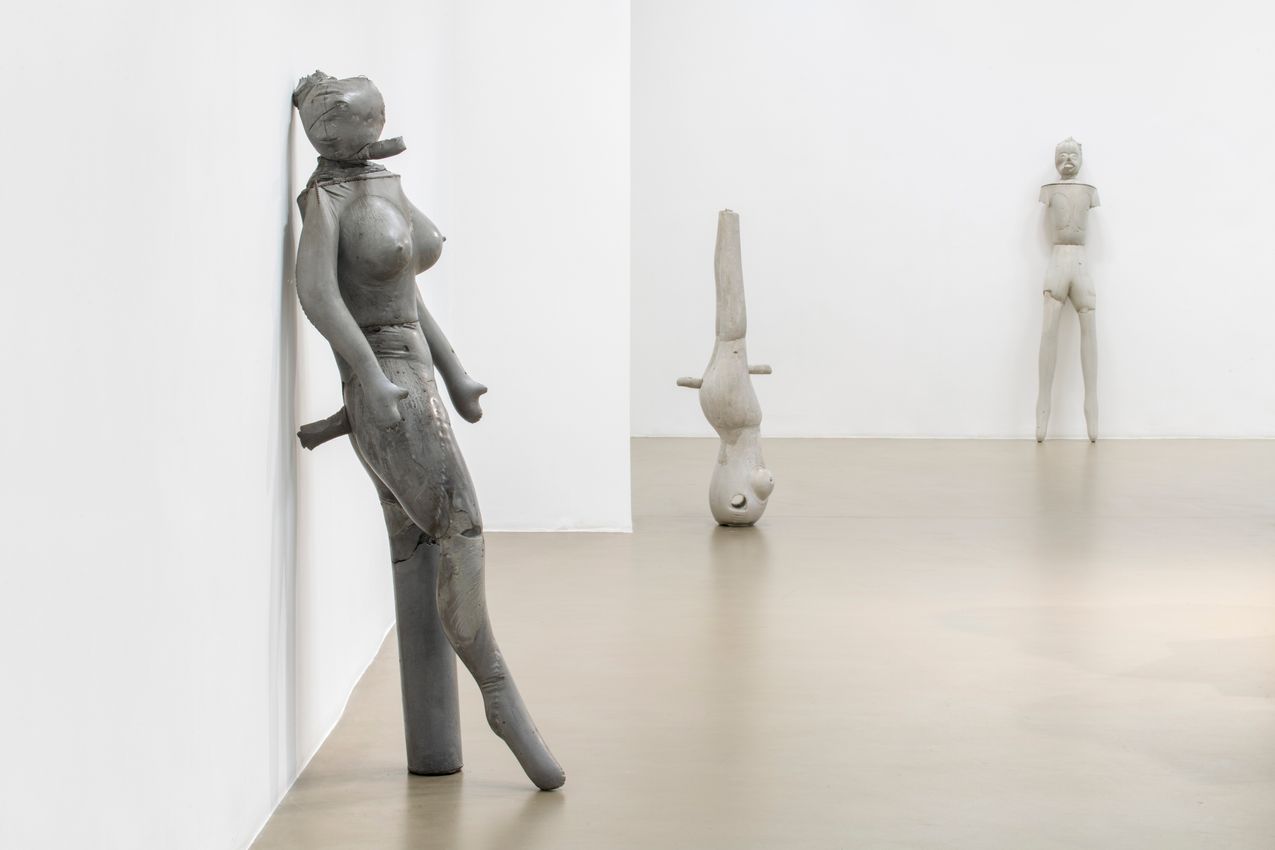
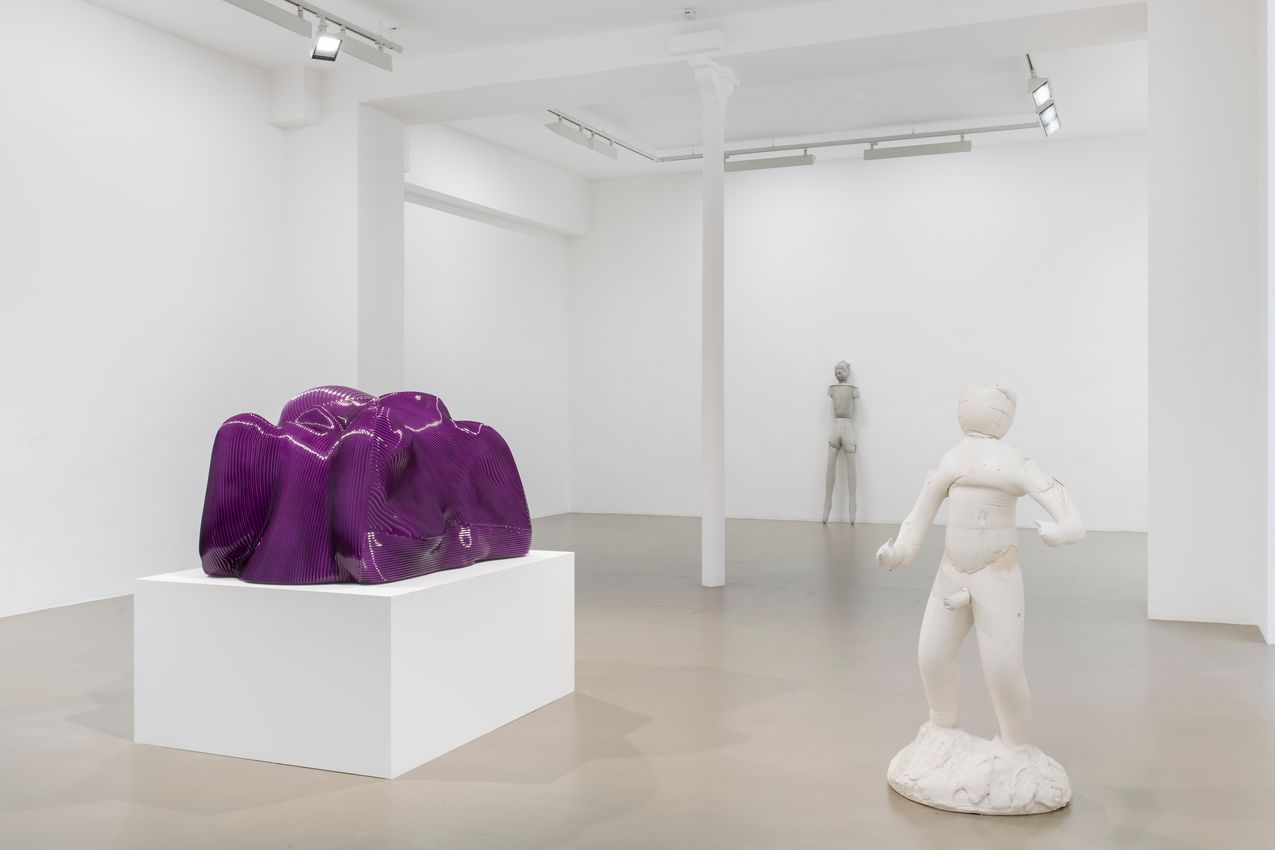
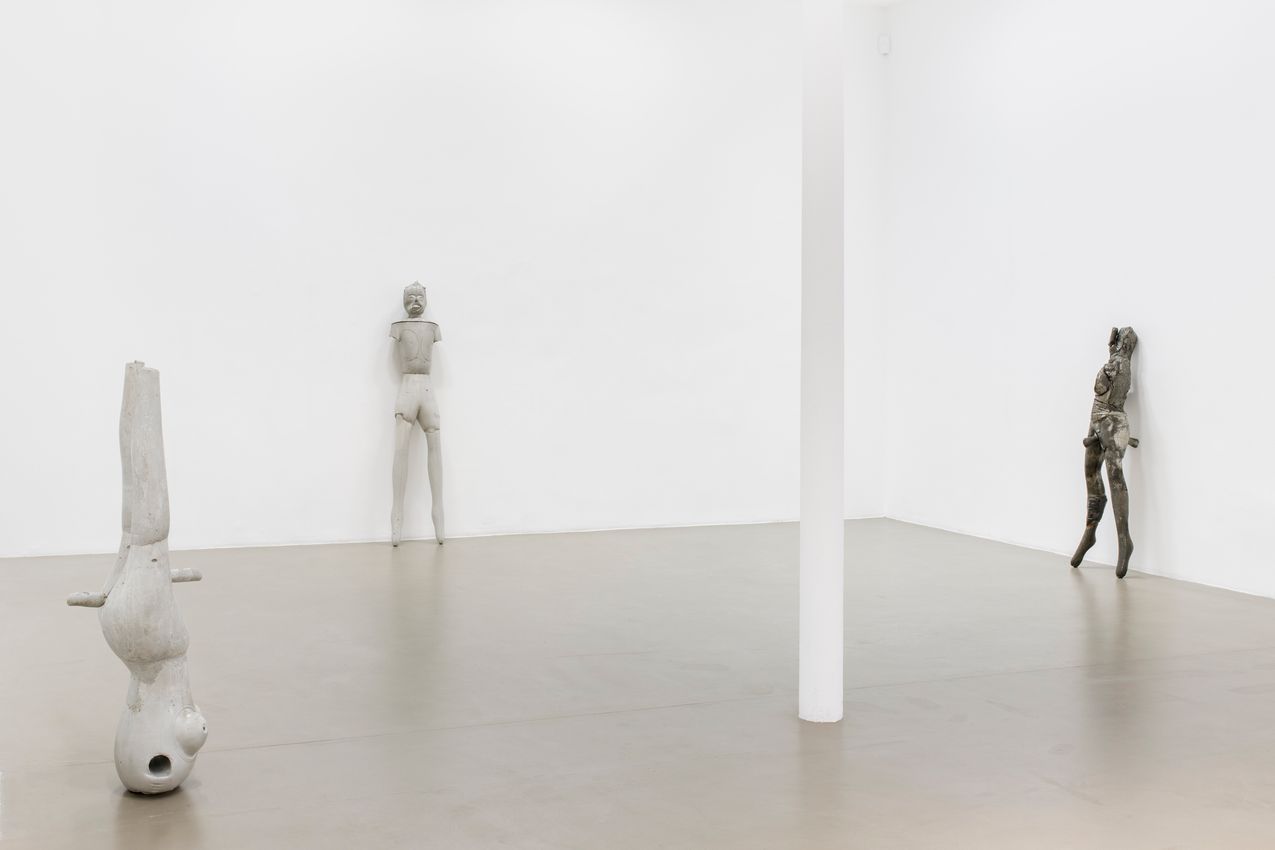
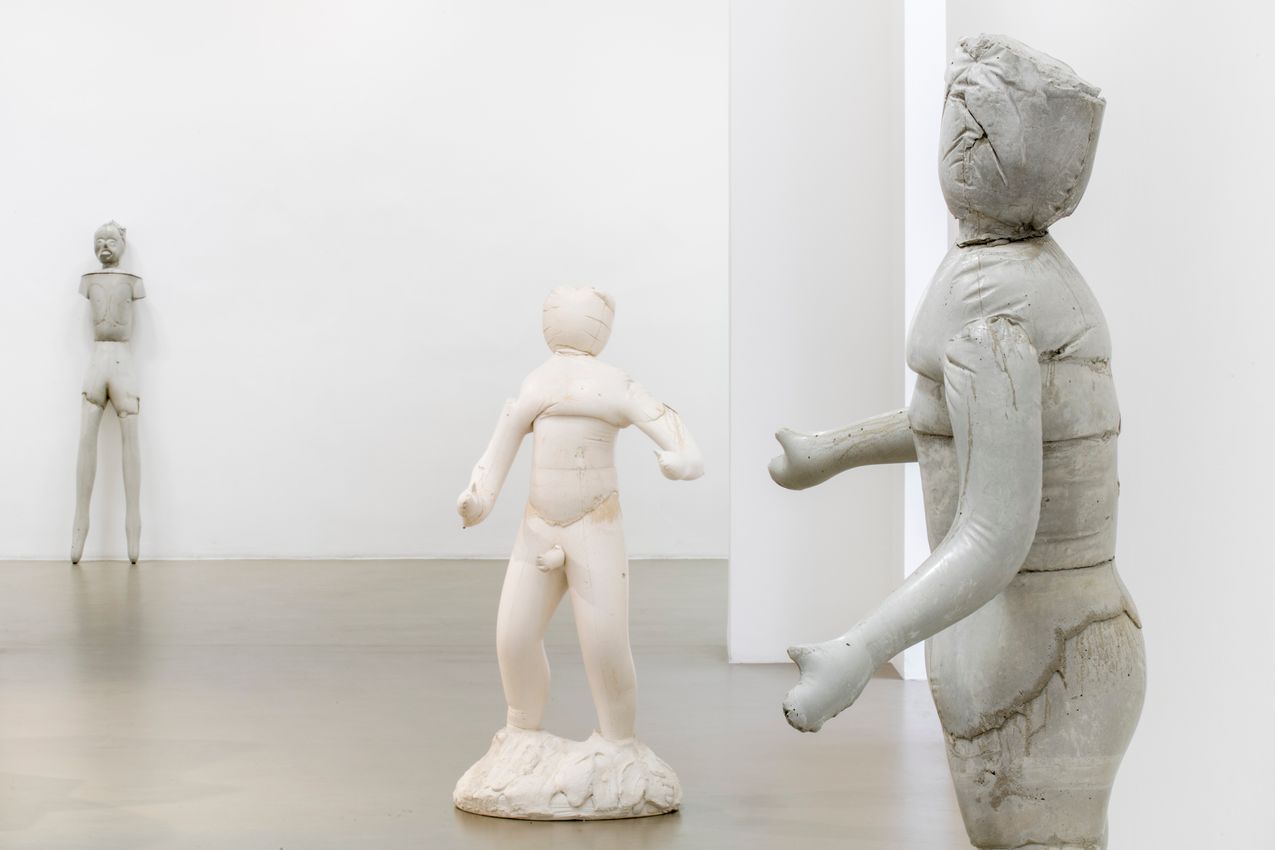
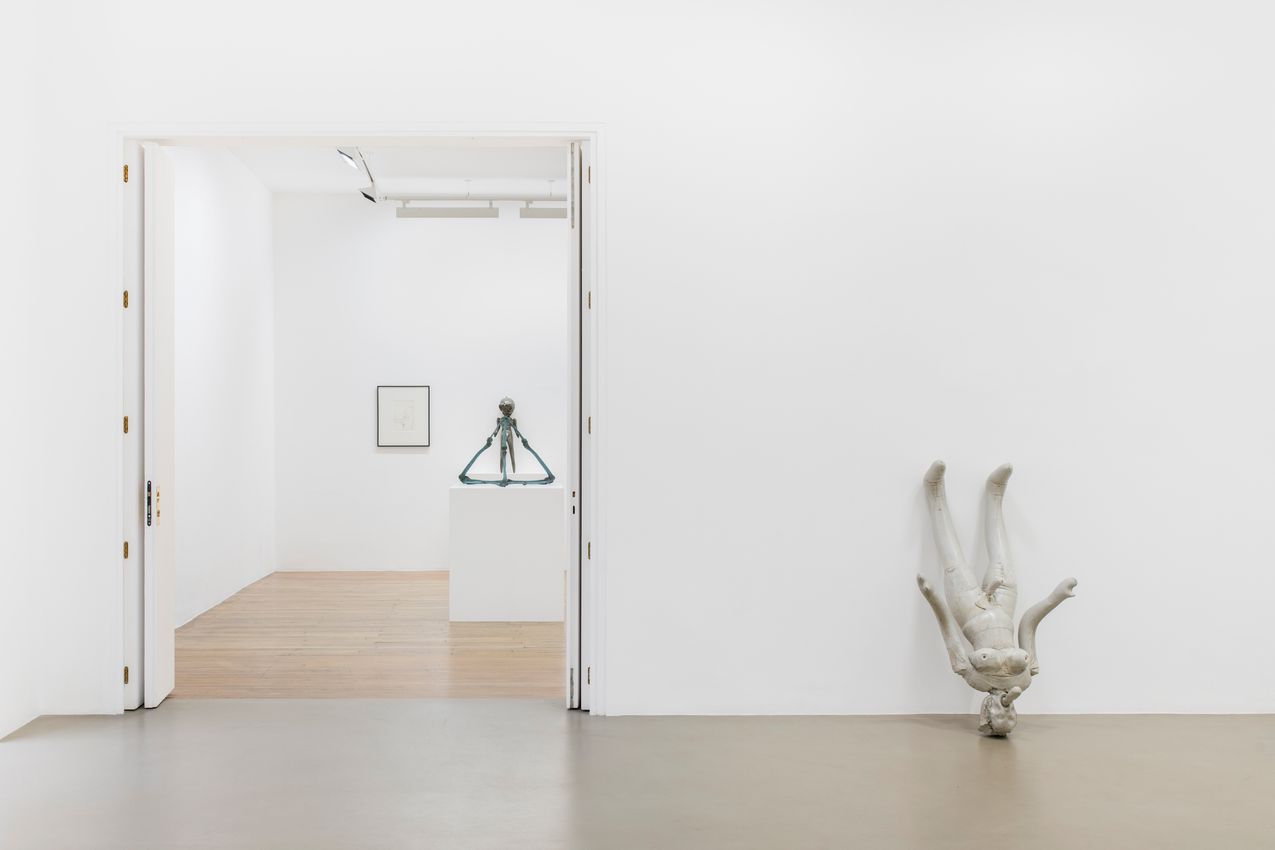
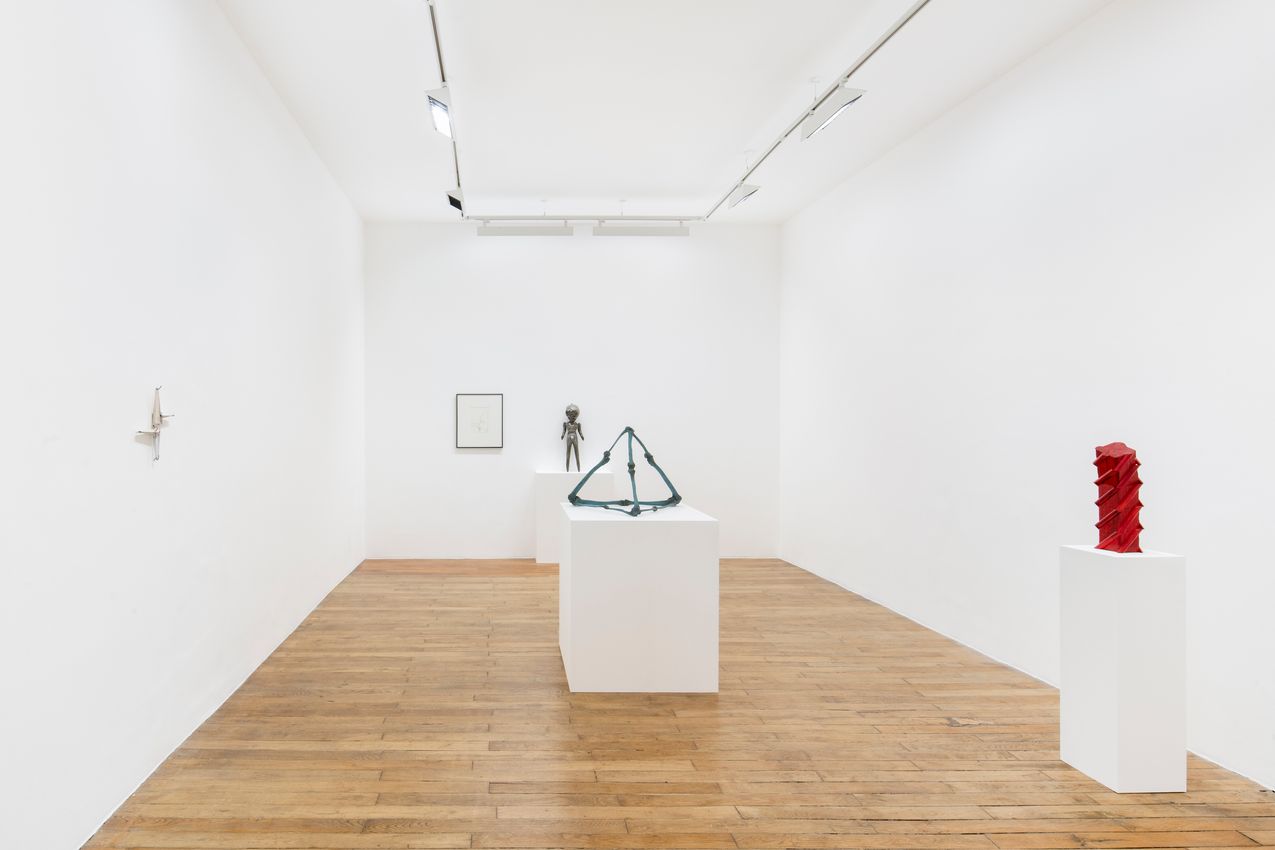
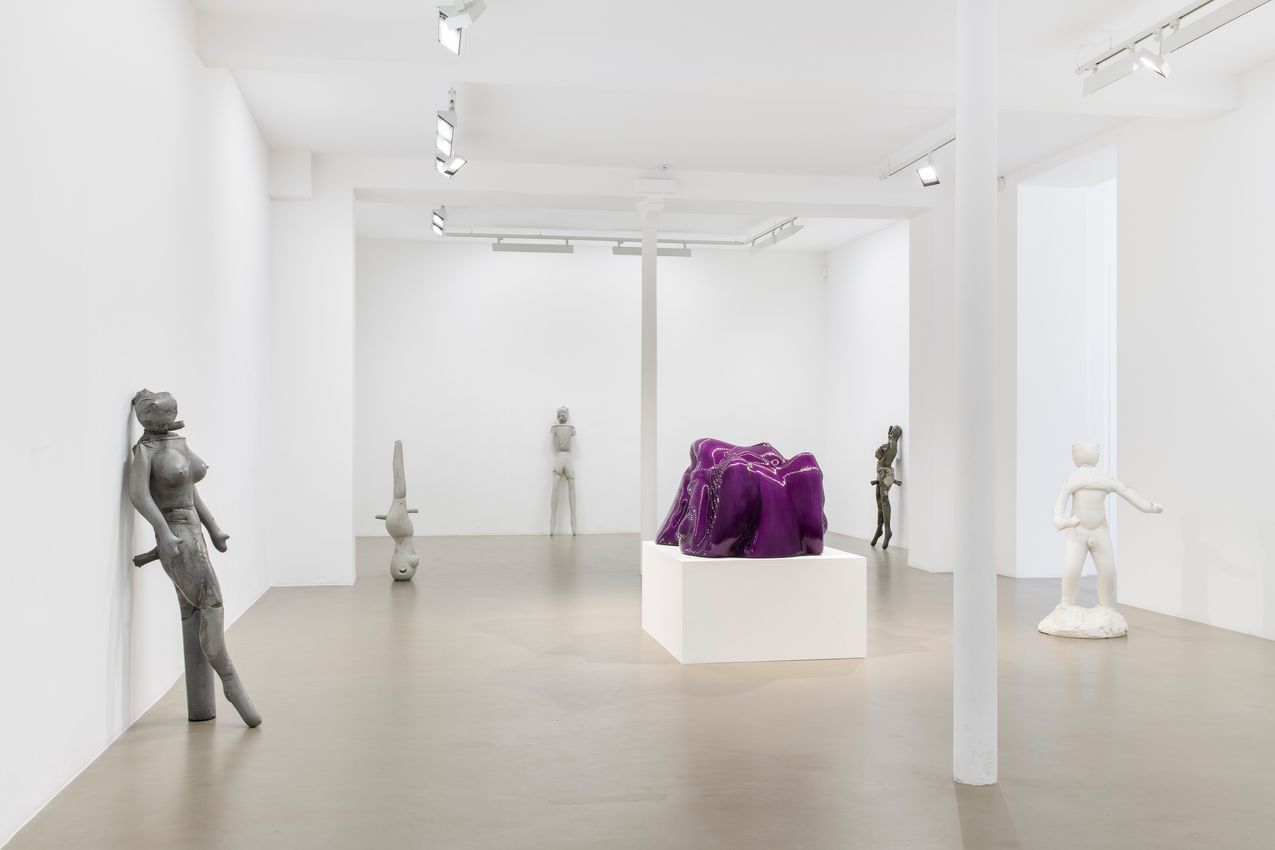
In the first room, the abstract object Montagne pourpre (2019) is put up upon its base. The fruit of 3D modelling turned out on machine-tools, this impressive hard-foam sculpture is a surface with body. Designed by the artist as a three-dimensional monochrome, the coloured abstraction stands among a new ensemble of hand-crafted concrete sculptures entitled Implicites (2020). Grouped around the Montagne pourpre and back against the wall, they watch from afar but, observers, the Implicites witness and observe their own interiority. Resulting from the same production protocol as the ‘Tronches’ series (2014–2017)1, the figures are upside-down and inside-out, interiorised then filled with concrete—effigies with distorted faces and bodies. The concrete appears different from one sculpture to the next in terms of colour (tones of grey) as much as surface (wax or epoxy). The bodies’ shapes and attributes burst out from their own erasing by the act of filling. This, in a sense, is a staging of sensitive existence.
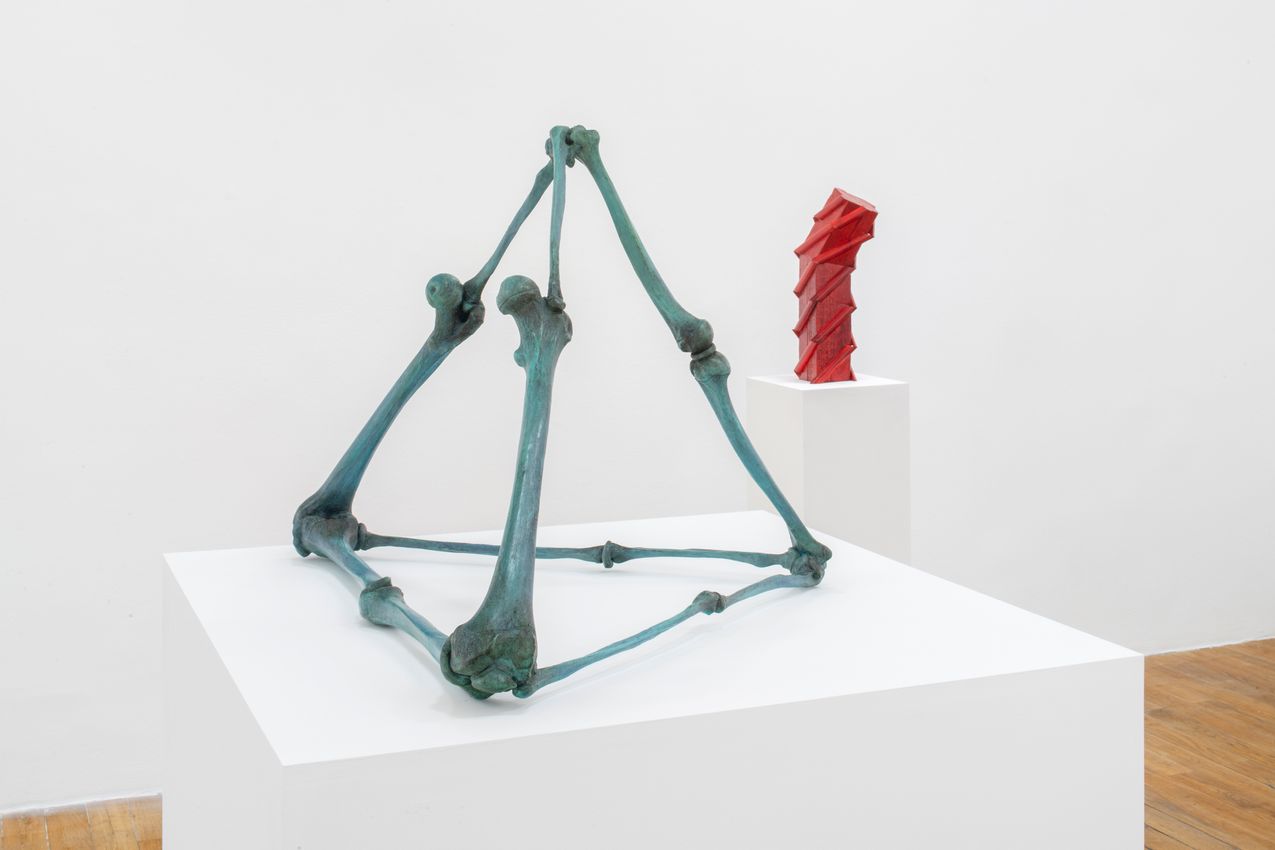
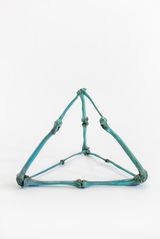
At the heart of the second room, a bronze, totem-like sculpture is presented on a pedestal, Pyramid’os (2020). Here, the long bones of the human body both form the edges of a pyramid and delineate its surfaces, or rather absence of surface because its core remains empty. The joints, the articulations, become the peaks and cornerstones. Pyramid’os shares quarters with a portrait sketch (Tronche, 2020) and various other objects including one small-scale Implicite (Redux Implicite, 2020) also back against the wall, opposite and eye-level with the pyramid.
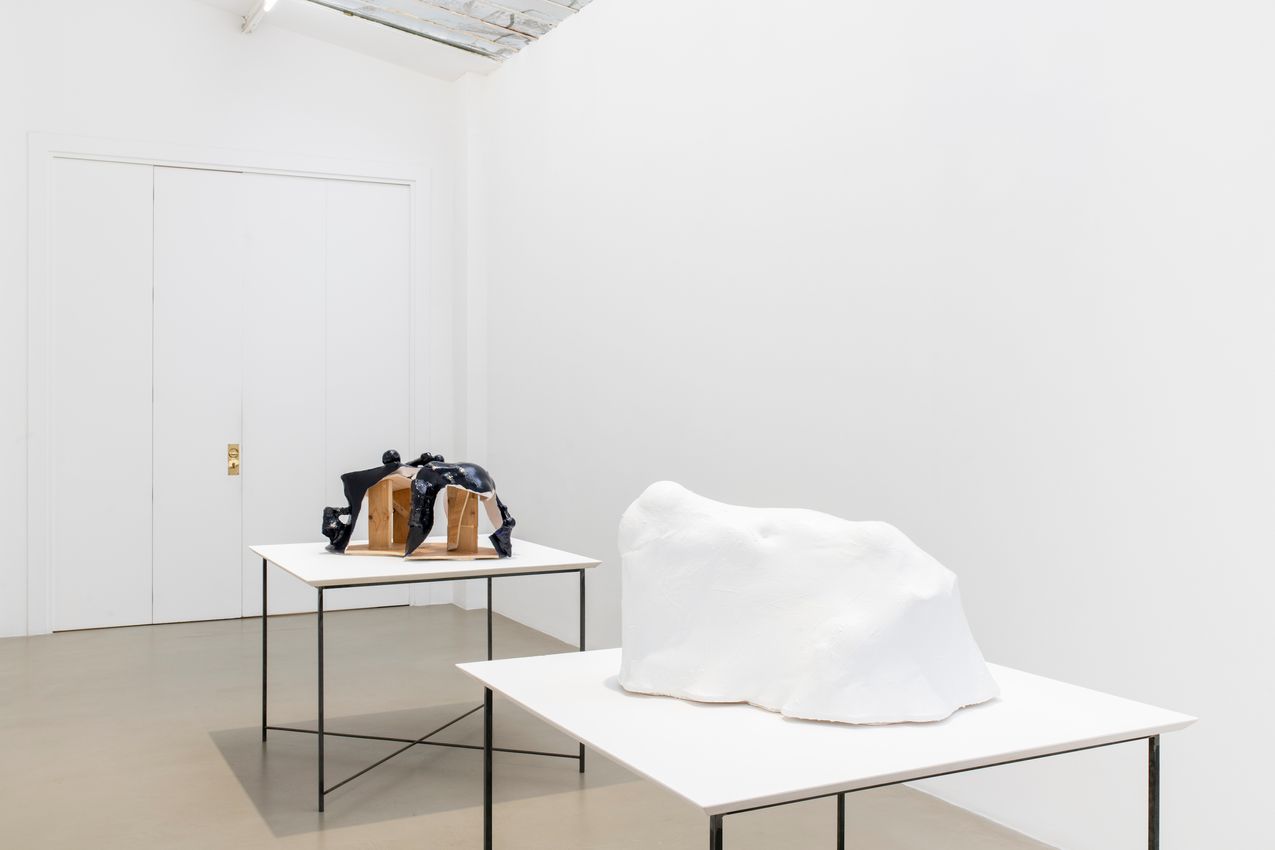
Lastly, resonating with the above works, the third and final room to the side of the first presents three sculptures, two of which are large-scale abstractions placed on tables. Reiterating the formal issues raised by Montagne pourpre, Montagne blanche (2020) has a ‘quelconque’ (ordinary)2, abstract shape, a large white monochrome still with traces of oil painting on its surface, each trace linking straight back to the visible gestures of the artist painting on canvas. A variation of this, Nature Morte (2020), is a relief painting too, a volume this time with realistic, non-covert parts, bones and stones. ‘Abstraction [...] is not simply a theme, a technique or a style, but an evolving protocol that enables thought to see the image of itself from the perspective of a matter that implacably stalks it.’3
To close, the two abstractions rub shoulders with one last sculpture positioned on a wooden beam, Yeux bleus (2020). From the observer viewpoint, this is an object composed of two stones found and glued together by epoxy paste. Spread over the top are hundreds of nazar boncukları, small, traditional, Turkish glass amulets designed to protect against the evil eye—tipping the wink one could say at the ‘quelconque’ abstraction shown at the 2019 Venice Biennale (Pale blue Eyes, 2019)— which seem to proliferate and look around, eyeing as much the sculptures as the visitors.
As Philippe Vasset said so well, I like ‘to linger in Jean-Luc Moulène’s exhibitions: full of puzzles and suggestive details, they are real fantasy machines.’4
During these past two decades, Jean-Luc Moulène’s works have been presented in many great institutions and for important international events with for instance: the exhibitions More or Less Bone at Sculpture Center, New York, (2019), U.S.A.; The Secession Knot at Secession, Vienna, Autria (2017); Jean Luc Moulène at Centre Georges Pompidou, Paris, France (2016); Il était une fois at Villa Medici, Rome, Italy (2015); Documents and Opus (1985 - 2014) at Kunstverein in Hanover, Germany (2015); Jean-Luc Moulène. works at Beirut Art Center, Lebanon (2013); Jean-Luc Moulène at Modern Art Oxford, Oxford, U.K. (2012); Opus + One, Dia:Beacon, Beacon, New York, U.S.A. (2012); Jean-Luc Moulène at Carré d’art – Musée d’art contemporain in Nîmes, France (2010); or Le Monde – le Louvre at Musée du Louvre, Paris, France (2005); His participation to several biennales: 58th Venice Biennale, Italy (2019); Taipei Biennale, Taipei, Taiwan (2016); Biennale Internationale Design, Saint-Etienne, France (2015); Sharjah Biennale, U.A.E. (2011) and at the Sao Paulo Biennale, Brazil (2002).
1 Jean-Luc Moulène worked on the ‘Tronches’ series from 2014 to 2017. They are latex Halloween masks the artist turned inside out and poured concrete into. Once dry, the latex is removed and the concrete waxed, then the mask placed on a cover for exhibition. The concrete is hence grey or coloured. The artist exhibited an ensemble of ‘Tronches’ in his solo exhibition at the Villa Medici in 2015.
2 The French term, ‘quelconque’ designating an unsurprising ordinariness with no one-to-one translation, is often part of Moulène’s vocabulary. It refers to ‘ordinary’ shapes or things of which we know neither the structure, composition nor transformation.
3 Reza Negarestani in ‘Torture Concrete: Jean-Luc Moulène and the Protocol of Abstraction’, Sequence press editions, New York City, U.S.A., 2014, p.5.
4 Philippe Vasset: in ‘Un rituel sans liturgie’ (ritual without a liturgy), Jean-Luc Moulène exhibition catalog; publ. Centre Georges Pompidou & Dilecta, Paris, 2016, p.108.
For more than twenty years, Jean-Luc Moulène has developed a complex body of work, both analytical and mysterious, of which photography has long constituted the most visible and best-known part. From the Disjunctions—a series of seemingly banal, frequently urban images that function as indeterminate topographical references at the heart of the real world—to the celebrated Objets de grève (‘Strike objects’: product shots of industrial artefacts made by striking workers, subverting the tools of their trade), Moulène’s photographs are strikingly raw, cruel and uncompromising, but always secretly metaphorical.


Located on rue Charlot in the 3rd arrondissement in Paris, Galerie Chantal Crousel presents a selection of artists highly diverse in their national and cultural origins and mediums who together contribute to a universal visual language.

A respected voice in contemporary art discourse.
Focusing on ambitious storytelling and insightful art-world commentary. Ocula Magazine publishes in-depth interviews, critical essays and timely analysis on the artists, exhibitions and ideas driving the global art world.
Learn more about Ocula Magazine
Showcasing the best of the art world.
Ocula partners with galleries from around the world to highlight their artists, artworks and exhibitions. Gallery membership is by application and invitation, with each member vetted by an independent panel.
Learn more about Ocula Membership

Specialises in the sale of major artworks.
Led by a team with deep ties to the world’s leading auction houses, galleries and collectors. Ocula’s advisory team offers bespoke services to high-net-worth clients from around the world who are looking to acquire the best of contemporary and modern art.
Learn more about our team and services