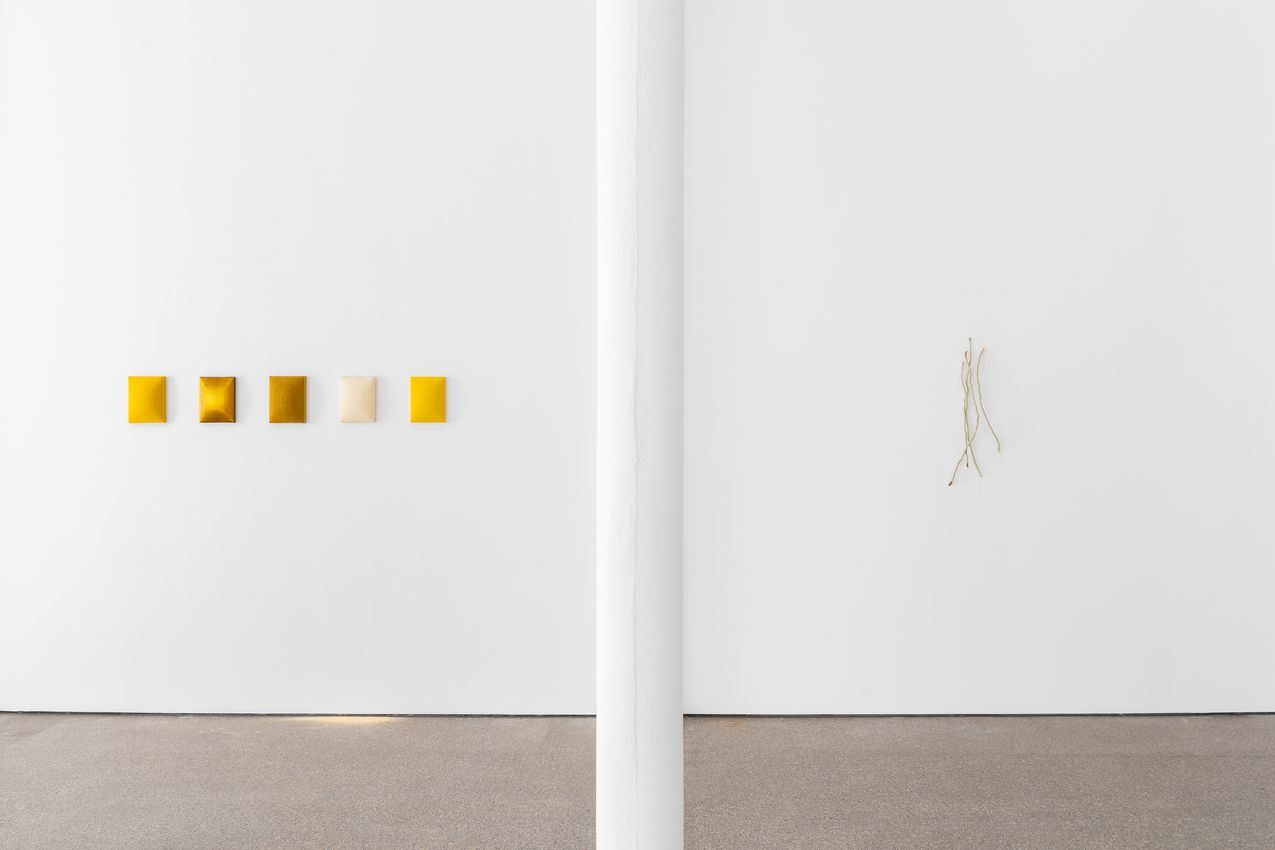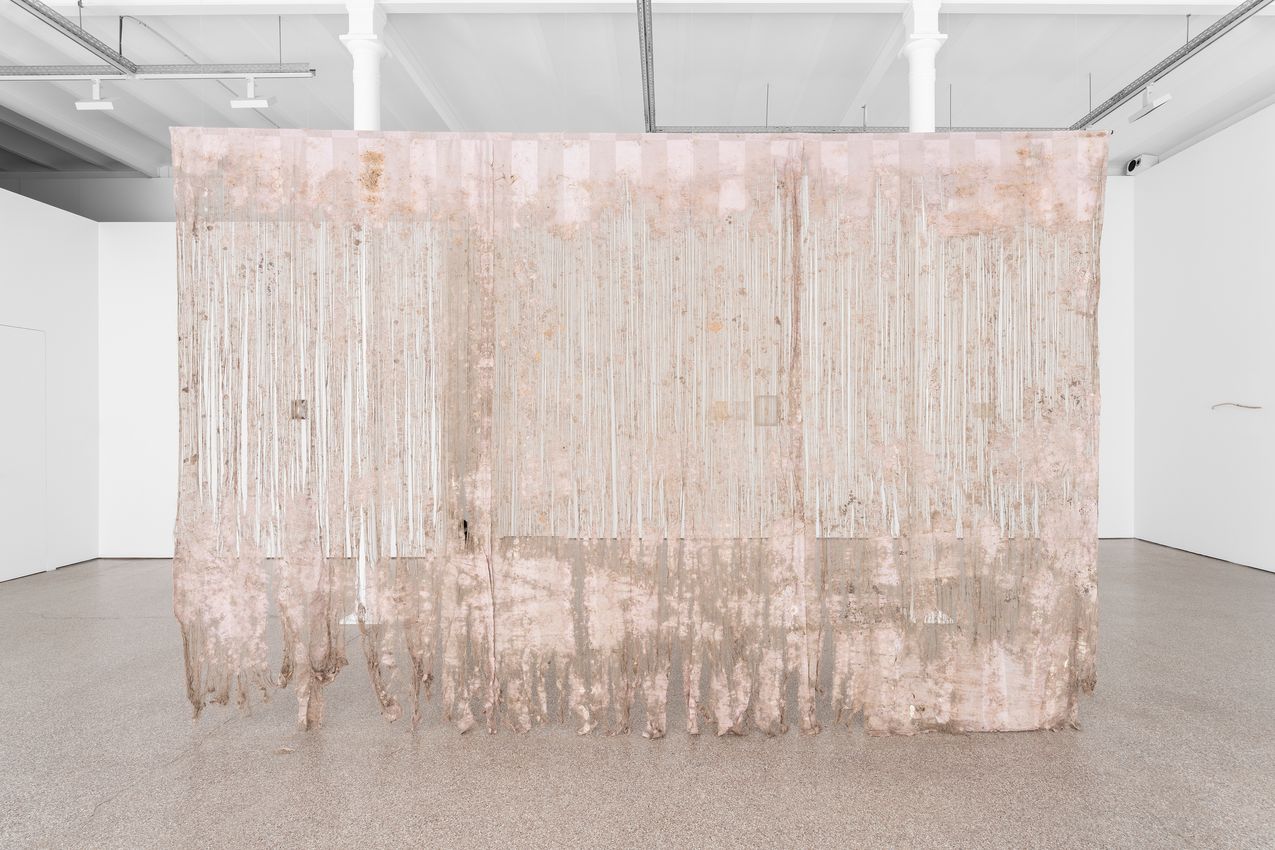
Galerie Greta Meert is pleased to present its fourth solo exhibition by Belgian artist Edith Dekyndt, spread over the ground and first floors.
It was within the context of a residency in the north of Ibiza that this exhibition, entitled Ne pas laver le sable jaune, emerged; perhaps it’s inevitable then that its focus fell on the recent past of this enigmatic island.
Ibiza saw an influx of very diverse figures in various waves during the second half of the 20th century, a kind of wide-eyed counterculture that found its home on the island. It was within the island’s idyllic conditions, and the context of the ‘Summer of Love’, that specifically hippie culture found refuge here since the 1960s, away from any form of US imperialism; remember, the Vietnam War was raging at the time.
Zooming out, we see that in Silicon Valley, this kind of counterculture had been responsible for the emergence of various technological movements, claimed by some sociologists to have sprouted directly from the hedonistic life philosophies that had been rampant since the late 60s. We can recognise a clear contradiction here, one inherently present within the technological narrative, where the individual is always in conflict with the collective, underlining the search to find a balance between forms of progressive thinking and (re)valuing traditional techniques and customs.
This particular aspect becomes highly pronounced in places like Ibiza, where within the specificities of its recent past and present, a penchant for the natural, the authentic—the analogue—is mixed with every aspect of the technological revolution—the digital. It’s precisely at this intersection that Edith Dekyndt’s work finds its significance. Her art seamlessly traverses organic elements and purely technical components such as laptops, screens, and drones.
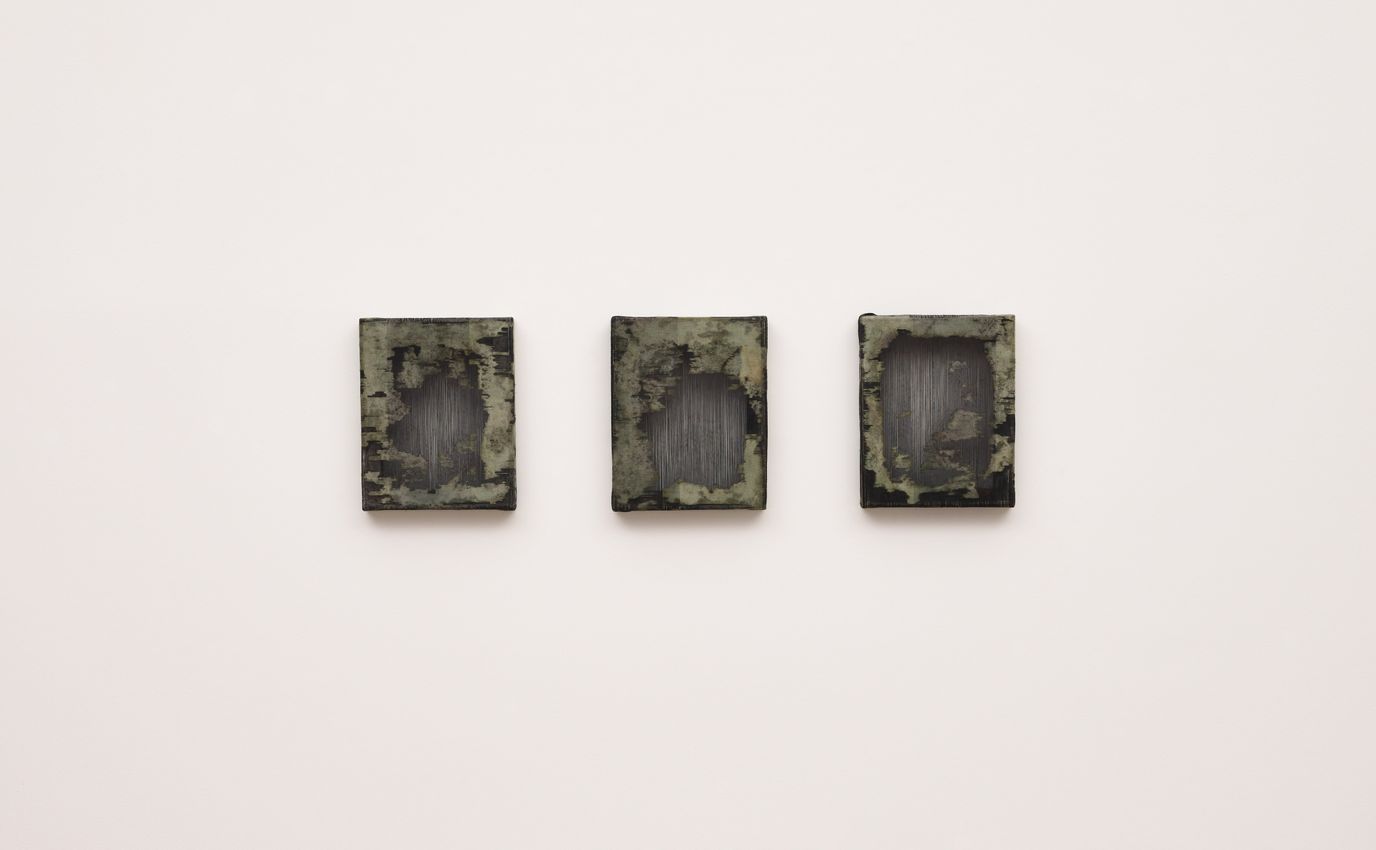
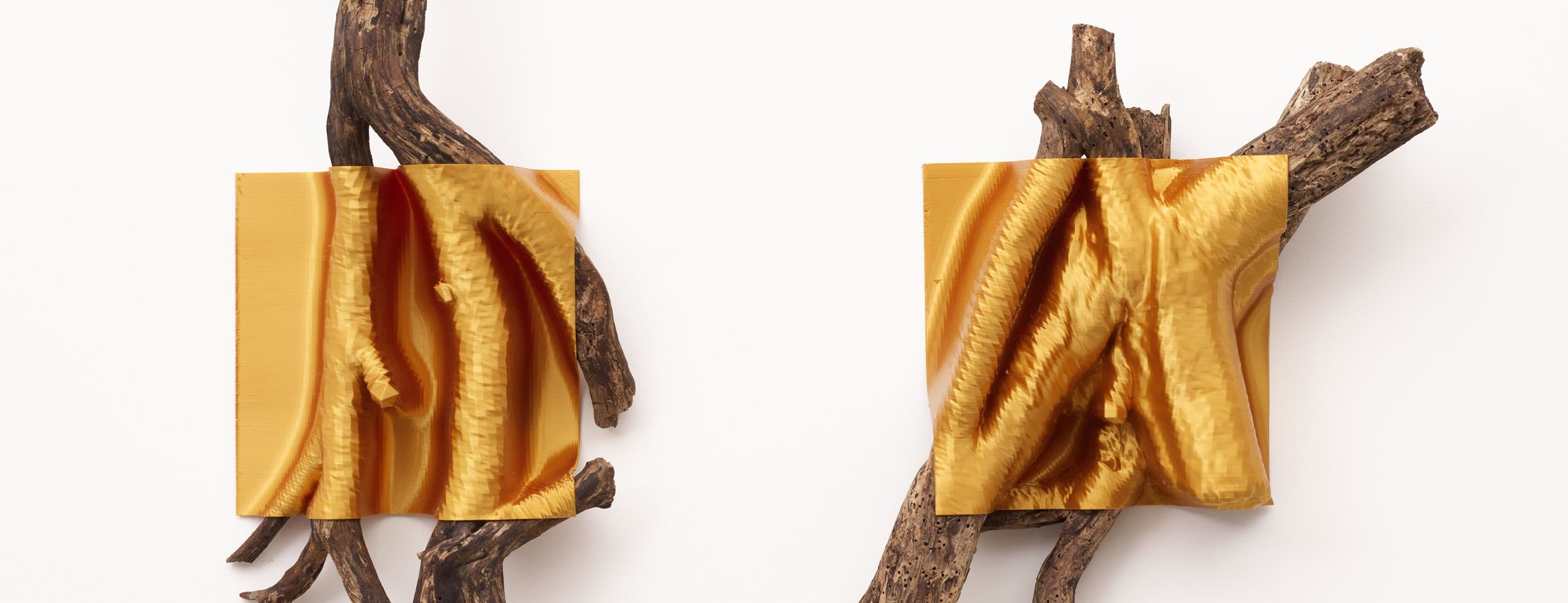
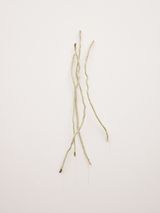
Ne pas laver le sable jaune presents assemblages of natural elements—wood, earth, textiles and plants—in dialogue with pieces made in collaboration with Claire Warnier and Dries Verbruggen’s UNFOLD studio, a practice dedicated to experimental research in three-dimensional printing. Working calculatedly with the technique of 3D printing creates a genesis that expresses itself as intuitive, empirical and entropic. Intriguingly, skilled crafts such as crocheting, knitting and weaving form a close affinity with the principles that one must adopt to (further) develop and understand this otherwise radically contemporary technology. Accordingly, in the exhibition, we will see organic materials such as wooden branches sheathed in fine threads, highlighting, through light and texture, the versatility of their forms and properties.
Similarly, Edith Dekyndt will create a new video work in Ibiza at the end of September, entitled la Puerta del Cielo (Heaven’s Gate), and it will be installed in early October as part of the exhibition. It illustrates the fact that for some 20 years the island has been overrun by snakes, their eggs unintentionally imported from mainland Spain as stowaways in centuries-old olive trees. These snakes inexorably destroy the native fauna, especially the lizards that have been essential to the island’s subtle environmental balance for millions of years.
Working with video, sculpture, installation, sound and drawing, Edith Dekyndt addresses timeless questions about time and space. Using this wide range of techniques, she makes transient physical phenomena and momentary incidents visible, creating a conceptually rich and materially engaged visual language. Paying homage to what is neither clean nor pure, her work functions as a translation of time into materiality and vice versa, a study of the subtle variations in the fabric of our tangible world.
The gallery is also delighted to announce that on the 21st of October it will be hosting a launch of the artist’s new book, From two thousand and sixteen to two thousand and twenty-three. Published by Éditions Dilecta, it contains contributions from Emma Lavigne, Léon Kruiswijk, Rebecca Lamarche-Vadel, Katja Schroeder, Vinciane Despret, Tim Goosens and Dirk Snauwaert.
Edith Dekyndt (b 1960, Ypres, Belgium) lives and works in Brussels. Recent exhibitions include l’Origine des choses, Bourse du Commerce, Paris, France (2023), Icônes, Punta della Dogana, Venise, Italy (2023), Area of Inertia, Laennec Chapel, Pinault Collection, Paris, France (2022), Concentrated Form of Non-Material Energy, St. Matthäus Kirche, Berlin, Germany (2022), Visitation Zone, Riga International Biennal of Contemporary Art, Riga, Lithuania (2020), They Shoot Horses, Kunsthalle Hamburg, Germany (2019), The Black, The White, The Blue, Kunsthaus Hamburg, Germany (2019), CONVEX / CONCAVE, Belgian Contemporary Art, TANK, Shanghai, Chine (2019) ; Biennalsur, Bienal Internacional de Arte Contemporeana de America del Sur, Musee de la inmigracion, Buenos Aires, Argentina (2019), Luogo e segni, Punta della Dogana, Venise, Italy (2019), Viva Arte Viva, 57th Bienniale di Venezia, Italy (2017), Ombre Indigène, Wiels, Brussels, Belgium (2016), Théoreme des Foudres, Le Consortium, Dijon, France (2015).
Edith Dekyndt (b. 1960, Ypres, Belgium) works across video, sculpture, installation, drawing and sound to address timeless concerns of light, time and space in the most subtle ways. Throughout her work, she manifests a profound interest in physical phenomenons and ephemeral incidents by paying close attention to materials and their transient nature. She transforms her sensual perceptions to create a conceptually rich and materially engaged visual language. She lives and works in Berlin, Germany and Brussels, Belgium.
Over the past 30 years, Galerie Greta Meert established itself as one of Brussels’ leading contemporary art galleries. Founded in 1988 as Galerie Meert Rihoux, it was subsequently renamed after its founding director Greta Meert in 2006. Located in the center of Brussels, the gallery occupies a five-story Art Nouveau building designed by Louis Bral and renovated for the gallery by renowned Belgian architects Hilde Daem and Paul Robbrecht. Since 2012 three floors of the building are dedicated to exhibitions, making it possible to maintain an expanded exhibition schedule.

A respected voice in contemporary art discourse.
Focusing on ambitious storytelling and insightful art-world commentary. Ocula Magazine publishes in-depth interviews, critical essays and timely analysis on the artists, exhibitions and ideas driving the global art world.
Learn more about Ocula Magazine
Showcasing the best of the art world.
Ocula partners with galleries from around the world to highlight their artists, artworks and exhibitions. Gallery membership is by application and invitation, with each member vetted by an independent panel.
Learn more about Ocula Membership

Specialises in the sale of major artworks.
Led by a team with deep ties to the world’s leading auction houses, galleries and collectors. Ocula’s advisory team offers bespoke services to high-net-worth clients from around the world who are looking to acquire the best of contemporary and modern art.
Learn more about our team and services