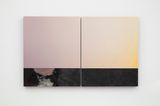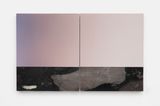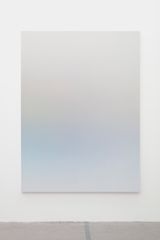




HUBBLE TROUBLE is Pieter Vermeersch’s third solo exhibition at Galerie Greta Meert. For this installation, the artist produced a new body of work where he brings together and combines a mural painting with works on canvas, as well as painted and silkscreened marbles, into an architectural ensemble that extends across two floors.
Vermeersch deploys painting and adjacent pictorial strategies as instruments to create images that maintain a compound relationship to time, space and matter, thereby oscillating between abstraction and representation. In alluding to the technological eye of the space telescope, the artist continues his exploration of the uncertainties that arise in the act of looking deeper. For Vermeersch, these uncertainties, or troubles, become the engine of the work. By looking deeper in an attempt to confirm something about existence that nonetheless remains elusive, a paradoxical relationship becomes visible. The complex technological tools or pictorial techniques involved in capturing and expending our understanding of time and space on the one hand; and the inevitable glitches and pictorial failures that ensues on the other hand, come to form an abstract language that emerges from reality, only to show the limits of our perception.
This abstract language is activated in Vermeersch’s colour gradients. These paintings are the result of a meticulous process whereby the artist becomes a kind of human printer—blending paint into smooth and seamless surfaces that conceal the labor involved in making them. These seemingly straightforward paintings and the illusory space they conjure aim to register a presence while also allowing that presence to expand through representation and test the limits of what can constitute an image. Here, a painting technique that requires control and mastery is put to use for the translation of poor technical images—accidental photographs or images without spatial referents, photographs of undefined shadows, clear skies or architectural details. In the process of filtering these already abstract photographic sources, painting liberates itself from any referent to invent a formless representation that enables a purely physical and perceptual experience. This physical experience, which requires the presence of the body in space entails a slow way of looking that counters the fast consumption of images that prevails in our day to day.
In the artist’s new silkscreened marble, the reality of the material itself and that of its representation are conflated. Rasterised photographic images of the surface of the marble are consecutively silkscreened on top of the surface they depict using the CMYK principle. In this tautological operation, the image dissolves into the material to blur the line between matter and representation—the two central elements of our visual world. The geological time crystallised in metamorphic rock is also present in a series of painted marble diptychs that evoke abstract landscapes. Painted directly onto the geology of the divided marble slabs, these luminous landscapes, which are also divided in two parts are confronted to the actual surface of the marble, and in turn, they take on a quasi photographic quality. From hyperrealistic abstraction to formless representation, Pieter Vermeersch devises a constant back and forth that reflects our need to simultaneously divide and connect time and space, abstraction and representation.
Pieter Vermeersch (1973, Kortrijk, Belgium) lives and works in Brussels, Belgium and Torino, Italy. Recent solo exhibitions include: Museum M (2019), Leuven; Office Kersten Geers David Van Severen (2019), Brussels; NC-arte (2019), Bogota, Columbia. Recent group exhibitions include: On the lookout (2022) Fondation CAB, Brussels (Belgium); Spring (2021) Fondation Thalie, Brussels (Belgium). In 2019, Vermeersch received the Best Exhibition Award from AICA for his solo exhibition at Museum M in Leuven (Belgium).
Originating from photographic sources, Pieter Vermeersch’s work deploys painting as an instrument to create images that perpetually oscillate between abstraction and representation. In scanning the extremities of the medium and its relationship to architecture he looks for the degree zero of an image. His preoccupation where time, space and matter constutue the three main elements.
Over the past 30 years, Galerie Greta Meert established itself as one of Brussels’ leading contemporary art galleries. Founded in 1988 as Galerie Meert Rihoux, it was subsequently renamed after its founding director Greta Meert in 2006. Located in the center of Brussels, the gallery occupies a five-story Art Nouveau building designed by Louis Bral and renovated for the gallery by renowned Belgian architects Hilde Daem and Paul Robbrecht. Since 2012 three floors of the building are dedicated to exhibitions, making it possible to maintain an expanded exhibition schedule.

A respected voice in contemporary art discourse.
Focusing on ambitious storytelling and insightful art-world commentary. Ocula Magazine publishes in-depth interviews, critical essays and timely analysis on the artists, exhibitions and ideas driving the global art world.
Learn more about Ocula Magazine
Showcasing the best of the art world.
Ocula partners with galleries from around the world to highlight their artists, artworks and exhibitions. Gallery membership is by application and invitation, with each member vetted by an independent panel.
Learn more about Ocula Membership

Specialises in the sale of major artworks.
Led by a team with deep ties to the world’s leading auction houses, galleries and collectors. Ocula’s advisory team offers bespoke services to high-net-worth clients from around the world who are looking to acquire the best of contemporary and modern art.
Learn more about our team and services