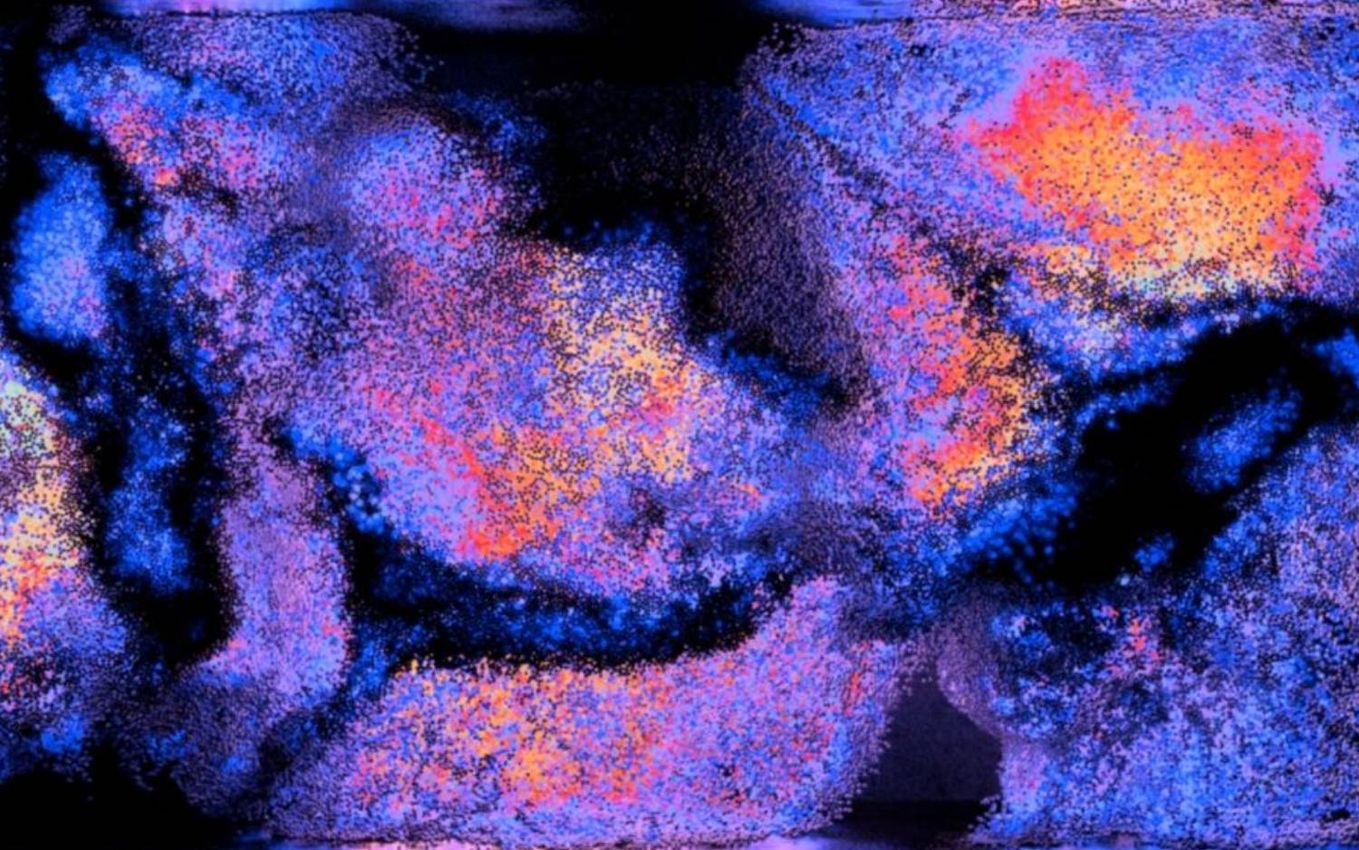
Maxim Zhestkov’s first solo show with Unit London, Simulation Hypothesis, is an immersive exploration of artificial intelligence and virtual reality and the ways in which they are intrinsically linked to our human heritage. Zhestkov, inspired by the writing of Noam Chomsky, seeks to overcome the limitations of language through an exploration of origin and narrative through painting and art.
Zhestkov equally seeks inspiration in pre-historic cultures of cave art and ancient bas-reliefs. He plays with a visuality that precedes written language, from a time in which early humans used clay to make vessels and figurines. Zhestkov’s tools, however, are those of programming and software, deployed to mould these mysterious simulations, in which scale and time are left unaccounted. In dialogue with machines and algorithms, the artist works with the functions of Artificial Intelligence. Amid the widespread fears that Artificial Intelligence poses a threat to human existence, he hopes that his work will move viewers to think of AI not as an adversary, but as a descendent of human consciousness and as part of the process of creation.
The title of his show, Simulation Hypothesis, connects these themes, as he proposes that we can better understand ourselves through the tools that are inherently found within the building blocks of the universe. Zhestkov’s work positions even the smallest details as agents of ‘true meaning’: his process is iterative, each step informing the next. Curator and art historian Jiyoon Lee writes, “By engaging with what are seemingly constraints, limitations and restrictions, he explores the concept of inverse thinking, wherein the significance lies not only in what is said but also in what is left unsaid. It is within these boundaries and thought processes that Zhestkov discovers the emergence of sculpture-like after-effects of his creative process and decisions, creating a narrative that resonates with the human condition as the echo and after-glow of previous choices.”
The show takes viewers on a conceptual journey, immersing them first in Clouds of Creation, a large-scale projection that recreates the Big Bang, and then guiding them through micro manifestations of this transformative moment of genesis. Zhestkov’s second large-scale projection Dimensional Dreamscapes evokes the emergence of complex biological structures. In particular, it reflects the transformation of humanity, tracing our journey from cosmic origins to becoming active agents of creation. It suggests that humanity’s desire to create, build, and alter the world is a continuation of primary cosmic energy, presenting the creative process as a perpetual dance between humans and the elements that were spun into existence with the universe’s inception.


Unit seeks to preserve the artist’s essential role as the flag-bearer of creativity in our future.

A respected voice in contemporary art discourse.
Focusing on ambitious storytelling and insightful art-world commentary. Ocula Magazine publishes in-depth interviews, critical essays and timely analysis on the artists, exhibitions and ideas driving the global art world.
Learn more about Ocula Magazine
Showcasing the best of the art world.
Ocula partners with galleries from around the world to highlight their artists, artworks and exhibitions. Gallery membership is by application and invitation, with each member vetted by an independent panel.
Learn more about Ocula Membership

Specialises in the sale of major artworks.
Led by a team with deep ties to the world’s leading auction houses, galleries and collectors. Ocula’s advisory team offers bespoke services to high-net-worth clients from around the world who are looking to acquire the best of contemporary and modern art.
Learn more about our team and services