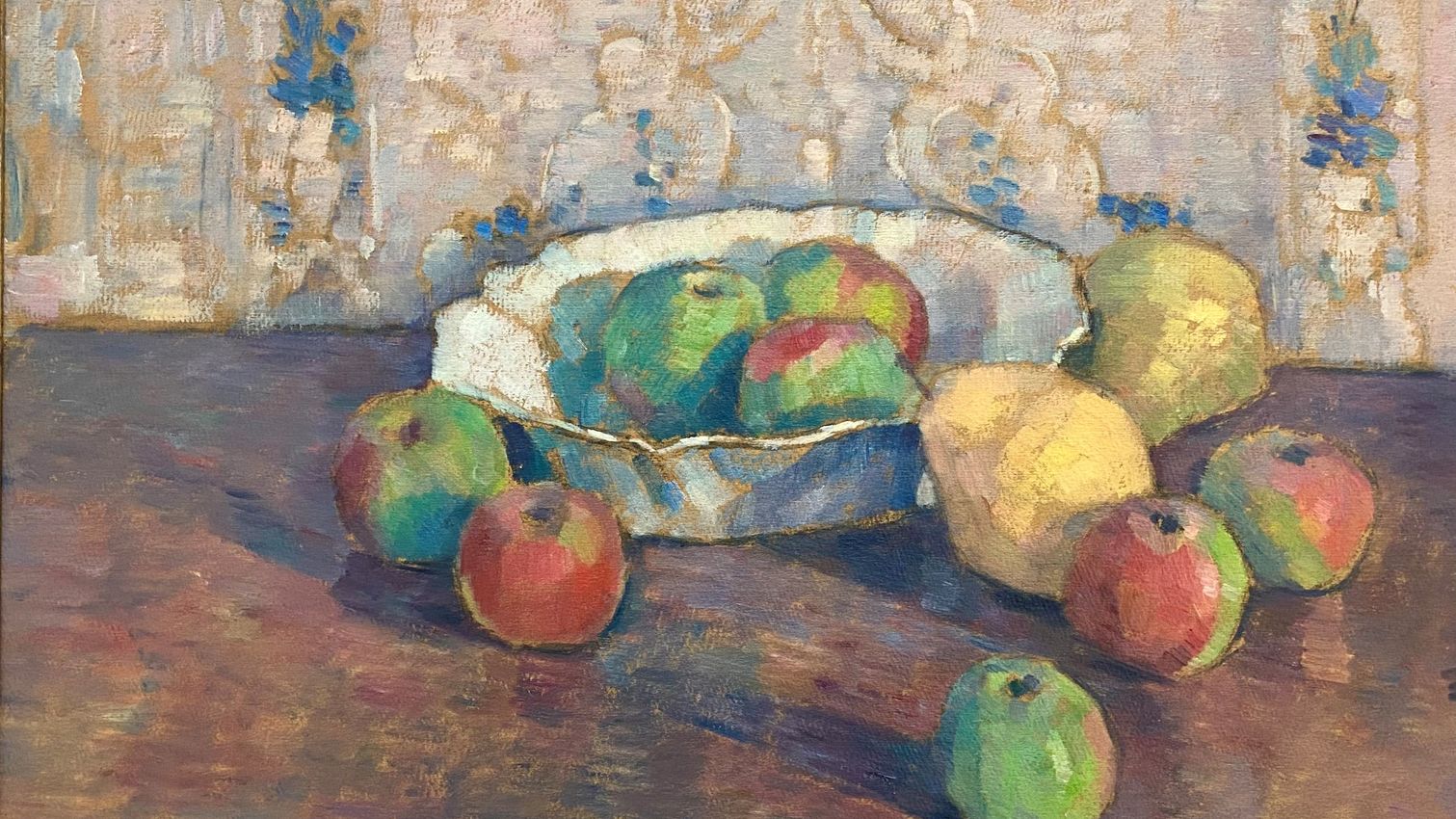
Alexej von Jawlensky’s portraits, landscapes, and still lifes are characterised by vivid colour schemes, expressive brush strokes, and an increasingly abstracted approach to form.
Head Paintings in Munich
From around 1910, Jawlensky began to paint his first set of ‘Head Paintings’, a dominant format that he developed and altered throughout his career. Mostly featuring women—and believed by some to be a continuation of Russian Orthodox icon painting traditions—these were close-up, intimate portraits of friends and acquaintances.
Initially, these paintings depicted women in wide-brimmed hats, such Young Girl with a Flowered Hat (1910). Over time, influenced by Modernist currents, Jawlensky stripped the portraits of such details to focus on the form of the head. In Head of a Woman (1911), flat areas of rich colour are contained by black contours, and facial features are explored in daring contrasts and harmonies of colour. These harmonies became richer when Jawlenksy joined Der Blaue Reiter, as seen in the bold reds and greens in Mme. Turandot (1912).
Alexej von Jawlensky Landscapes
Both Der Blaue Reiter, split up by the outbreak of war in 1914, and Jawlensky as a Russian national were soon exiled from Germany for the duration of the First World War. Cloistered in Saint-Prex, Switzerland without a studio, the artist made an extensive series of ‘Variations’, representing the view from his bedroom window.
More complex and abstract than earlier landscape paintings, Jawlensky’s ‘Variations’ pared reality down into cones, circles, ovals, lines, planes, and dots. Colours depended on the season, weather, and the artist’s personal disposition. Reflecting on these works, Jawlenksy said, ‘every day I painted these colourful variations, always inspired by the atmosphere of nature at the time, paired with my spirit.’ Jawlensky focused almost exclusively on this motif until 1917. He continued to paint ‘Variations’ from memory until 1921.
Alexej Portraits - Mystical Heads
In 1917, taking this meditative mood with him to Zurich, Jawlensky met artists such as Hans Arp, Sophie Taeuber-Arp, Wilhelm Lehmbruck, and Arthur Segal. Frequenting the circles of Café Odéon, he also met the likes of Hugo Ball, Emmy Hennings, Hans Richter, and Tristan Tzara.
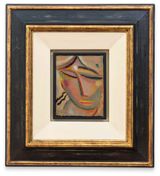
At this time, Jawlensky produced a series of ‘Mystical Heads’. These employed a more simplified visual language, often expressively imbued with a sense of spiritual calm and quiet meditation. This was followed by a series of ‘Saviour’s Faces’ (1918—1920), which carried deeply religious sentiments.
Abstract Heads
Further developing his seminal style, Jawlensky made over 300 ‘Abstract Heads’, also known as ‘Constructivist Heads’, between 1918 and 1934. These are notable for their increased abstraction of the face into simple forms.
Jawlensky developed a visual canon that he applied ritualistically across these works. The head is shown strictly face-on, bordered by a U shape or tilted U with only a few lines for facial features, and featuring a few coloured dots to hold together the various colour compositions of the face. Part of the universal spiritualism underpinning these works, the eyes were always closed, intimating a state of inner meditation.
Post-war, Kandinsky, Jawlensky, Klee, and Lyonel Feininger reunited as Die Blaue Vier (the Blue Four) to promote their works in Mexico and America. From 1929, crippling arthritis increasingly restricted Jawlensky’s art making. Becoming paralysed by illness, the artist would live long enough to see his paintings in Germany seized as part of Hitler’s purge of Modern art and exhibited in the infamous Degenerate Art Exhibition of 1937. He passed away in 1941.