





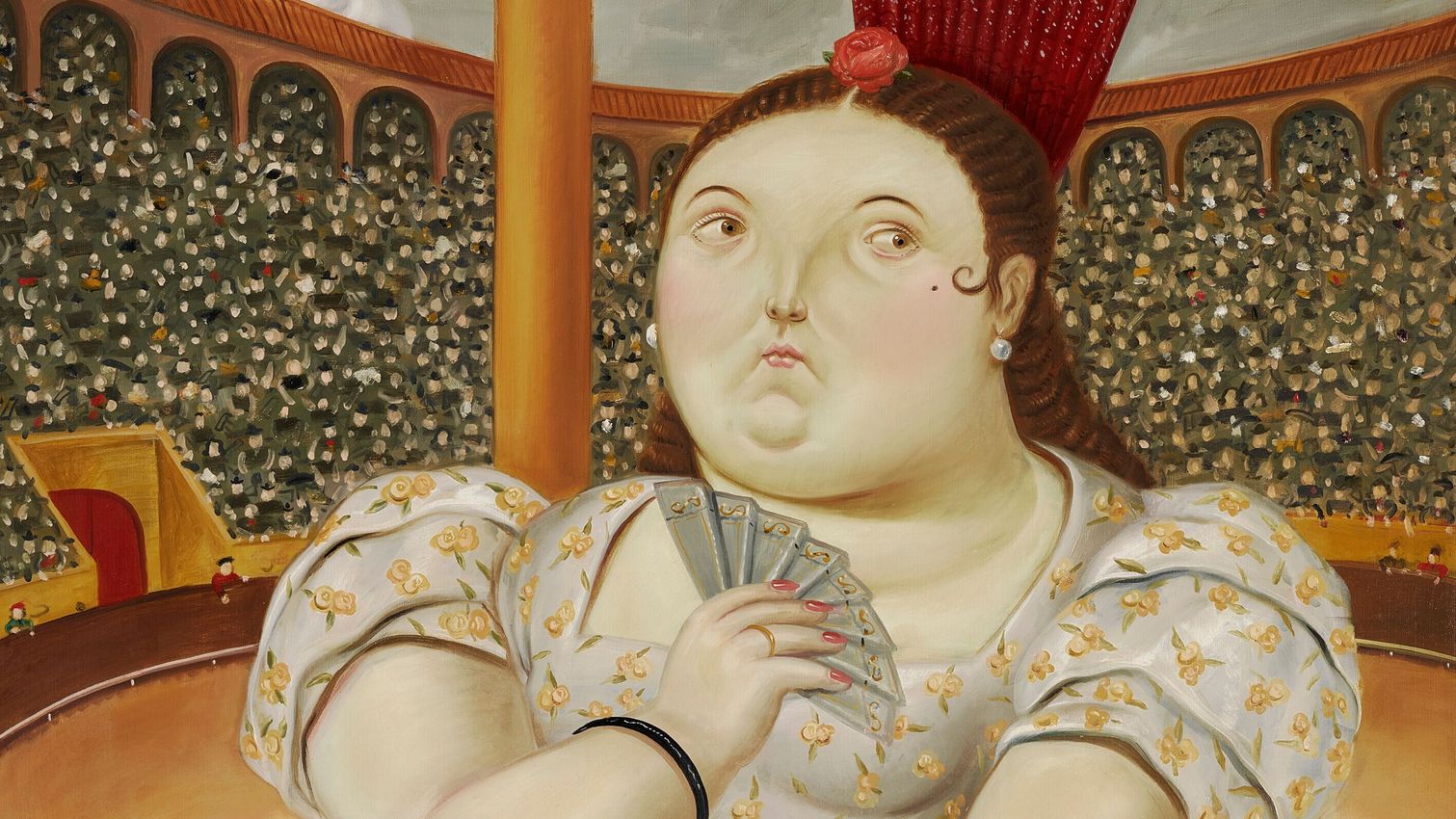
FERNANDO BOTERO
b. 1932, ColombiaFernando Botero’s figurative paintings and sculptures portray humans in voluptuous, voluminous form—the exaggerated proportions of the rounded subjects convey amusement and tenderness, depicting everyday life, religion, and even political commentary. “Boterismo” is instantly recognisable, and his works have been exhibited across the world.
Early Years
Fernando Botero Angulo was born in Medellín, Colombia, on 19 April 1932. Following the death of his father, his uncle became a father figure, supporting both Botero’s artistic endeavours and a brief period in which Botero decided to train to be a matador. Bullfighting was in fact the subject of the first watercolours he sold, aged 15. Speaking to The New York Times shortly before his death in 2023, Botero said: “Back then, I painted the world I saw around me because that was all I knew in my youth—the houses, the myths, the people. But that world has continued to be my principal inspiration.” When he was 16, Botero attended Catholic school but also produced illustrations for a local paper. He wrote a piece called Pablo Picasso and Nonconformity in Art, which the newspaper published... and which got him expelled from school. As the same age, he took part in his first group exhibition, with his first solo show coming three years later. While Botero was living in New York City in 1961, curator Dorothy Miller bought Mona Lisa, Age Twelve (1959), a chubby-cheeked, juvenile take on da Vinci’s infamous artwork, for the Museum of Modern Art (an unusual choice at a time when abstract expressionism was fashionable)—the start of his prolific and successful career.
Fernando Botero: Artworks
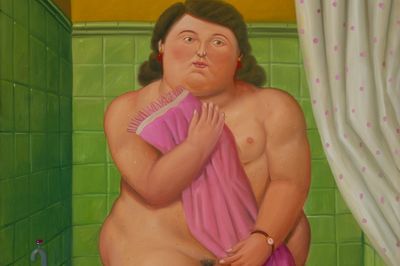
Bright colours, smooth skin and surfaces and sensual, exaggerated proportions are the hallmarks of “Boterismo”. A bright colour palette further enhances the “inflatable” appearance of his human subjects.
- Priests often appear in Botero’s paintings—a great example is 1965’s Dead Bishops, a slightly absurd, slightly funny heap of clerics, lying on top of each other. The bishops haven’t been murdered; they’re simply piled placidly, still clinging on to walking sticks and other possessions.
- 1972’s Homage to Bonnard revisits Pierre Bonnard’s favoured depiction of nude models: near a bathtub. However, Botero brings his voluptuous bather into the 1970s as she steps out of her avocado bath, drying between her legs.
- In Picnic (1989), Botero takes us to a cloth spread with smoothly rendered oranges, a variety of other fruits and a baguette. One of the diners is asleep but we can see the scarlet-nailed hands of another figure clutching a cigarette. Rolling hills—and a smoking volcano—populate the background.
- During the 1990s, Botero brought a more explicitly political viewpoint to his work, painting a series examining drug-connected violence in Colombia. 1999’s Death of Pablo Escobar shows the drug baron on city rooftops, being gunned down by police.
- Another excellent example of “Boterismo” is 2000’s Taller de Costura: three women are pictured in a sewing studio reminiscent of Botero’s mother’s own workshop, which she set up after becoming a widow. Speaking in 2023, Botero said: “Memories like these are evident in much of my work; my homeland has always been the raw material for my art.”
Fernando Botero: Select Exhibitions
Select Solo Exhibitions
- Fernando Botero: in Praise of an Amplified World, Opera Gallery, London (2026)
- Botero In New York, Sotheby’s, New York City (2026)
- Fernando Botero: A Universal Master, Palau Martorell, Barcelona (2025)
- Palazzo Bonaparte, Rome (2024)
- Watercolours, Galerie Gmurzynska, Zurich (2022)
- Fernando Botero: Beyond Forms, Beaux-Arts Mons (BAM), Brussels (2021)
- El Joven Maestro, Museo Nacional de Colombia, Bogotá (2019)
- Fernando Botero: Celebration, Bilbao Fine Arts Museum, Bilbao (2013)
- Fernando Botero, Pera Museum, Istanbul (2010)
- Botero in Singapore, Singapore Art Museum (2004)
- Botero, Museo Nacional Centro de Arte Reina Sofía (1987)
- Fernando Botero, Seibu Museum of Art, Tokyo (1981)
- Fernando Botero, Hirschhorn Museum and Sculpture Garden, Washington DC (1979)
- Fernando Botero, Retrospective, Museum Boijmans van Beuningen, Rotterdam (1975)
Select Group Exhibitions
- Still Life, Living Form, Almine Rech, Gstaad (2026)
- Theatre of Operations: The Gulf Wars 1991–2011 ,MoMA PS1, New York City (2020)
- America America: Art for Human Rights, Berkeley Art Museum (2017)
- Latin View Points, Nassau County Museum of Art, Long Island (1996)
- Latin American Artists of the Twentieth Century, MoMA, New York City (1993)
- Ways of Looking, MoMA, New York City (1971)
Further Reading
- Official website
- Obituary in The New York Times_
- 2023 interview from The New York Times_
- Botero’s global exhibitions compiled by Galeria Duque Arango
- Artist profile page at Surovek Gallery
Fernando Botero FAQs
Did Fernando Botero make pictures of Iraqi prisoners?
Yes—in 2005, Botero produced 48 paintings and sketches, in his familiar style, in response to reports of torture carried out by US forces at Abu Ghraib prison in Iraq. The images, in oils, pencil and charcoal, featured prisoners beaten by guards, dangling from ropes and attacked by dogs and were exhibited in Rome, Athens and Künzelsau in Germany. “These works are a result of the indignation that the violations in Iraq produced in me and the rest of the world,” Botero told The New York Times at the time.
Were Fernando Botero’s sculptures in New York and Paris?
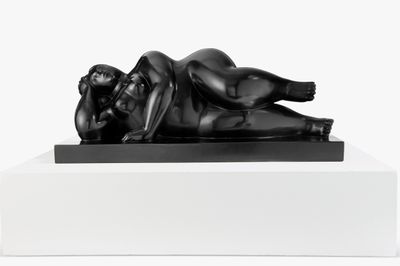
Yes—in 1992, 31 Botero sculptures were placed alongside the Champs Elysées in Paris. In 1993, 14 monumental bronze sculptures were placed along Park Avenue in New York City: Maternity (1989), Cat (1984), Roman Soldier (1985), Reclining Venus (1988), Woman with Serpent (1993), Torso (Man) (1992), Horse (1992), Woman (1989), Man (1990), Rape of Europa (1992), Woman with a Mirror (1987), Bird (1990), Seated Woman (1976), and Torso (Woman) (1982). In addition, Adam and Eve (both 1990) were displayed at Doris C Freedman Plaza.
Was there a film about Fernando Botero?
Yes, in 2018 Canadian director Don Millar made a documentary profiling Botero, featuring interviews with the artist, his family, and curators.
Was a Botero sculpture blown up?
Yes. In 1995 a terrorist group put a bomb under Pájaro (Bird) (1990), which Botera had donated to a ark in Medellín. The attack happened during a music festival and killed 23 people, injuring around 200 others. Botero responded to the bomb by creating La Paloma de la Paz (The Dove of Peace) (2000), which sits alongside the remains of the original.
Did Fernando Botero donate his artworks?
Yes. Between 1990 and 2000, he donated more than 300 works (his own and those by other artists) to Medellín’s Museum of Antioquia and the Banco de la República in Bogotá (which became the start of the Botero Museum.
Ocula

Explore Fernando Botero's Exhibitions










Explore and Follow Artists Shaping Contemporary Art
A respected voice in contemporary art discourse.
Focusing on ambitious storytelling and insightful art-world commentary. Ocula Magazine publishes in-depth interviews, critical essays and timely analysis on the artists, exhibitions and ideas driving the global art world.
Learn more about Ocula Magazine
Showcasing the best of the art world.
Ocula partners with galleries from around the world to highlight their artists, artworks and exhibitions. Gallery membership is by application and invitation, with each member vetted by an independent panel.
Learn more about Ocula Membership
Specialises in the sale of major artworks.
Led by a team with deep ties to the world’s leading auction houses, galleries and collectors. Ocula’s advisory team offers bespoke services to high-net-worth clients from around the world who are looking to acquire the best of contemporary and modern art.
Learn more about our team and services