





NIYAZ NAJAFOV
b. 1968, AzerbaijanNiyaz Najafov is a self-taught painter and sculptor celebrated for his whimsical, dramatic and psychologically charged works. Having worked as a professional hand-to-hand fighter, a Soviet soldier, and a policeman, it was not until 2003, at the age of 35, that he began experimenting with oil paint—a practice that soon became an obsessive and passionate endeavour and lead him to represent his home country of Azerbaijan at the 53rd Venice Biennale in 2009.
Najafov graduated from the Baku Technical School of Physical Culture in 1985 and coached hand-to-hand combat for years before becoming fascinated by the act of painting. Interested in drawing as a child and inspired by other self-taught painters such as Paul Gauguin and Francis Bacon, Najafov allows his background in sports to influence his practice as an artist, focusing on movement and figure in many of his artworks.
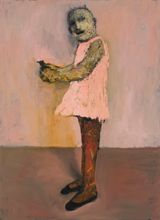
Throughout his career as an artist Najafov has mainly worked in the medium of oil paint, creating figurative, landscape, and nature morte paintings. In his figurative works, the artist seems to express the struggles of the regular man, the fragility of human life, and also the dualities of human existence. The artist’s landscape paintings, on the other hand, appear to express his global identity, his life split between Paris and Baku. In striking landscapes such as After the Storm (2012–2013), the artist sparsely populates the canvas with trees whose white lower trunks are redolent of French roadsides and upper limbs are bowed and creaking in gales—a reference to his home city of Baku, the City of Winds.
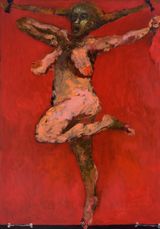
Najafov’s figurative paintings are often depictions of characters involved in normal, everyday activities, albeit caught up in absurd situations: a naked figure might jump over a radiator, walk a dog, or drink from a cow’s udder, for example. Having experienced various moments of darkness in his life—including a year in jail in Azerbaijan—such scenes are perhaps influenced by a personal existential anguish. His artwork is characterised by a type of bleakness, and yet are equally endowed with a dark sense of humour and even joy. Dancing on Bones (2012) depicts a woman caught naked in the middle of a dance move, one arm flung wide and a knee bent, her hair splayed in two pigtails, the blood red of the background a clashing contrast to the pink of her body. In Untitled 2 (2013–2014), four men sit around a table in shadows apparently swatting at flies—possibly a humorous reference to the proliferation of insects in Baku during the warm months, but also an act that is both mundane and ultimately violent.
Najafov’s works have been included in numerous group and solo exhibitions in Baku and internationally, including at Gazelli Art House, London (2019); The Museum Centre, Baku (2017); Ningbo Museum of Art (2014); MAXXI, Rome (2013); and the French Embassy, Baku (2009). His works have also been acquired for reputable collections such as those of Alberto Sandretti, the Baku Museum of Modern Art, and the Museum of Modern and Contemporary Art of Trento and Rovereto.
Leila Sajjadi | Ocula | 2019






Explore Niyaz Najafov's Exhibitions





Explore and Follow Artists Shaping Contemporary Art
A respected voice in contemporary art discourse.
Focusing on ambitious storytelling and insightful art-world commentary. Ocula Magazine publishes in-depth interviews, critical essays and timely analysis on the artists, exhibitions and ideas driving the global art world.
Learn more about Ocula Magazine
Showcasing the best of the art world.
Ocula partners with galleries from around the world to highlight their artists, artworks and exhibitions. Gallery membership is by application and invitation, with each member vetted by an independent panel.
Learn more about Ocula Membership
Specialises in the sale of major artworks.
Led by a team with deep ties to the world’s leading auction houses, galleries and collectors. Ocula’s advisory team offers bespoke services to high-net-worth clients from around the world who are looking to acquire the best of contemporary and modern art.
Learn more about our team and services