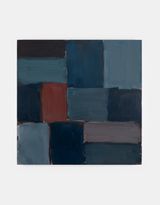
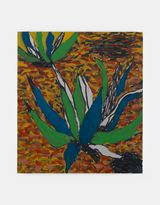
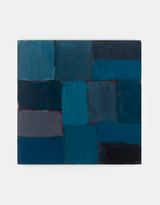
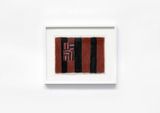
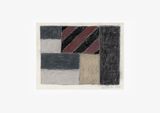
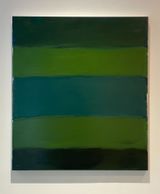
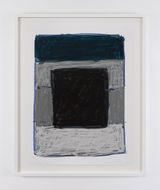
Sean Scully’s seminal paintings are characterised by compositions of rectangular or square sections painted in various colours—often deep, rich and stormy or autumn-toned hues. Thickly brushed layers of oil paint produce illusions of luminescence or movement, with a dynamic surface texture often compared to skin.
Painting in the 1980s
Reflecting his upbringing in working-class neighbourhoods and his adult life in cities, Scully’s works from the 1980s were inspired by conflict, discord, haphazard urban planning and human competition for survival—weighty themes reflected in the paintings’ sombre palettes and cramped, brick-like compositions. While in such early works Scully used tape to delineate the clean, structured sections on his canvases, he later abandoned that hard-edge aesthetic and began painting more loosely, allowing the shapes to breathe and show evidence of their making. In Battered Earth (1988), for example, patches of cream-coloured rectangles belie their earthy underlying layers, as do the blood-coloured sections with the umber paint beneath.
Wall of Light
Showing a further loosening up of technique, Scully’s major ’Wall of Light’ series works (1998–ongoing) are first drawn out with charcoal stuck to the end of a long stick before being filled in with paint. The series begun when the artist was travelling in Mexico and was struck by the play of light on Mayan stone walls. Indeed, the combination of vertical and horizontal bars in Scully’s paintings are often compared to architectural elements; the sections are said to resemble Stonehenge-like structures.
While he mostly works with oil on canvas, Scully also uses watercolour, pastels and aquatints, as well as painting directly on aluminium—a support that enhances the thickness of the oil paint and its illusion of emitting light.
Sculpture
Sean Scully’s more recent sculptures borrow the same compositions as his paintings; Air (2018) is a large cube made of multi-coloured recinto, marble and cantera, assembled in blocks that create asymmetrical grid patterns when viewed from each angle.