






WALASSE TING
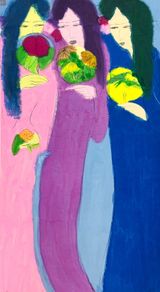
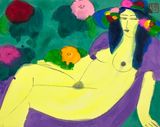
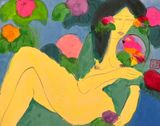
1929-2010, ChinaAn excellent example of diaspora art, Walasse Ting (1929—2010) merged the aesthetics of Chinese traditions and Pop Art (and other Western traditions) to develop vivid, energetic figurative paintings of women, cats, birds and flowers using expressive, dripping strokes and bright, fluorescent colours on rice paper.
Early Years
Walasse Ting was born in Wuxi, China but raised in Shanghai. Biographical details vary, some suggesting he began his painting career on Shanghai pavements and others saying he briefly studied at the Shanghai College of Fine Arts during the 1940s. During the early 1950s. Ting moved to Paris, where he lived the life of a struggling artist but became friends with Pierre Alechinsky, who in turn introduced him to the CoBrA avant-garde movement. A move to New York saw Ting becoming involved with the Pop Art movement and influenced by American Abstract Expressionism.
Ting spoke many visual languages, absorbing influences from wherever he was living and connecting Chinese and Western art movements in his work. In 1987, he settled in Amsterdam.
Walasse Ting: Artworks
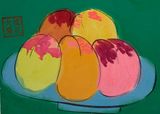
While Ting began with drawings in a figurative style, his more well-known works are abstract. He used acrylic on canvas to create highly colourful paintings, but then moving to a style where he blended bright colours on to rice paper. Ting painted using splashes of vivid hues outlined in black, creating high energy art with an almost dream-like quality.
Ting’s influences come from both his heritage and the cities in which he lived, even though he did not categorise himself as being part of any specific movement. He also wrote poems, and found harmony in both art and language. His children have spoken about watching him paint, sometimes wearing not many clothes—the physicality of his approach to the canvas and paper gives his works their trademark dripping splashes.
- White Butterflies Sleep on a Violet Bed (1970) is an example of his abstract-meets-figurative style—the acrylic-on-canvas work showcases his dripping brushwork
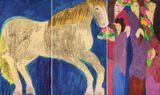
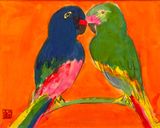
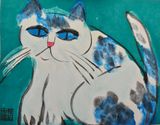
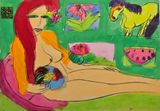
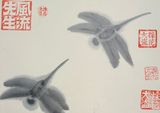
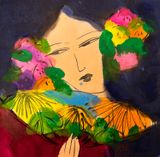
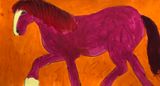
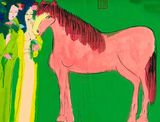
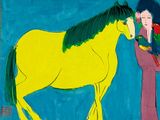
- During the 1980s and 1990s, Ting moved towards working on rice paper, with pieces characterised by fluorescent and vivid colours, such as Oriental Beauty__with a Bright Yellow Horse (1980s), Big Blue Cat (1990—1995), Rooster (1995) and Kissing Birds (1995—1999)
Walasse Ting: Exhibitions
Select Solo Exhibitions
- Walasse Ting: Joy, Temptation and Magic, Alisan Fine Arts, Hong Kong (2024—2025)
- Walasse Ting: New York, New York, Alisan Fine Arts, New York (2023)
- Walasse Ting: Parrot Jungle, NSU Art Museum, Fort Lauderdale (2023—2024)
- Walasse Ting Exhibition, Catto Gallery, London (2022, 2020, 2017
- The Magical World of Walasse Ting, Alisan Fine Arts, Hong Kong (1993)
Select Group Exhibitions
- The Chinese Avant-Garde in Paris, Alisan Fine Arts, Hong Kong (2026)
- Tradition Transformed, Alisan Fine Arts, Hong Kong (2025)
- Beyond Tradition: The Metamorphosis of Chinese Art, Alisan Fine Arts, London (2023)
Further reading
- Walasse Ting’s biography at Catto Gallery
- A 2017 interview with Walasse Ting’s son and daughter
- The Instagram account of the Walasse Ting estate
- Walasse Ting’s obituary from the New York Times’ Overlooked series (2025)
- Details from NSU’s Parrot Jungle exhibition in 2023
Walasse Ting FAQs
What was 1 Cent Life? Did Walasse Ting write a book?
Walasse Ting had the idea for 1 Cent Life in 1962—he wanted to produce a book of international artists and different styles alongside his own art and poetry. He developed the book with the artist Sam Francis. 1 Cent Life was published in 1964 and contains 62 lithographs made by 28 European and American artists with 62 letterpress poems by Ting. It includes work by Roy Lichtenstein, Robert Rauschenberg and Andy Warhol.
What materials and techniques did Walasse Ting use?
Walasse Ting used colour playfully by splashing and dripping vibrant colours in a manner that referenced the mark-making techniques of abstract expressionism. He also used skills he learned as a young artist in China, such as brushwork techniques and use of line and space. Walasse Ting made connections between Chinese art traditions and parts of Western modern art movements—for example, between intuitive free-flow painting and Chinese ink artists’ brushwork, both of which give artists the space to explore their inner selves.
Where did Walasse Ting live?
Walasse Ting was born in Wuxi in China in 1929 but raised in Shanghai. He moved to Hong Kong during the 1940s and then travelled to France, settling in Paris during the early 1950s, where he became friends with members of the CoBrA avant-garde movement. He made his home in New York at the end of the decade, being influenced by the Pop Art movement. During the late 1980s, he moved again, spending his final years in Amsterdam.
Ocula

View Walasse Ting's Artworks


















Explore Walasse Ting's Exhibitions







Explore and Follow Artists Shaping Contemporary Art
A respected voice in contemporary art discourse.
Focusing on ambitious storytelling and insightful art-world commentary. Ocula Magazine publishes in-depth interviews, critical essays and timely analysis on the artists, exhibitions and ideas driving the global art world.
Learn more about Ocula Magazine
Showcasing the best of the art world.
Ocula partners with galleries from around the world to highlight their artists, artworks and exhibitions. Gallery membership is by application and invitation, with each member vetted by an independent panel.
Learn more about Ocula Membership
Specialises in the sale of major artworks.
Led by a team with deep ties to the world’s leading auction houses, galleries and collectors. Ocula’s advisory team offers bespoke services to high-net-worth clients from around the world who are looking to acquire the best of contemporary and modern art.
Learn more about our team and services