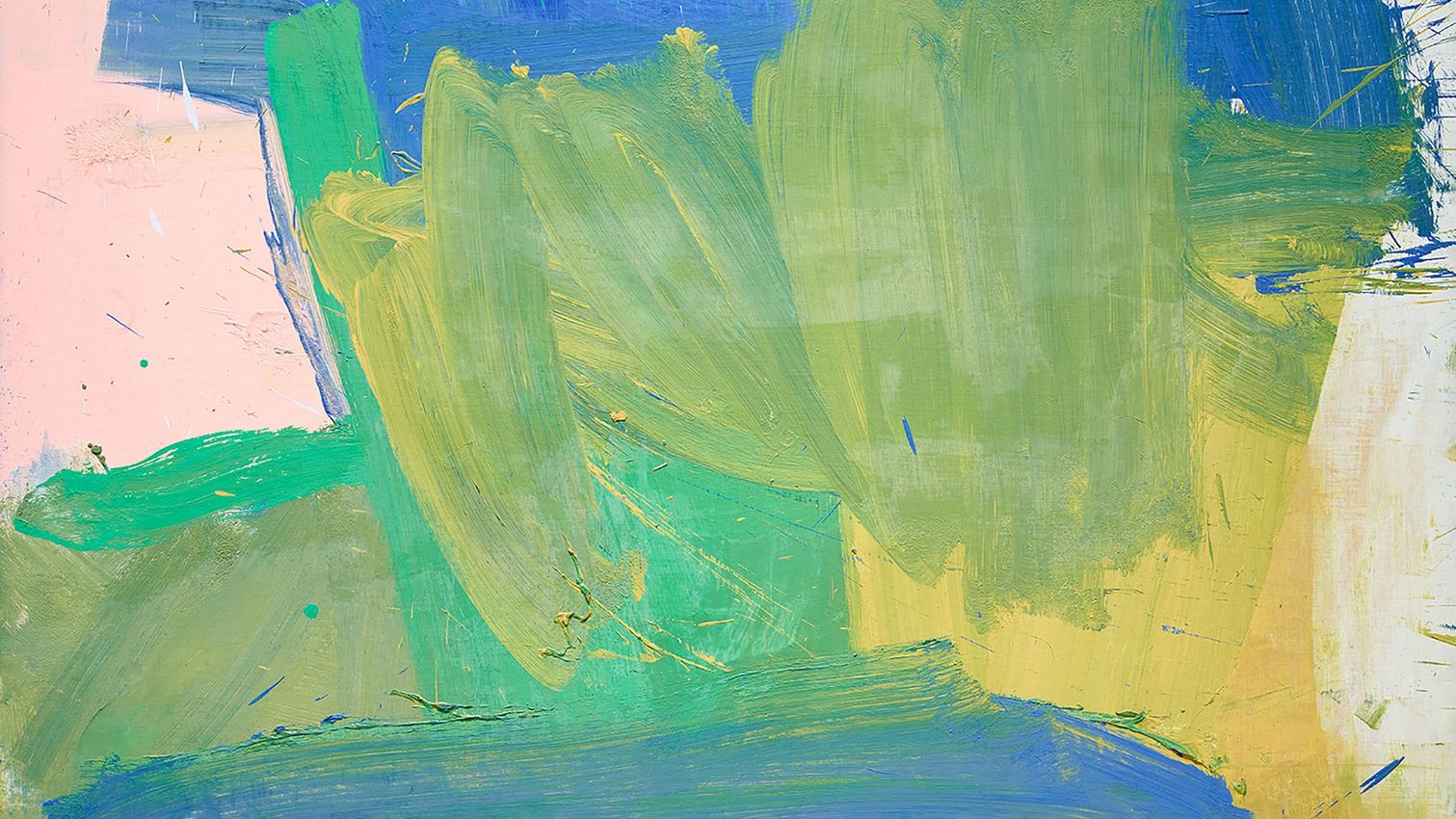
During the 1940s Willem de Kooning’s focused on abstract art and the avant-garde. He worked on creating abstract paintings that rejected traditional painting styles such as Cubism and Surrealism. Together with his New York contemporaries, including Jackson Pollock and Mark Rothko, de Kooning forged new forms of painting that deconstructed symbolism through vivid colours and the visceral motions of ‘action painting’.
In 1948 de Kooning was invited to display work in his first solo exhibition at Charles Egan Gallery. Here he displayed his black-and-white paintings, a series of thick oil and heavy enamel artwork that is still celebrated today.
Excavation
Conceivably one of the most important paintings of the 20th century, de Kooning’s Excavation (1950) awarded him the Logan Medal and Purchase Prize from the Art Institute of Chicago. The painting was exhibited at the 25th Venice Biennale in the same year and exemplifies the artist’s gestural style and unusual use of space and abstract imagery.
‘Women’ Series
De Kooning’s ‘Women’ Series (1950—1953) depicts aggressively painted human figures in vivid colours. These works shocked audiences due to their frightening representation of the female figure, viewed by some as misogynistic and objectifying, and offended those who believed the work’s figurative subject to be a regression from the abstract expressionist style.
Despite many perceiving de Kooning’s return to figuration as a betrayal of abstract expressionism, the Museum of Modern Art in New York endorsed this change in style as an advancement in de Kooning’s creative practice. In 1953, they purchased his work Woman I (1950—1952) for their permanent collection.
Interchange
Interchange (1955) presents de Kooning’s departure from painting the human figure to his focus on abstract urban landscapes. The painting represents a seated woman in a pink mass of hurried brush strokes: a technique de Kooning found himself influenced by in the practice of artist Franz Kline.