





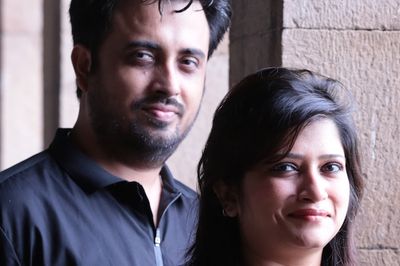
Desire Machine Collective was established in India in 2004 by Mriganka Madhukaillya and Sonal Jain. They create films, video, photography, and sound and multimedia installations that consider space and time, with particular reference to human habitation, natural environments and their occupation. They have previously shown work at the Guggenheim New York (2012), Palais de Tokyo, Paris (2012), and at the first Indian Pavilion at the Venice Biennale in 2011.
In this interview, the artists discuss Residue, a 39-minute film they are showing at APT8, the benefits of working in an artist collective and their commitment to activating public spaces.
Congratulations on your inclusion in APT8. Can you tell us more about the work you will be showing, Residue (2011), and its surrounding ideas and politics?
Residue is a film that was shot in a redundant thermal power plant on the outskirts of the city of Guwahati, in Assam, India. The plant has been shut for the last 30 years and is surrounded by dense tropical forest and is an area steeped in myth and tantric practices. Assam is a major source of oil and natural gas and a large part of the political unrest endured in the state was woven around the politics of resources. The natural environment has reclaimed its dominance over the industrial site of the power plant creating a no man’s land invaded by growing jungle and offering an apocalyptic, aesthetic sight.
This film is a reflection on constructed signs that can never be replicated or remembered, and the relationship between matter and memory. There is also a reflection on the endless circularity and the unbearable silence—the pause that punctuates the experience. Close to the vision of an abandoned temple or a monument in ruins, here, nature and industry intermingle. Without an explicitly documentary statement, Residue is an experimental film, a stroll through a dream world incorporating both the universe of the mechanical, human and natural as when a machine morphs into a butterfly, or power meters indicate depleted figuresHaving shown your work recently at institutions such as the Guggenheim New York (2012), Palais de Tokyo, Paris (2012) and at the first Indian Pavilion at the Venice Biennale (2011), you are no strangers to working within large exhibition and biennale-style curatorial formats. Do you expect Residue to have a specific resonance within the APT context and Australian audiences?
The context of Australia is particularly synchronous to our practice due to the number of parallels with the context we are working in—the Northeast region of India, which has a very rich and diverse population of indigenous groups. We have closely engaged with the world views and traditional knowledge systems that are getting more relevant today in the context of climate change. The colonial past and the violent exploitation of resources in the context of globalisation are all issues that have an urgency in Australia and our work.

What is it that interests you about working as an artist collective, can you tell us more about how you started working together? How does working in Assam influence your work?
Having travelled a trajectory of political violence and conflict, being from the Northeast of India which has a history of political movements, Desire Machine Collective started off as a dialogue. There was a need to negotiate with the political but also understand it at a level of the personal and experiential. The experience of othering and everyday violence needed an expression beyond the objective categorisations being offered. The impetus for our practice was collaboration and participatory methods of working and so the collective practice emerged.
99% of the borders of Northeast India are international. It is a landlocked region caught in a web of violence post-independence, in the process of nation-building and the establishment of a modern state. It comprises mainly diverse indigenous groups and is a large biodiversity hot-spot. This rich context provides a great base to inform our experience, work and engagements. We are constantly developing strategies that subvert the hegemony of a centre. These strategic devices in turn inform not only the content of our work but also the form. There is a constant negotiation with, and revealing of, power relations involved—be it the nation state or any other apparatus at work, like a particular discourse or knowledge structure
Being situated in Assam where the practice of contemporary art or associated infrastructures like an art market, galleries or state-run art establishments are absent, there was a need to assume a larger role than that of an individual artist, so also the collective emerged.
Can you tell us more about your role in directing the artist space called Periferry, and how A+type came about?
Periferry is Desire Machine Collective’s foray into the notion of space and takes the modes of working with collaborative and hybrid practices further. It has the scope of being more participatory and inclusive of multiplicities than a conventional studio space. It pushes for experimentation and extends the limits of our practice as well as other practitioners. It was the creation of a space for experimentation and cross-disciplinary practices. It arose from a need for a context, which existed between insurgency and counter-insurgencies spanning decades. Which essentially meant that the space for civil dialogue was much reduced.
Periferry is located on a ferry-barge on the transnational river Brahmaputra, which starts in Tibet, flows through China, Assam and then through Bangladesh before falling into the Bay of Bengal. And as such it opens up questions of borders, boundaries, nation states and the like. It also occupies a space that is liminal and in-between—land and water, urban and rural.
It draws from Manuel Castells, who describes the modern world as a 'space of flows—flows of people, capital, information, technology, images, sounds and symbols.' The flow and flux being seen as the only constant; conversations, residencies, workshops and symposiums were woven around it.
Desire Machine Collective is committed to activating public spaces. A+type reinvestigates the notion and use of space, in its common understanding. It is a durational project where an 'Assam-type' house is opened up for people to interpret in their own ways. Participants are invited to come and live for a particular period of time in the house and develop their practice in relation it. The British developed what is popularly called 'Assam-type' architecture as a hybrid form incorporating elements from the local indigenous architecture. These structures have become cultural markers of an era gone-by and have a certain melancholy attached to them. Residents are invited to explore and develop their individual or communal relationship to the space in terms its functional, social, architectural, historical and cultural aspects. Different residents constantly redefine the space and make for new interpretation of this perishing construct—allowing for a renewed conversation on its place in history and the future.
This project initiates the process of reactivating these structures, documenting the design and history of the 'Assam-type' architecture and its use. —[O]
Main image: Sonal Jain and Mriganka Madhukaillya. Image courtesy Desire Machine Collective Studio.

A respected voice in contemporary art discourse.
Focusing on ambitious storytelling and insightful art-world commentary. Ocula Magazine publishes in-depth interviews, critical essays and timely analysis on the artists, exhibitions and ideas driving the global art world.
Learn more about Ocula Magazine
Showcasing the best of the art world.
Ocula partners with galleries from around the world to highlight their artists, artworks and exhibitions. Gallery membership is by application and invitation, with each member vetted by an independent panel.
Learn more about Ocula Membership
Specialises in the sale of major artworks.
Led by a team with deep ties to the world’s leading auction houses, galleries and collectors. Ocula’s advisory team offers bespoke services to high-net-worth clients from around the world who are looking to acquire the best of contemporary and modern art.
Learn more about our team and services