





Do Ho Suh’s Anti-Monument Arrives at the Smithsonian Museum
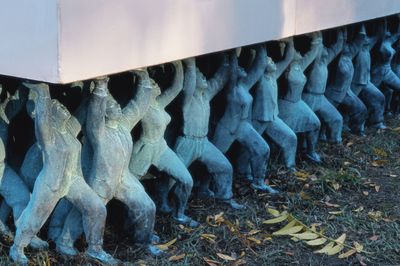
Do Ho Suh, Public Figures (1998–2023). Jesmonite, aluminium, polyester resin. Courtesy the artist and Lehmann Maupin, New York, Seoul, and London.


Hundreds of resin figures struggle to hoist an empty stone plinth in Public Figures (1998–2023), Do Ho Suh‘s monument critiquing monuments.
The Korean-born, London-based artist’s ‘anti-monument’ will be unveiled on 27 April as part of the Smithsonian’s National Museum of Asian Art (NMAA)‘s centenary programme. It will be placed in front of the museum’s Freer Gallery of Art for the next five years, facing Washington D.C.‘s National Mall.
First shown during the 1998 Public Art Fund exhibition, Beyond the Monument, Public Figures refuses to elevate powerful individuals, instead drawing attention to the collective efforts of the masses and the everyday heroism of normal people.
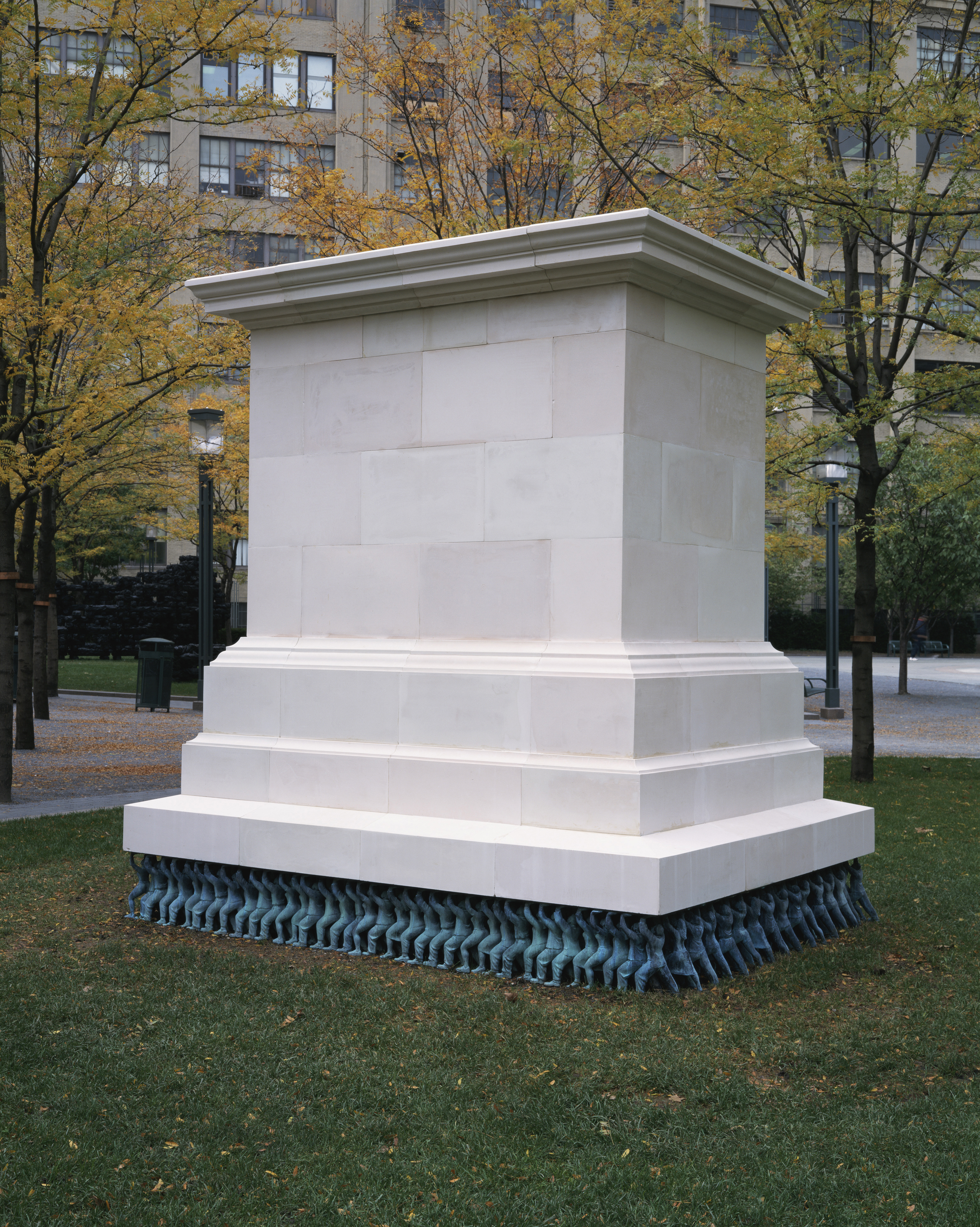
That the work was first presented over 25 years ago, and yet has been reprised in the current context, surrounded by the American capital’s many hallowed monuments, suggests enduring interest in examining the purpose and function of monuments.
The NMAA’s director, Chase F. Robinson, said the sculpture will ‘prompt visitors to ask questions about individual and collective identity, whom we memorialise and why.’
When Public Figures was first presented in Brooklyn’s MetroTech Commons, the artist said that the miniature figures below the monument’s plinth ‘represent the multiple, the diverse, the anonymous mass ... supporting and resisting the stone’.
The installation of Public Figures at the Smithsonian follows the vandalisation and destruction of monuments by Black Lives Matter protestors, who saw them as symbols of imperialism, racism, and exploitation.
Artists such as Kehinde Wiley and Hank Willis Thomas have since created monuments that offer alternative ideas for who can and should be immortalised.
The arrival of Suh’s work at The Smithsonian underscores a shift in social mores, where institutions’ deification of powerful historical figures (and contemporary figures such as the Sacklers) can no longer be taken for granted. —[O]
Main image: Do Ho Suh, Public Figures (1998–2023). Jesmonite, aluminium, polyester resin. Courtesy the artist and Lehmann Maupin, New York, Seoul, and London.






A respected voice in contemporary art discourse.
Focusing on ambitious storytelling and insightful art-world commentary. Ocula Magazine publishes in-depth interviews, critical essays and timely analysis on the artists, exhibitions and ideas driving the global art world.
Learn more about Ocula Magazine
Showcasing the best of the art world.
Ocula partners with galleries from around the world to highlight their artists, artworks and exhibitions. Gallery membership is by application and invitation, with each member vetted by an independent panel.
Learn more about Ocula Membership
Specialises in the sale of major artworks.
Led by a team with deep ties to the world’s leading auction houses, galleries and collectors. Ocula’s advisory team offers bespoke services to high-net-worth clients from around the world who are looking to acquire the best of contemporary and modern art.
Learn more about our team and services